Essential West Magazine
- Featured Artists
- Event Calendar
- Artist Biographies
- News & Press
- Educational Videos
- Podcast
- Essential West
- Learn
Learn about the latest Medicine Man Gallery happenings; all about our artist, see our educational videos about native American art and fine art, watch podcasts with your favorite artists and check out art and history-related links we think you'll enjoy.
Exploring Art, Literature, History, Museums, Lifestyle, and Cultures of the West

It amazes me that four letters - W-E-S-T - have the ability to evoke an instantaneous emotional image. Simply the act of reading these four letters has caused you to form a narrative of your west.
Can the West be distilled to its essence - a simple direction or region? I believe not; it is a deeper dive of consciousness. How America sees itself and the world defines us. Diverse cultures, strong individualism, open spaces, and raw natural beauty marinated in a roughshod history have formed this region’s unique milieu.
Our online magazine’s primary focus is to feature relevant topics in art, literature, history, museums, lifestyle, and culture; lofty goals for any publication. No single magazine can be the beckon of all things western; it is a diverse, evolving paradigm that cannot be pigeonholed. As the publisher, I hope to be the buffalo that grazes the wide expanse of western sensibility and relay to you a glimpse of how I perceive our Essential West.
- Mark Sublette
Featured Article
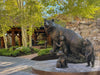
Grizzly 399 Monument Unveiled at National Museum of Wildlife Art
Grizzly 399 was born in 1996. She successfully birthed 18 cubs in her lifetime including a rare four-cub litter during the COVID-19 pandemic. Her last cub was born when Grizzly 399 was 24, a record birthing age for the species. She represented more than numbers. Often seen with her cubs near roadsides across Grand Teton National Park and...

Darren Pearson' Light Painting Photographs of Nevada
When Travel Nevada reached out to Darren Pearson about the possibility of him road tripping through the state, he jumped at the chance. Officials at the state’s tourism office had become captivated by Pearson’s light painting photographs and wanted him to use the Silver State as a fresh backdrop. Not Vegas. Sin City gets enough attention; Travel Nevada wants travelers to know there’s more to the state than its most prominent place. The results of Pearson’s excursion can be seen through April 6, 2026, at the Nevada State Museum, Las Vegas – hey, you can’t escape it all together. “I...

'Beyond Bison' at Missoula Art Museum
In 1908, the Federal Government created an 18,776-acre National Bison Range in western Montana between Kalispell to the north and Missoula to the south. It was established as an island of bison protection in a sea of slaughter. By that time, white settlers and market hunters had obliterated America’s bison population from perhaps 50 million at the turn of the 19th century to a low of a few hundred 80 years later. The Range was located in the middle of the Flathead Indian Reservation. Unceded land. The Tribes protested the additional incursion. Further theft of their land. The United States...

Lessons in Collecting from Dr. Albert Barnes
Albert Barnes (1872–1951) was one of this country’s greatest art collectors. Dr. Albert Barnes. He made his fortune co-inventing antiseptic. Anyone with tons of money can collect art. Separating the mere shoppers from the memorable collectors are vision, commitment, legwork, confidence – among other characteristics. Fortunately, none of those skills require a private jet. They are skills we can all hone. Barnes didn’t simply buy spectacular art, although he did buy spectacular art. Between 1912 and 1951 he acquired one of the largest private holdings of oil paintings by Paul Cézanne in the world. Ditto Pierre Auguste Renoir. Sixty-one oil...

The Foremothers of Western Art
“Essential West” has been highlighting origins the past two months. The origins of Modern Native American art. The origins of the Amon Carter Museum of American Art. The origins of painter Clyfford Still. The origins of Indigenous storytelling in North America. Another origin story this week: women artists in Colorado and Utah. History Jackson Hole presents “Women Artists of the American West: Colorado and Utah, 1885–1940” (January 20 through June 30, 2026), the second in a two-part exhibition highlighting trailblazing women in the western United States. This first presentation centered Montana and Wyoming. The series highlights white women. Mostly painters...

The Enduring Global Appeal of The West
This past November I visited an art festival in the Azores. I asked a fellow reporter, an Italian working in Germany, where in the States she’d most like to visit. She had never been. “Texas,” she answered. She wanted to see a cowboy. The international pull of the cinematic, scene, authentic, imagined “West” never ceases to amaze me. I was reminded of its power again upon receiving news that Gagosian – the largest and most powerful art gallery in the world – is staging an exhibition for Richard Avedon’s (1923-2004) In the American West (1979–84) photo series at its London outpost...

The Origins of Modern and Contemporary Native American Art
Whenever I’m asked, “what’s your favorite kind of art,” I always respond, “contemporary Native American art.” Primarily painting. It has been since I picked up an interest in art literally out of nowhere shortly after turning 40. Call it a professional mid-life crisis. I had a 20-year career in the sports media, focused on college football, and completely lost interest in it. Sports was my passion and profession since high school; now, I don’t even follow the scores. I haven’t watched a game in years. Any kind of game. How art came to fill this void is an unlikely story....

Start an Art-Filled 2026 with the California Desert Plein Air Festival
No better way to begin an art-filled 2026 than with the California Desert Plein Air Festival January 8 through February 1 in Palm Desert. The event celebrates the California desert’s tradition of landscape painting en plein air – outdoors. “Our landscape, flora, and fauna – we have the best,” Diane Moore, co-founder of the nonprofit Desert Plein Air Association, the Festival’s organizer, said of the area’s appeal to plein air painters. “And it happens that our prime time of year is January and February, and that’s not good for the rest of the country.” The event opens with four days of...

Georgia O'Keeffe's Connection to the Amon Carter Museum
Georgia O’Keeffe’s history with New Mexico is well known. In 1929, O’Keeffe first visited the state with her artist friend Rebecca Strand. They stayed for three months in Taos with famed arts patron Mabel Dodge Luhan. At this time, O’Keeffe (1887-1986) was living in New York City and spending summers upstate at Lake George. O’Keeffe fell in love with northern New Mexico, a deeper love than she had for her husband, photographer and gallerist Alfred Stieglitz. She returned almost every year in the late spring and summer until Stieglitz died in 1946, then moved there permanently. Lesser known is O’Keeffe’s...
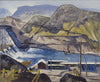
Clyfford Still: Western Artist
Western artwork by artists not considered “Western” fascinates me. Particularly the early and mid-century American masters. Marsden Hartley, Stuart Davis, John Marin, Thomas Hart Benton, Jackson Pollock, Richard Diebenkorn. A-listers associated with Modernism, with American art, but never the art of Western America. Georgia O’Keeffe, too. Despite her deep engagement and decades spent living and painting the West, she’s never thought of as a “Western” artist. This exclusion comes at the hands of American art historians, curators, and writers, and at the hands of Western art historians, curators, and writers. I will never understand why so many devotees of Western...

Along the Pecos River in West Texas, an Artistic Tradition Unbroken for 4,000 Years
Carolyn Boyd wasn’t a trained archaeologist when she first visited the rock art sites in West Texas along the Pecos River. She was an artist. Being one and not the other allowed her to see something one, but not the other could. “I saw compositions,” Boyd, Shumla Endowed Research Professor in the Department of Anthropology at Texas State University, said. “Highly sophisticated, well-planned compositions with rules in terms of the way that they applied the paint making it even more complicated.” Hitherto, researchers believed the massive rock art murals – some stretching as long as 100-feet, with individual figures nearly...