Artist Hopid at Museum of Northern Arizona
By Chadd Scott on
The Museum of Northern Arizona in Flagstaff highlights a lesser-known chapter in Native American art history central to its region: Artist Hopid. An exhibition series on view through April 30, 2027, features work from the groundbreaking collective formed in 1973 by celebrated Hopi artists Michael Kabotie, Delbridge Honanie, Terrance Talaswaima, Neil David Sr. and Milland Lomakema.

Artist Hopid in 1976. From left Honvantewa (Terrance Talaswaima), Dawakema (Milland Lomakema), Coochsiwukioma (Delbridge Honanie), Neil David Sr., Lomawywesa (Michael Kabotie). Photo credit Jessica Welton.
“They all grew up on the Hopi reservation, went to different schools, but knew each other as youngsters,” Kelley Hays-Gilpin, Museum of Northern Arizona Curator of Anthropology and exhibition co-curator, said. “Then Michael Kabotie’s father, Fred Kabotie, formed the Hopi arts and crafts guild on Second Mesa–where all, but Neil were from–and that became a gathering place for not only Hopi silversmiths, but other artists.”
Artist Hopid may be unfamiliar to Native Art devotees, but Fred Kabotie (1900–1986) isn’t. The Hopi painter, silversmith, and educator established himself as a signature talent in the mid-century.
He was commissioned by the Museum of Modern Art in New York to reproduce the Awatovi Ruins murals in 1940. He won a Guggenheim Fellowship in 1945, one of the most prestigious recognitions of creative talent in the world.
Fred Kabotie attended the Santa Fe Indian School where he and his contemporaries learned a “flat,” realistic style of painting traditional Indian motifs then favored by the art market. This mid-century Santa Fe style is sometimes derisively called the “Bambi Style,” for the volume of blue, big-eyed, deer that populated the artworks. Artworks that may have inspired the Disney film.
“Artist Hopid, inspired by the ancient murals as much as by contemporary art, consciously broke from (the Santa Fe style) in order to reach a contemporary audience,” MNA Fine Art Curator and exhibition co-curator Alan Petersen said.
“Michael’s father, Fred, and others who learned to paint in Santa Fe in the first half of the 20th century, stuck to a naturalistic style, figures on a white background, mostly images of ceremonial dances with some of daily life,” Hays-Gilpin explained. “Artist Hopid used the whole canvas, bright colors, blocks of colors, abstraction, etc.”
Artist Hopid spoke to tribal members by incorporating familiar symbology, but also intentionally to non-Hopi audiences by blending traditional Hopi values and imagery with contemporary visual styles. Writing in 2006 for MNA’s Plateau journal, Kabotie and Honanie detailed the group’s mission: “We wanted Hopi and non-Hopi to know that our worldview is about seeing that everything is connected and that no part is unimportant.”
The art was visually dynamic, often humorous, and deeply rooted in Hopi cultural knowledge.
They were influenced by ancestral art, kiva mural paintings, pottery, textiles, petroglyphs, the Santa Fe Indian School style painting, farming, and Katsina figures. Familiar Hopi iconography including clouds, lightning, rain, clan symbols–bear, eagle, badger, water, corn, butterfly – distinctive villages, and landscapes populate Artist Hopid paintings. Paintings also informed by Cubism, Surrealism, psychedelia, and Color Field painting. Picasso and Dalí.
Traditionally influenced, radically presented.

Untitled opaque watercolor painting by Milland Lomakema (Hopi), Acrylic paint, 20 x 24.25 inches, 197. Photo courtesy of the Museum of Northern Arizona.
“These artists were steeped in ancient cultural knowledge, but not the least bit afraid to try new things,” Hays-Gilpin said. “They worked hard to balance the changes in the world around them while staying grounded in tradition.”
Artist Hopid members had access to American and global contemporary art trends. Michael Kabotie attended the first session of the Southwestern Indian Art Project at the University of Arizona, a precursor to the Institute of American Indian Arts.
“Michael said that his father asked him, ‘What we did wasn’t good enough for you?’ but didn’t discourage him from innovating,” Hays-Gilpin said. “(Artist Hopid) paintings sold, and they got commissions and awards, so I guess the reception from the outside world was positive, but sounds like mixed reviews in the community—some thought it inspired pride, but some thought it was too radical and shared too much sacred imagery with outsiders. That still happens today!”
‘Artist Hopid Unveiled’
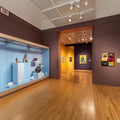
“Artist Hopid Unveiled” displays a range of works in three separate thematic installations: “Tending the Source” (May 16-September 8, 2026), “Ancestral Echoes” (September 12-December 6, 2026), and “Enduring Images” (December 11, 2026-April 30, 2027). Items come from the museum’s extensive collection of Artist Hopid works, including recent acquisitions.
Paintings.
Artist Hopid members wanted to paint.
Thanks to Fred Kabotie, generations of Hopi artists found a way to earn money through jewelry making. At the encouragement of the Museum of Northern Arizona, Kabotie and his cousin Paul Saufkie (1898–1993) developed a distinct overlay jewelry technique in the mid-century with designs inspired by traditional Hopi pottery. This allowed Hopi to compete in the market with Zuni and Diné makers.
Artist Hopid members took advantage of this, but were focused outside of it.
“They wanted a way to market their paintings–they made money with silver jewelry and katsina carvings–but wanted to paint and to fulfill their mutual goals of sharing Hopi art with the world and with their own communities,” Hays-Gilpin explained. “They were proud of the long history of various art forms in Hopi history and wanted everyone to be aware of it and inspired by it.”
In addition to establishing a creative model for future generations of Hopi artists to follow, Artist Hopid members modeled a lifestyle.
“Lots of Hopi artists left home for places like Santa Fe and Phoenix, but most of the Artist Hopid members lived and worked in their home villages and stayed connected to the daily life and, importantly, ceremonial life on the Mesas,” Hays-Gilpin said. “Kids then and now can see that you can make a living with art and not have to leave for a city. You can be connected to the wider art world and to your family and community. You can work in multiple media–Mike (Kabotie) kept on making jewelry as well as painting, Neil (David Sr.) is a renowned carver as well as painter–you can try new materials, techniques, and styles. You can collaborate with others, which is a strong Hopi value, not just be an individual competing for accolades and sales.”
Peterson shares this quote from Michael Kabotie’s son, Ed:
“I’m extremely grateful to have been surrounded by the works and personalities of Artist Hopid in my formative years. Their work gave context to the times, and inspired a lifelong interest in the arts and ‘Alter-Native Histories.’ My dad believed that pursuing the arts should not be considered a career, but a journey. He and other members of the group have spoken openly of personal battles they’ve fought in their lives when faith became an essential part of the journey. Looking back, I recognize that there are many of us that have been challenged and/or mentored by the vision of Artist Hopid in one way or another.”
Concurrent this summer with “Artist Hopid Unveiled,” Adobe Gallery in Santa Fe presents its own exhibition of Artist Hopid artworks through September 6.

“Ah-hola Priest” by Milland Lomakema (Hopi). Acrylic on canvas, 21 x 23.5 inches. Photo courtesy of the Museum of Northern Arizona.
Hopid
Lastly, what about that word, Hopid?
“It is an older spelling of Hopìit, the plural noun form of ‘Hopi,’” Hays-Gilpin explains. “In Hopi, the ‘d’ and ‘t’ sounds are very close, so Taawa is the Hopi Dictionary spelling of the word for “sun,” but it is often rendered ‘Dawa’ as in Dawakema, sun’s house, (and Artist Hopid member) Milland Lomakema’s Hopi name. Hopìit, pronounced hoe-peet, means, in the dictionary definition: 1. People who are mannered, civilized, who adhere to the Hopi way. 2. Hopi people. 3. Human beings.”
The more you know.
In addition to individual works by Artist Hopid, the Museum of Northern Arizona holds in its collection a large six-panel mural and two three-panel murals by Kabotie and Honanie. Created in 2001, the Journey of the Human Spirit and Pottery Mound murals reflect the Hopi way of life, ancestral imagery, spiritual cycles, and historical and contemporary influences on Hopi culture. Although not a part of the current exhibit, the murals have been displayed in past shows, and visitors may see them by reserving a spot on the museum’s monthly public tour of its Easton Collection Center.