Fritz Scholder Remembered at Sigler Western Museum
By Chadd Scott on
Fritz Scholder (1937-2005) wasn’t the first Native painter to work in a modern style. To fuse Modern art trends from Europe and New York with his Indigenous heritage. Oscar Howe (1915-1983; Yanktonai Dakota), who instructed Scholder as a high school student in Pierre, South Dakota, did so earlier. George Morrison (1919-2000; Grand Portage Chippewa) did so earlier. Others as well.
Scholder, however, was the first artist to become a star for doing so. To enter the mainstream gallery, collector, and institutional worlds. As such, he’s often thought of as “first,” even though he wasn’t.
Scholder’s off-the-charts charisma, his magnetism, his movie star quality and self-promotion also worked to launch him and his career into a realm no other contemporary Native painter had achieved. That all mattered, but without the work, it wouldn’t have.
Fritz Scholder’s art was defined by vivid portraits and bold, unapologetic color. His paintings were confrontational. Large scale. Provocative. The antithesis of the stoic Indian white America was comfortable with.
Scholder challenged long-held stereotypes and romanticized imagery of Native Americans through works marked by honesty, intensity, and emotional depth. Rather than traditional depictions, Scholder’s artworks presented a striking psychological realism. With distorted features, expressive brushwork, and somber tones – as much influenced by Willem de Kooning and Francis Bacon as Oscar Howe – his figures convey pain, alienation, and frustration, encouraging viewers to confront complex narratives surrounding identity and representation.
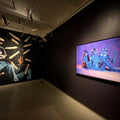
See for yourself during “Vivid Portraits and Violent Color: The Art of Fritz Scholder,” on view at through February 21, 2027, at the Sigler Western Museum in historic Wickenburg, Arizona.

Installation view, ‘Vivid Portraits and Violent Color The Art of Fritz Scholder,’ at the Sigler Western Museum. Courtesy of the Sigler Western Museum.
“He was creating work that had not been considered like that before for Indigenous people – the Native person with the beer can – taking a look and saying we are contemporary people, with obvious ties to our traditions, but we are also living and thriving in this day and age, and we're like other people in the country,” Tricia Loscher, The Dita and John Daub Curator of Western Women’s Art & Chief Curator Sigler Western Museum, told me. “He used his contemporary format with the huge color fields to create a strong Indigenous person, or horses, whatever he was depicting, and tying that to contemporary times while still drawing upon the historic past and the historic conditions and all of the stereotypes of Indigenous people.”
Scholder did so despite vowing not to do so.
He was one-quarter Luseino, a California Mission tribe. While Scholder grew up around Native people and Native culture, as an artist, he was primarily interested in Modern art, not Indian art. In 1957, at age 20, Scholder moved with his family to Sacramento where he studied with leading modern artist Wayne Thiebaud. He was a prodigy, with solo shows at galleries and museums soon after.
It wasn’t until 10 years later, early in his tenure as an instructor at the relatively new Institute of American Indian Art in Santa Fe, after having met IAIA’s founder, Cherokee designer, Lloyd Kiva New, after having studied with Hopi jeweler Charles Loloma, after graduating from the University of Arizona with an MFA Degree in 1964, that he took on Native people as a subject of his artmaking. Doing so stemmed from his frustration with his students’ inability to capture the subject as he saw it.
Scholder taught Advanced Painting and Contemporary Art History at IAIA. One of his students was T.C. Cannon. Earl Biss and Kevin Red Star and Linda Lomahaftewa were others. The so-called Miracle Generation of early IAIA artists who would go on to revolutionize Native art, American art, and contemporary art.

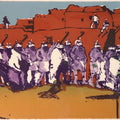
Fritz-Scholder-(1937–2005),-‘Dancers-at-Zuni,’-1987.-Lithograph-Collection-of-Alan-K.-Pace.-Image-size-22”-x-30.”
Collector and Artist
Works featured in “Vivid Portraits and Violent Color” are on loan from the collection of Alan K. Pace, who has also pledged the artworks as a gift to the Museum’s permanent collection. Collector and artist became close friends.
“Alan tells a story, (Fritz) was having a party at his house and Fritz's wife was looking for someone to help with the technical, and somehow she met Alan and right place, right time,” Loscher explained “He would attend gallery showings with Fritz, and at the time, Fritz had people who would send him death threats for his controversial work. People were unhappy with how he was depicting Native people in some cases.”
Future collector became faux bodyguard.
“Alan tells stories where he would put in a little earpiece and make it look like he was his bodyguard, and he would he would chauffeur Fritz and his wife to the galleries in Old Town Scottsdale and stand next to him,” Loscher continued. “Fritz would be sitting there signing things and Alan would hand him the pen. He did that one night and Fritz said, ‘Well, you're, doing this from now on. You're my bodyguard.’”
Fritz Scholder was the first Native painter to be famous. Famous beyond Native circles. To need a bodyguard. San Ildefonso potter Maria Martinez was famous before Scholder, but to the mainstream contemporary art world, to New York and LA and Paris, painting held the highest stature; pottery was mere “craft.” That’s not fair, but almost nothing is when it comes to the treatment of Indigenous people.
Again, without the work, it wouldn’t have mattered. Work that could make an impression even on a little girl.

Fritz-Scholder-(1937–2005),-‘Indian-Cowboy,’-(State-II),-1974.-Image-size-24”-x-17.”-Collection-of-Alan-K.-Pace.
“(My family was) in Tucson, visiting, and there was a gallery in downtown. We walked by, and it was probably the first time I encountered – I was maybe seven or eight – peeking into the gallery and seeing his huge paintings, and then his name Fritz Shoulder,” Loscher remembers. “I already loved art and artists and especially Indigenous art. It really resonated with me, his name and who he was. I grew up knowing who Fritz Shoulder was; for me, he was the iconic painter of American Indian art.”
For many, he continues to be.
Collectors new to Native American art still routinely put a Fritz Scholder painting at the top of their “must have” list. To an almost absurd degree. As if he was not only first – which he wasn’t – but the only – which he isn’t. But no Native artist can match Scholder’s name recognition and mystique. Still.
“He was so remarkably out there with his thinking,” Loscher said. “He adapted his own internal instincts and experiences and his color palette, but also the world around him and what he witnessed and the people that he encountered, from people on the reservation to European royalty.”