'ASCO: Without Permission' Documentary Premiering on PBS
By Chadd Scott on
Artists work best in community.
Ask the Impressionist painters working in Paris. Or the Taos Society of Artists. Or New York’s Abstract Expressionists of the 40s. Artist Hopid, recently featured by “Essential West,” on the Hopi Reservation in the 1970s.
Artists flourish in communities of artists.
It’s why art colonies develop. Places like Taos and Provincetown, MA, and the East End of Long Island.
It’s why art schools exist. The Institute of American Indian Arts in Santa Fe. The Arts Students League in New York. The Pilchuck Glass Studio outside Seattle.
Artists need other artists.
The volume of prominent artist groups and collaborations from history destroys the popular myth of artists creating in isolation. The lone genius. Artists do need alone time free from distractions to concentrate and produce their work, but outside those hours, their creative inspiration and sustenance comes from being around other artists.
So it was for another fascinating – and hitherto scantly known – artist group that came together as teenagers in 1970 Los Angeles. ASCO, more so than most artistic collectives, spoke nearly with one voice. An artistic troop like a theatre company. A team.
ASCO receives a measure of its due in a documentary premiering on the PBS series “VOCES,” Friday, October 2, 2026, at 10 p.m. ET (check local listings) on PBS, PBS.org and the PBS app.

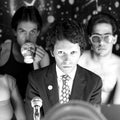
Still from ‘ASCO Without Permission,’ featuring Willie Herrón, Gronk, Patssi Valdez, Harry Gamboa Jr. Photo Harry Gamboa Jr. Courtesy of Asa Nisi Masa Films.
‘ASCO: Without Permission’
Harry Gamboa Jr., Glugio “Gronk” Nicandro, Willie Herrón, and Patssi Valdez met in high school. They formed ASCO, from the Spanish word for disgust. “Asco” was in the guts of the four as they observed the police brutality around them in East LA and the body bags of community members returning from Vietnam.
“There was no reprieve from the conditions that we were in, and that made us stronger,” Gamboa says in the documentary.
The group took on the art world through provocative performances, photography, video, and muralism. Its creative output was experimental, collaborative, political, dangerous, unsettling, performative, subversive, genderbending, and funny, too.
“Art by any means necessary in a volatile time period,” as the film’s opening comment states.
Frustrated by the stereotyping and lack of access for themselves and their peers – Chicano artists were excluded from gallery representation, museum recognition, and acceptance in the fine art world – ASCO began creating work across Los Angeles. The group’s ballsy confrontation/infiltration of the Los Angles County Museum of Art is recalled in the film.
“Creative disobedience,” in the words of a documentary commentator.
The group challenged the established order of Hollywood, museums, and media.

Still from ‘ASCO Without Permission,’ featuring Gronk, Patssi Valdez, Humberto Sandoval, Willie Herrón. Photo Harry Gamboa Jr. Courtesy of Asa Nisi Masa Films.
Becoming ASCO
Growing up in East LA in the 1960s, ASCO members lived in and around violence, poverty, alcoholism, and street gangs.
“One of the ideas we had as young people, it was very uncertain if we would live one more day, and if you’re given one more day, what would you do with that one more day,” Gamboa remembers.
They were initially focused on how to get out of the “prison” of high school. They dressed in the style of “Jetters,” a sort of “’60s mod Chicano style” in Gamboa’s words. Exaggerated, flamboyant. Think a cholo David Bowie. Costumes and makeup.
ASCO came together after the Chicano Moratorium in 1970 around the members’ collaborative work on an underground Chicano magazine. They inspired, motivated, and assisted each other. They talked constantly about art and life and pop culture and society and spent countless hours together.
“They went into a garage, and instead of coming out as a band, like many other young people did at the time, they became an artist group,” commentary in the documentary explains.
By the 1980s, ASCO expanded to over 20 people, creating video works and theatrical productions with younger artists before the group disbanded in 1987. While each of the founders achieved success in the art world, ASCO remained in relative obscurity until the early 21st century, when a new group of curators began showcasing their work internationally and introducing ASCO to a new generation.
“My hope is the film is a manifesto, the ASCO manifesto, for the next generation of the Chicano and Latinx community, as well as any marginalized group that wants to take from ASCO’s playbook,” Director Travis Gutiérrez Senger said via press release. “I hope the film inspires people to be daring and take risks, to be open to working and trusting one another. I’m honored to tell their story and help open the next chapter of Latinx history where our stories and work can be as bold and electrifying as ASCO’s.”

Still from ‘ASCO Without Permission,’ featuring Harry Gamboa Jr. Photo Harry Gamboa Jr. Courtesy of Asa Nisi Masa Films
Art as Activism
ASCO merged activism with radical artmaking, as Chicano art has always done.
They were students during the 1968 Chicano high school walkouts – Gamboa led the action at his high school. The film shares contemporary news reports of the shocking/not shocking police violence in response. Law enforcement occupied East LA, cracking down on discontentment.
The 2006 movie “Walkout” tells this story.
California was on fire in the late 60s and early 70s as minority groups sought their liberation from American subjugation. The Chicano Movement. The Black Panthers. The American Indian Movement. The farm workers movement. Feminists. Anti-war.
Each of these movements incorporated artwork as a tool resistance.
This is the environment ASCO grew up in and contributed to.
Following the walkouts was 1970’s Chicano Moratorium. This community-wide protest targeted the Vietnam War, especially the high casualty rate amongst Chicano soldiers and the armed services’ aggressive recruitment of teenage community members. A day-long festival of dancing and music was held. Hundreds of cops in riot gear surrounded and brutalized the peaceful gathering. Stunning color video footage of the attack and aftermath are shown in the film.
Police deploying tear gas against citizens. Wantonly swinging night sticks. People died. Whittier Boulevard erupted. Shocking visuals mostly erased from United States history.
“It never looked the same again,” Valdez said of the neighborhood.
She possessed an undeniable star quality that comes through in the archival footage. A Cyndi Lauper-type one decade earlier.
“What I decided to do is to bring a contemporary image to the screen,” Valdez explained. “Break with these stereotypes. I created this image, and I’m gazing at you with this so-called ASCO stare. An ‘I dare you’ thought in mind. To me, I was addressing the world as a Latina, as a brown person; look at us, my culture – not so much me – but look at us, we’re more than what we’ve been perceived as.”

Still from ‘ASCO Without Permission,’ featuring Patssi Valdez, Willie Herrón, Gronk, Humberto Sandoval, Harry Gamboa Jr. Photo by Harry Gamboa Jr. Courtesy of Asa Nisi Masa Films.
How to Watch ASCO Documentary
“ASCO: Without Permission” is produced by Latino Public Broadcasting. The PBS documentary series “VOCES” features the best of Latino arts, culture, and history, shining a light on current issues impacting Latino Americans.
“We’re excited to present this documentary and share the groundbreaking work of artists who refused to be silenced, dared to stand up to institutions and brought their art into the streets for everyone in their community,” Sandie Viquez Pedlow, Executive Producer of “VOCES,” said in a press release. “Their work deserves to be widely known, and this film does a brilliant job of bringing their art to life and conveying why they matter as much now as ever.”
VOCES “ASCO: Without Permission” will stream simultaneously with broadcast and be available on all station-branded PBS platforms, including PBS.org and the PBS app, which is available on iOS, Apple TV, Android mobile and tablets, Android/Google TV, Roku, Amazon Fire TV and tablets, Comcast, Samsung Smart TV, VIZIO and LG Smart TVs.