Thomas Hart Benton's 'Picture of America in its Entirety'
By Chadd Scott on
A picture of America in its entirety.
A ludicrous pursuit for any artist.
So vast. So diverse.
Constantly changing.
Yet, that was Thomas Hart Benton’s (1889-1975) stated objective, and he came as close to achieving that goal as any recorder of the nation.
“I was after a picture of America in its entirety...I ranged north and south and from New York to Hollywood and back and forth in legend and history,” Benton once said.
The painter’s efforts toward “a picture of America in its entirety” can be seen now through October 16, 2026, at Schoelkopf Gallery in New York during a retrospective exhibition tracing his storied five-decade career of depicting the United States from Martha’s Vineyard to the Desert Southwest.
Benton was born in Neosho, Missouri to a prominent political family. His father, Colonel Maecenas Benton, was elected to Congress four times as a representative of Missouri and named his son after his great uncle, Thomas Hart Benton, who had served as a Missouri senator for three decades.
He studied at the Art Institute of Chicago, then in Paris, and lived and worked and taught in New York for more than a decade. Between 1926 and 1936, Benton taught painting at the Art Students League of New York. His most famous student was Jackson Pollock.

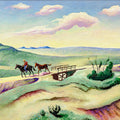
Thomas Hart Benton, ‘Wyoming Landscape,’ c. 1955–60. Watercolor on paper. 16.5 x 22.25 inches. © T.H. and R.P. Benton Trusts. Licensed by Artists Rights Society, New York. Courtesy Schoelkopf Gallery.
By the 1930s, Benton emerged as a pioneer and the outspoken leader of American Regionalism, an art movement consciously rejecting European abstraction in favor of depicting realistic, everyday American life. In 1934, Benton was the first artist to appear on the cover of Time magazine, marking what may have been the apex of his recognition in popular culture. The following year, he returned to his home state of Missouri, where he spent decades teaching at the Kansas City Art Institute and mentoring future masters of American art.
Thomas Hart Benton and the West
Traveling widely across the Midwest and South, Benton sketched working-class people, farmers, and changing industrial landscapes. His work was distinctly American in its colorful and dynamic representations of people’s lives and labor.
While not exclusively a “Western” artist, like other prominent American modernists including Marsden Hartley and Georgia O’Keeffe, Benton was an artist of the West.
His influence on contemporary western art is undeniable. Look no further than the work of Kim Wiggins.

Thomas Hart Benton, ‘Trail Riders,’ c. 1964–65. Oil on canvas mounted on board. 11.75 x 16 inches. © T.H. and R.P. Benton Trusts. Licensed by Artists Rights Society, New York. Courtesy Schoelkopf Gallery.
Benton began painting the West in the 1920s and continued doing so throughout his long career. During his western travels, Benton observed the landscape directly, capturing his wonderment of vast expanses and imposing mountains. His energetic, cinematic compositions represent physical experiences with the land, and it’s limitless possibilities.
“Benton aimed to convey the energy and intensity of modern times,” art historian Erika Doss explained in a press release for the gallery’s “A Picture of America in its Entirety” exhibition. The presentation traces Benton’s numerous journeys across the United States, absorbing the grandeur of the land and the character of its people.
Benton’s engrossing compositions, marked by sweeping landscapes, rhythmic movement, and impassioned figures, embody the physical and emotional terrain of a nation in flux. His ambitious work chronicles the complex social changes of the 20th century, bearing witness to the effects of war, racism, oppression, technological progress, politics, music, and culture.
Throughout his career, Benton remained committed to painting scenes of American life and labor and frequently positioned his work as a means through which to examine and challenge the nation's history. The subject of cotton pickers, for instance, was a recurring motif.
Benton wasn’t a complete romantic. No “picture of America in its entirety” could be exclusively rosy.

Thomas Hart Benton, ‘The Desert,’ 1956. Tempera on paperboard. 21 x 28.5 inches. © T.H. and R.P. Benton Trusts. Licensed by Artists Rights Society, New York. Courtesy Schoelkopf Gallery.
The Nation’s Muralist
Benton achieved his greatest fame through grandiose, narrative murals. America Today (1930-31) (collection of the Metropolitan Museum of Art) and The Arts of Life in America (1932) (collection of the New Britain (CT) Museum of American Art) are, but two capturing the vitality and struggles of a nation rebuilding during the Great Depression. Tracking Benton’s murals across the U.S. would make for a noble road trip.
His public works were frequently controversial for their raw, socially conscious commentary, refusing to whitewash the unpleasant chapters of American history. A mural commissioned in Indiana featured the Ku Klux Klan to the chagrin of the commissioners.
The Schoelkopf Gallery exhibition features several studies for Benton’s renowned murals, including one related to Joplin at the Turn of the Century (1972). Commissioned by the city council of Joplin, Missouri – 20 miles from Benton’s hometown – the mural depicts a bustling city street, showcasing a mix of social classes and the city's mining industry. The mural incorporates many autobiographical elements, including a figure at the center left of the composition that represents the artist’s younger self working as a cartoonist.
The Joplin mural was completed in April 1972 and was unveiled during the city's centennial celebration the following year.
Benton continued painting with immense vitality until his final moments, passing away in his studio in 1975 after placing the finishing touches on his final masterpiece, a mural for the Country Music Hall of Fame.
Through public murals, museum commissions, and portrait paintings, Benton’s work helped shape the framework of America’s cultural identity.
‘The Kentuckian’
As a special treat, “A Picture of America in its Entirety” includes artwork Benton produced for the 1955 film “The Kentuckian.” In the movie, Burt Lancaster plays the lead, journeying with his young son from Kentucky to start a new life in West Texas. Along the way he accumulates a cast of intriguing characters while enduring hardships.
In 1953, motion-picture company Norma Productions hired Benton to make a painting for the movie’s publicity. Lancaster and Harold Hecht, producers of the motion picture, admired Benton’s art, and it was upon their initiative that Benton received the commission.

Thomas Hart Benton, Study for “The Kentuckian”, 1954. Oil on Masonite, 15 x 101⁄2 inches. © T.H. and R.P. Benton Trusts Licensed by Artists Rights Society, New York. Courtesy Schoelkopf Gallery.
Benton’s finished painting, The Kentuckian (1954), was owned by Lancaster for many years before being donated to the Los Angeles County Museum of Art in 1977.
Except for its showing at the movie’s premiere in Washington, D.C., the canvas was never exhibited until its donation to the museum. It was, however, reproduced on labels for bottles of Beam’s Choice whiskey.
The Schoelkopf Gallery exhibition includes two studies for The Kentuckian, one in grayscale and one in color. Also on display are a movie poster featuring Benton’s artwork and a bottle of Beam’s Choice with the painting reproduced.