Smith, Cannon, and Scholder Artworks Enter Prestigious Museum Collections
By Chadd Scott on
Museums are the ultimate arbiters of taste. The most exclusive velvet rope. The final boss.
Museums are concerned with collecting for time immemorial, not of the moment. Trends and fads don’t interest them, that’s why they still collect antiquities with relish. Museums acquire artworks today as much for the 22nd century as the 21st.
By definition, anything worthy of being owned by or displayed in a museum is “good.” Ownership and display in the nation’s most preeminent museums are reserved for “masterpieces.” The best of the best of the best from 5,000 years of human creativity.
Jaune Quick-to-See Smith (Confederated Salish and Kootenai Nation, 1940-2025), T. C. Cannon (Kiowa/Caddo, 1946-1978), and Fritz Scholder (La Jolla Band of Luiseño Indians, 1937-2005) are the best of the best of the best. Not among Native artists or American artists, among all artists ever anywhere. While the nation’s greatest art museums hold work by all three, each had additional pieces recently acquired by prominent institutions, preserving and promoting their legacies for the ages.
Jaune Quick-to-See Smith
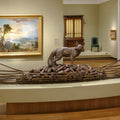
On August 31, 2026, the Virginia Museum of Fine Arts in Richmond, one of the largest comprehensive art museums in the United States, announced the acquisition of Smith’s Making Medicine: Coyote (Going Forward, Looking Back) (2024-2025). The monumental bronze sculpture includes two reoccurring motifs in Smith’s practice: the canoe and the trickster figure of Coyote.
In Making Medicine, Coyote stands atop a pile of refuse held within the canoe, mostly made up of bronze casts of plastic water bottles and Styrofoam cups from fast-food restaurants. The familiarity of the refuse implicates the viewer, leveling an incisive critique of our shared treatment of the environment, which deviates from a traditional Indigenous understanding of land as a living relative to be treated with reverence, rather than as a tool for extraction. Making Medicine’s vessel also highlights the role held by canoes, including within Smith’s own Flathead Salish heritage: providing portage and a safe journey for the passengers within.
Despite the work’s reference to environmental harm, its title also suggests a level of hope. By referencing medicine and a cyclical understanding of time, Smith’s Coyote invites engagement with ideas of collective healing and learning from our past mistakes to benefit future generations.
“This is a quintessentially Indigenous understanding of the responsibilities that we all hold as future ancestors and evokes a question central to the understanding of Smith as an artist: what can we accomplish together to shape a more just world?” Siera Hyte, VMFA’s Schiller Family Curator of Indigenous American Art, said in a press release announcing the acquisition.

‘Making Medicine: Coyote (Going Forward, Looking Back),’ 2024-2025, Jaune Quick-to-See Smith (Confederated Salish and Kootenai Nation, 1940–2025), bronze. Virginia Museum of Fine Arts, Arthur and Margaret Glasgow Endowment and Adolph D. and Wilkins C. Williams Fund, by exchange, 2025.220
Jaune Quick-to-See Smith’s Making Medicine: Coyote (Going Forward, Looking Back) is currently on display in Waterways, a permanent collection installation in the Virginia Museum of Fine Art’s American Art galleries.
T.C. Cannon and Fritz Scholder
A compelling argument could be made positioning Smith as the most important, influential, and highly regarded Native painter of the 21st century thus far. It would be hard to make an argument against that title belonging to Fritz Scholder for the 20th century. Next week’s “Essential West” article will focus squarely on Scholder.
On August 19, 2026, the National Gallery of Art in Washington, D.C. – the nation’s art museum – announced the acquisition of a bronze sculpture by Scholder, revealing an important though lesser-known aspect of the artist’s practice. Iconic for his paintings and prints, Future Clone (1999) is the last sculpture the artist made prior to his passing in 2005. The unusual sculpture/statue stands 8-feet-tall and features an armless man with wings.
Future Clone is the first sculpture by Scholder to enter the National Gallery’s collection and is currently on view on the mezzanine of the East Building.
Scholder was an instructor in the mid-to-late 1960s at the Institute of American Indian Arts in Santa Fe as the school was becoming established. One of his students was T.C. Cannon. Scholder, who was only nine years older than Cannon, had more of a friendly competition relationship with his pupil than mentor-mentee.
I like to think of Cannon as Native art’s Vincent van Gogh or Jean-Michel Basquiat, a singular talent for the ages whose life was cut far too short, a creative genius unable to fully blossom. Cannon was 31 when he died in a car wreck.
In that time, Cannon produced an astonishing body of work that changed the face of Native art and American art forevermore. At 29, I believe Cannon painted the greatest self-portrait in American art history.

T.C. Cannon (Kiowa/Caddo) ‘Collector #5,’ 1978, color woodblock on laid paper sheet (irregular): 64.14 x 50.48 cm (25 ¼ x 19 7/8 in.) image: 45.09 x 39.05 cm (17 ¾ x15 3/8 in.). National Gallery of Art, Ailsa Mellon Bruce Fund, 2026.2.1
The National Gallery has acquired a suite of five woodblock prints by Cannon (Kiowa/Caddo) (1978), also among the artist’s final projects, and often referred to as the “Memorial Suite.” These works reflect the complexity of Native American experiences in the mid-1900s and capture the intersectionality of Native American culture with the non-Native world by depicting community members in traditional regalia in modern settings. These are the first works by the artist to enter the collection.
Bad job there by the National Gallery. Cannon has been gone almost 50 years and has been a legend every day of that time. The National Gallery’s historic recognition of Native artists has been dismal. In 2023, it hosted its first exhibition of Native art in 30 years and its first exhibition of contemporary Native art in 70 years. That exhibition was curated by Smith.
Bear in mind, the National Gallery of Art doesn’t only display or acquire American artworks. Its collection of French Impressionism is among the best in the world.
Anyone interested in learning about contemporary Native American art from scratch could do worse than starting that education with Smith, Scholder, and Cannon. Amazingly, Smith was only three years younger than Scholder, but survived him by 20 years, and was actually born six years before Cannon. The three are contemporaries even though Smith seems to occupy a later generation, a generation that saw Native art achieve mainstream status, thanks to her, and Scholder, and Cannon. That mainstream status continues being entrenched in America’s top art museums.