Hyper SoCal Photography Exhibition at Santa Barbara Botanic Garden
By Chadd Scott on
Hyper SoCal debuted in January 2026 as an effort to spotlight unexpected, under-the-radar arts spaces across five Southern California counties. Originating at Glendale’s Brand Library & Art Center, a historic institution known for its art and music collections and its longstanding support of emerging and established artists, Hyper SoCal extends that mission outward. The initiative unites a diverse collection of partner spaces committed to experimentation, accessibility, and artist-centered programming, expanding notions of where art can be seen beyond museums and galleries.
Hyper SoCal has quickly grown to encompass a network of more than 40 municipally run contemporary art venues throughout the region. Together, these locations reimage everyday spaces as vital platforms for contemporary art.
“There wasn’t something that tied together our specific element of the art scene; working in a municipal or a nonprofit venue means that you have very limited resources, very limited staffing, but everyone's still being ambitious because we're all passionate about the arts,” Glendale Library, Arts & Culture Exhibition Coordinator and Hyper SoCal creator Stephanie Sherwood said. “Why not try and band together and create something that helps celebrate our unique little corner of the world?”
While less ballyhooed, the small arts centers scrapping to survive across Southern California – across the United States – are vastly more numerous than their gigantic museums with their billion-dollar endowments like the Los Angeles County Museum of Art or Getty Center. The little guys also democratize art by dispersing it throughout neighborhoods and into locations frequented by the public – often free of charge.

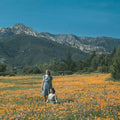
SBBG Spring Meadow, California poppies, 1940.
Photo Courtesy of Santa Barbara Botanic Gardens.
“Art in public places is something I've always been passionate about,” Sherwood said. “I'm an artist myself, and I work in some public realms; I think that moment of discovery and surprise when you stumble upon a big mural on a building, or ‘Oh my gosh, I'm going through the airport, and there's this sculpture.’ I think that can be impactful for people.”
Hyper SoCal encourages collaboration among Southern California’s community-focused art spaces by sharing audiences, expanding access, and offering alternative ways to experience contemporary art. Through rotating exhibitions, shared programming, and cross-institutional visibility, the initiative seeks to deepen public understanding of the nonprofit and municipally run venues the anchoring the region’s creative ecosystem, creating new opportunities for locals and visitors to discover off the beaten path art spaces.
Places like LAX airport, the Martial Arts History Museum in Glendale, the Museum of Neon Art in Glendale, Forest Lawn Memorial Park cemetery and museum, and the Santa Barbara Botanic Garden.
Santa Barbara Botanic Garden
The first botanic garden in the nation to focus exclusively on native plants, Santa Barbara Botanic Garden this year celebrates 100 years of conservation leadership and work to better understand the relationship between plants and people. Since its founding in 1926, the Garden has grown from 13 acres to 78, and now features more than six miles of walking trails, a library, a public native plant nursery, and a Conservation Center home to various programs, including research labs, an herbarium, a lichenarium, one of the largest seed banks in California, and an art gallery.
An art gallery.
At a botanic garden.
Art off the beaten path.
Perfect for Hyper SoCal.
Now through March 21, 2027, the Santa Barbara Botanic Garden presents “Still Growing: 100 Years of California’s Native Plants.” Created as part of the Garden’s Centennial celebration, the exhibition offers visitors a visual journey through a century of dedication to California’s native plants while inviting them to help shape the future of conservation
Ladies in the meadow, circa 1940.
Photo Courtesy of Santa Barbara Botanic Gardens.
Drawn entirely from the Garden’s extensive archives, “Still Growing” showcases over 200 photographs spanning the organization’s 100-year history. The exhibition highlights the fieldwork, research, stewardship, and community efforts that have defined the Garden’s mission since its founding.
Installed in the Pritzlaff Conservation Center Gallery, with sweeping views toward the Channel Islands beyond, the presentation offers a dynamic collection of images introducing visitors to the people, plants, and places that have shaped the Garden’s legacy.
“While the exhibition reflects on the Garden’s past, it’s ultimately about the future,” Kevin Spracher, Santa Barbara Botanic Garden’s interpretation and exhibitions curator, said. “Native plants have the power to restore habitats, support wildlife, and build more resilient communities, but that future only grows with people behind it. We hope visitors leave inspired to see themselves as part of this living legacy and join the Native Plant Movement as stewards of California’s native landscapes.”
The Power of Native Plants
The Santa Barbara Botanic Garden defines a native plant as “one that has evolved in a particular place and continues to inhabit that geography in the wild.”
The institution’s mission is “to conserve native plants and habitats for the health and well-being of people and our planet.”
Why?
Because “native plants are one of the most direct solutions to our biodiversity and climate change crises” as the Garden succinctly states.

Meadow Section, poppies, La Cumbre Peak, date unknown.
Photo Courtesy of Santa Barbara Botanic Gardens.
Planet Earth faces two existential crises: climate change and biodiversity collapse. Both crises are man-made. Biodiversity collapse simply means the erasure of an expanding number of plants and animals – and entire species. Take enough strands out of the web of life and the entire web – humans included – collapses.
A third existential crisis, artificial intelligence, is emerging; another story for another day.
Climate change and biodiversity collapse are global catastrophes. While they should be the number one and number two priority for every government and corporation in the world, governments and corporations aren’t doing enough by half to address these problems – and many (most?) – continue exacerbating them. Put the United States at the top of that list.
What can one person do?
You can reduce your consumerism. You can educate yourself and vote. You can plant native plants. In California. Everywhere.
“Native plants are one of the most direct solutions to our biodiversity and climate change crises,” the Santa Barbara Botanic Garden website states.
Native plants combat climate change by capturing carbon out of the atmosphere and placing it into the ground through their enormously long roots. Doing so also promotes healthier soils – healthier soils with more organic material including microorganisms and insects, more biodiversity.
Those longer roots also result in native plants mitigating the effects of climate change. Longer roots soak up more water and slow the flow of water during heavy rains and flooding. Conversely, they store more water and reach further below ground sustaining native plants during droughts without irrigation.
Scientists studying the aftereffects of the 2025 Altadena fires are recommending residents install native plants in their landscaping as both a restorative and preventative measure against future wildfire.
At the same time, native plants sustain local and migrating bird and insect and animal populations because these are the plants those species evolved alongside over hundreds of thousands of years and use as food, for homes, and for pollination. Conversely, most of the landscaping plants consumers in the United States buy from big box retailers originated in other continents and are unusable to local wildlife or are laboratory concoctions engineered to stay green year-round with zero benefit to nature.
Awareness around the multitude of benefits offered by native plants and a movement to replace turf grass and exotic plant species with natives is beginning to take hold in the U.S. As the first botanic garden focused exclusively on native plants, the Santa Barbara Botanic Garden has been about that life for 100 years. A century ahead of the trend.
Native plants are seasonal, messy in all the good ways, buzzing with life – literally – evocative of place, riotously diverse, colorful, strange, inviting, a living biology laboratory in your yard, and an essential tool for humanity to maintain a livable planet.