Andy Warhol and the West
By Chadd Scott on
No artist is more associated with New York than Andy Warhol. The Factory. Studio 54. Celebrity culture.
Still, Warhol was fascinated with the West.
Seth Hopkins, Executive Director at the Booth Western Art Museum in Cartersville, GA first explored the connection in his master’s thesis.
“I took every Warhol book we had in our library home over a weekend and by the time I had looked through them all, I realized there were more Western subjects than I would have thought, yet I couldn’t find much written about it,” Hopkins told me back in 2019.
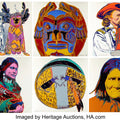
That was the year his museum debuted “Warhol and the West,” an exploration of Warhol’s Western influences and output. The artist’s Cowboys and Indians (1986) portfolio served as the exhibition’s centerpiece. A full set of the portfolio formed part of the Booth’s founding collection.
Cowboys and Indians represented Warhol’s last major project. He’d die early the next year following complications related to routine gall bladder surgery. The portfolio featured 14 iconic Western subjects including Geronimo, Annie Oakley, John Wayne, and General George Custer. Warhol was reportedly fascinated by Custer.
On October 22nd, 2026, Heritage Auctions offers a complete set of the Western screenprints along with their original box.

Andy Warhol, 'Cowboys and Indians,' 1986. Complete portfolio of 10 works. Courtesy Heritage Auctions.
Across 10 sheets measuring three feet square, Warhol turned his attention to the faces and symbols through which generations have imagined the mythic West. John Wayne’s Hollywood cowboy appears alongside historical figures including Theodore Roosevelt, while Mother and Child, Northwest Coast Mask and Kachina Dolls broaden the portfolio beyond famous personalities. In Indian Head Nickel, an everyday piece of currency becomes a monumental Pop image.
The Heritage Auctions portfolio’s John Wayne carries a particularly intriguing distinction: it is inscribed “Unique.” Hand-applied elements distinguish this impression from the standard edition, including a pink-to-blue gradient on Wayne’s gun and a red stripe on one tie of his bandana. These details add an individual flourish to one of the suite’s most immediately recognizable images, based on Wayne’s appearance in The Man Who Shot Liberty Valance.
As of this article’s writing, the portfolio had a current bid of $500,000.

Andy Warhol John Wayne from 'Cowboys and Indians,' 1986. Courtesy Heritage Auctions.
Warhol and the West
While there has never been another Andy Warhol (1928-1987), his interest in the West began the same as it did for millions of others.
“Initially it came from the same place as most Americans of a certain age: watching Western movies as a child and Western television shows as a young adult,” Hopkins said. “In his book Dream America, he talked about dreaming about what it might be like to live in other parts of the country, like out West, or particularly Texas.”
From Saturday matinees starring Gene Autry and Roy Rogers as a kid in the 1930s, Warhol would go on to produce two Western movies himself. He directed 1965’s “Horse” and wrote and co-directed 1968’s “Lonesome Cowboys,” which explored homosexual relationships among cowboys 37 years before “Brokeback Mountain.”
Warhol traveled the West extensively once his career took off in New York. He visited and owned property in Colorado. Taos was another favorite destination. He briefly owned an Indian artifact store there with actor Dennis Hopper.
“The voraciousness of his collecting of Native American material include(ed) rugs, pots, beadwork, primitive tools, Edward Curtis photographs, and many other things,” Hopkins said, this being a major surprise to him when researching Warhol’s affinity for the West. “Seems he went shopping during any free time he could find and usually bought something, such that when the Sotheby’s auction team cataloged all the material for (Warhol’s) estate auction they wound up cataloging over 10,000 items and hosting a 10-day sale; one whole day was devoted to just his Native American items.”
He also had a large collection of cowboy boots.
Warhol became friends with prominent Navajo painter R.C. Gorman during his visits to New Mexico. He also befriended Georgia O’Keeffe there, eventually producing a portrait of her.
Warhol’s portrait subjects also included legendary Native artist Fritz Scholder, American Indian Movement activist Russell Means, and Hopper and Clint Eastwood as Western movie stars.
And Elvis.
Life-size.
In 1963, Warhol chose not to depict Elvis as a teen pop, instead picturing him as a cowboy, gun drawn. Warhol’s cowboy Elvis pictures became one of his first professional successes.
An example of Warhol’s Double Elvis can be found in the permanent collection of the Museum of Modern Art in New York, a Triple Elvis at the San Francisco Museum of Modern Art. Eight Elvises, of which only one was ever made, sold for more than $100 million in 2008 in a private sale.
With this amount of work, can an argument be made for classifying Warhol as a Western artist?
“While Warhol produced enough Western art to have a body of work more than worthy of study and of significant influence on not only artists, but the way the American public views the West, it is such a small percentage of his voluminous output that it would be a significant stretch to call him a Western artist,” Hopkins explained.
To that point, Warhol produced more than 300 works alone featuring Jackie Kennedy, not to mention the constellation of other celebrities outside the Western genre he depicted.
While not a Western artist, Warhol has undeniably influenced Western art.
“Artists like Billy Schenck, Stan Natchez, Donna Howell-Sickles, Tom Gilleon and many more have been influenced by Warhol's graphic style, image appropriation, or his working methods,” Hopkins said. “His bold compositions, often featuring a single figure, have significantly impacted the contemporary look of much of today's Western art.”