Cara Romero: Panûpünüwügai (Living Light)
By Chadd Scott on
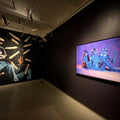
Following its debut at the Hood Museum of Art at Dartmouth College in 2025 and subsequent presentation at the Phoenix Art Museum earlier this year, “Cara Romero: Panûpünüwügai (Living Light),” opened at the Museum of Contemporary Art Jacksonville on October 1 where I finally saw it. More than 50 large-scale photographs spanning the past 10-plus years examine Indigenous life through a contemporary lens, celebrating the multiplicity, beauty, and resilience of Native American and Indigenous experiences with a strong focus on women and the land.
“Native people and our global Indigenous communities hold a sacred role in the health and future of the planet,” Romero (b. 1977; Chemehuevi) said in an exhibition press release. “Everything is connected. How do we shake it up and help people understand it’s just a fact that you can’t undervalue: we will never be able to erase these original instructions of ways of living in reciprocity with Mother Earth.”

'Cara Romero Panûpünüwügai (Living Light)' installation view at Museum of Contemporary Art Jacksonville. Photo by Chadd Scott.
Romero is among the most celebrated and distinguished contemporary photographers – Native or otherwise – working today. Her images have been featured in the nation’s most prestigious institutions including the Metropolitan Museum of Art. Her visual storytelling challenges dominant narratives of Indigenous decline and erasure, disrupting preconceived notions about what it means to be a Native American and showcasing the diversity within Indigenous nations and communities.
“It's beneficial that people understand that we have thousands of stories and that we're not a monolithic culture, that we're not a monolithic people, and so I call that the ‘one story narrative’ of what people think Native Americans are,” Romero told me before “Panûpünüwügai” opened at Dartmouth. “The more (museum) shows and the more representation and the more stories we have to tell opens people's minds to the fascinating diversity and lived experiences that we have, which adds a richness to the United States, a foundation that we all could benefit from getting back to and uplifting.”
A foundation, a way of life including practices of living collaboratively, not selfishly. De-emphasizing material possessions, reemphasizing community. Living in balance with nature. In harmony with the land. Seventh generation thinking.
Romero’s images are typically celebratory, taken in vibrant color, and depict Native American’s outside of traditional regalia, forcing non-Native viewers to see and acknowledge Native people as contemporary and vibrant, in opposition to the sepia-toned, stoic, posed Native portraits customary to previous centuries.
“Giving people our human story of resilience and beauty and countering preconceived notions or internal biases that we’re historic or bygone,” Romero said.

'Cara Romero Panûpünüwügai (Living Light)' installation view at Museum of Contemporary Art Jacksonville. 2 Photo by Chadd Scott.
Panûpünüwügai (Living Light)
The title of the exhibition, Panûpünüwügai, means “living light” in the Chemehuevi language and refers to the spirit of light.
“Panûpü is light, more like illumination, not a direct light source, but like when the sun comes up,” Romero explained. “Nüwügai in our language (means) something has a spirit, or something is a living entity. For me, ‘living light’ was about something bigger than just the technical aspects of photography. It's not just the capture of light and time, it's also about everything that happens in the shoots and bringing people together and making memories and telling stories from within indigenous community, all of the spirit of the people and place and culture that are being illuminated within the medium in the way that I work.”
Romero’s photographs include images of her children as well as other prominent Indigenous artists. Romero’s most famous picture, Water Memory (2015), features Santiago Romero (Taos/Cochiti Pueblo) and Rose B. Simpson (Santa Clara Pueblo).
The exhibition contains five central series including the iconic “Water Memories,” “First American Girl,” and “Ancestral Futures.” Each will live forever in American Art for their ingenuity and ability to communicate an underrecognized Indigenous experience across cultural lines.
“An incredible sense of humor, shared struggles, a love of life and community and culture and family… all the things that I see in my own backyard,” Romero told me when asked about her artwork’s message.
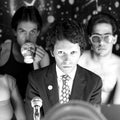
“Panûpünüwügai (Living Light)” in Jacksonville also includes an installation of TV Indians (Sepia) (2017), another of Romero’s eternal efforts, a satirical sendup of historic portrayals of Native Americans on television.

'Cara Romero Panûpünüwügai (Living Light)' installation view of 'TV Indians' at Museum of Contemporary Art Jacksonville. Photo by Chadd Scott.
Taken together, one unforgettable image after the next, one groundbreaking series after the next, Cara Romero stakes her claim as more than one of the most important contemporary Native American artists, she’s indispensable to the story of American art in the 21st century. Already one of the most important American fine art photographers to ever pick up a camera.
Now is a good time to remind you that she’s not yet 50 years old. In artistic terms, she’s just getting started. An exciting thought.
Becoming Cara Romero
Romero split her childhood between the sprawling metropolis of Houston and the remote Chemehuevi reservation in Mojave Desert, CA. As an undergraduate anthropology student at the University of Houston, she couldn’t fully express what she saw, felt, and experienced on the reservation.
During her junior year, she stumbled into a black and white film class.
Unable to adequately communicate in words her indigenous experience, she turned to another language: photography.
“While I struggled writing about contemporary Native issues, I fell in love with (photography) for its power of storytelling,” Romero told me. “I loved the mad science of it. It made my heart sing, and I never wanted to quit. There was always what I call a healthy compulsion. I wanted to get better. I wanted to do it in my spare time. I never imagined in million years that it would take me so far.”
Why photography?
“Some of it is a little bit unknowable,” she admits. “I was always an artist. I love to draw, I love to craft, make regalia, I sew, I basket weave. Art has always been a best friend, and I was never encouraged to do it as a life path. I think that that's true for many young people.”
“Cara Romero: Panûpünüwügai (Living Light)” can be seen at the Museum of Contemporary Art Jacksonville through March 21, 2027.