Historic "Grounded in Clay" Pueblo Pottery Exhibition Wraps Up Nationwide Tour in Albuquerque
By Chadd Scott on
“Grounded in Clay: The Spirit of Pueblo Pottery” debuted in July of 2022 at the Museum of Indian Arts & Culture in Santa Fe. Over the preceding four years, the stunning exhibition traveled to the Metropolitan Museum of Art in New York, the Museum of Fine Arts, Houston, and the Saint Louis Art Museum. The nation’s most elite arts institutions.
The pots have finally come back “home,” wrapping up their tour at the Indian Pueblo Cultural Center in Albuquerque. See them there through February 21, 2027, or forever hold your peace.
“Grounded in Clay” was curated by the Native American communities represented in the pieces. The project gives authority and voice to the Pueblo Pottery Collective, a group of over 60 individual members of 21 tribal communities including New Mexico’s 19 Pueblos, the Ysleta del Sur Pueblo of West Texas, and the Hopi Tribe of Arizona. Members include potters, designers, other artists, writers, community leaders, and museum professionals. Each selected item for display from two significant Pueblo pottery collections: the Indian Arts Research Center of the School for Advanced Research in Santa Fe and the Vilcek Foundation of New York.
Curators picked pottery made by relatives; others picked pieces from outside of their communities. Some carefully inspected hundreds of pots before choosing the one or two they wanted included in the show. Others knew immediately which they would select, having had a previous relationship with it.
Importantly, each member of the collective was allowed to write their own explanations for why an object was chosen.
No interlocutors.
No interference.
No adaptation.
Entries range from matter-of-fact narratives to poetry.
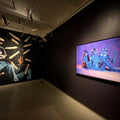
 "Grounded in Clay: The Spirit of Pueblo Pottery" installation view at Indian Pueblo Cultural Center in Albuquerque. Photo by Chadd Scott.
The curators' firsthand knowledge of pots and potters, family rituals, traditional materials, and daily use grounds viewers in a powerful sense of people and place.
In an accompanying PBS documentary playing alongside the exhibition, Collective members are shown talking and listening to the pots. Contemporary art superstar Rose Simpson’s (b. 1983; Santa Clara) interaction with a circa 1880-90 Santa Clara water jar proves especially powerful. While fighting back tears, she tells the pot, “I love you for all that you are. All the layers. I see your power. I see your fragility, your vulnerability.”
The artist/curator’s words demonstrate a degree of the importance pottery holds to the Pueblos. The Pueblos can’t be fully understood without an appreciation of pottery and its historic and ongoing significance.
“Pottery permeates the lives of Pueblo peoples,” Indian Arts Research Center Director and Pueblo Pottery Collective member Elysia Poon told me when I first visited “Grounded in Clay” in 2022. “For many, it is impossible to divorce the pieces from the people."
Pueblo pots are not functional things. They are not aesthetic things. They are not one thing or another.
They are everything.
Container. Pitcher. Artwork. Gift. Teacher. Relative. Ancestor.
Nothing in white culture approximates the significance of pottery within Pueblo cultures. Without needing to ascribe monetary value to everything, deeper values can be imparted.
Listen to descendants of the Indigenous people from what Spanish colonizers called “pueblos” – towns – across present-day New Mexico, West Texas and eastern Arizona – talk about their pottery, and this truth becomes readily evident.
The pots talk. They laugh. They sing.
When you know how to listen.
To anyone living outside of the Pueblos, outside of that world in the white world, such animation may sound preposterous, but when you see the pots, you know it’s true. If you’re willing to shed your prejudices that such things are not possible.
Pueblo pots have personalities. They are sacred. They are alive.
The pots tell stories.
Stories of joy. Of family, community, festival, harvest, spirituality.
A thread of ancestral memory connects individual pots to the pride, pain, and living legacy of Pueblo peoples.
Stories of drought, war, removal, genocide.
Stories of ingenuity. Resilience. Survival.
 "Grounded in Clay: The Spirit of Pueblo Pottery" installation view at Indian Pueblo Cultural Center in Albuquerque. Photo by Chadd Scott.
“(‘Grounded in Clay’) provides this beautiful opportunity for the curators to tell a story that's not just centered on ‘How is this pottery made, who were the famous potters, what was the linear progression of this pottery,’ which is how the stories are often told,” Poon said. “It provides an opportunity for different kinds of stories, and the important stories to Pueblo people to be told to the public in a way they want them to be told. That is something that is rarely done.”
Stories focused on why a particular pot was created, not just how. White culture focuses too much on how, not enough on why. Too much on outcome, not enough on intention. Pueblo people aren’t similarly afflicted.
“Although most Pueblo pottery exhibitions focus on the historic timelines and Western-derived concepts of fine art, this exhibit focuses on the lesser-known and intangible aspects of pottery intrinsic to the art and enduring culture of Pueblo people,” exhibition wall text at the Indian Pueblo Cultural Center reads.
Perhaps it has something to do with people and pottery both coming from the earth. Pueblo people coming from the earth, taking from the earth to make pottery, a symbiosis. Animism, as well. A spiritual belief understood in most of the non-Western world that all objects are imbued with a spirit – the trees, the animals, the rocks, the earth, the pottery.
“If you think about the pottery in this collection and take a look at any one of them – just focus on one – and think about its history, it's not just about who made it, it’s not just the staff who are stewarding it, it's about all the people in between and all the people that are coming in the future that are going to have a relationship with this pottery,” Poon said.
Yourself included.
 "Grounded in Clay: The Spirit of Pueblo Pottery" installation view at Indian Pueblo Cultural Center in Albuquerque. Photo by Chadd Scott.
“Pueblo potteries vibrate with the stories and experiences of those who made them, as well as the many people who have become a part of their history since then,” the exhibition wall text explains.
Visiting “Grounded in Clay,” spending time with the pots, spending time at the Indian Pueblo Cultural Center, experiencing the social dances by Pueblo people held there every Saturday and Sunday, venturing out into the Pueblos, seeing for yourself, outsiders can access the knowledge of these cultures. Their spirit. The answers you seek may be found there. Perspectives and relationships foreign to settler colonial society.
Be sure to also visit the School for Advanced Research’s Indian Arts Research Center – the Pottery Vault. I have described it as the most spiritual room I’ve ever been in.