San Francisco's de Young Museum Debuts Reinstalled Arts of Indigenous America Galleries
By Chadd Scott on
San Francisco’s de Young museum debuted completely refreshed Arts of Indigenous America galleries on August 26, 2025. Artworks on view span from Alaska to Central America. The presentation begins, however, in California.
The Fine Arts Museums of San Francisco – the de Young and the Legion of Honor – are located on land unceded by the Ramaytush Ohlone, the original inhabitants of what is now the San Francisco Peninsula.
The inaugural installation in the first gallery explores the interconnection between art, ceremony, and the land in the Hupa, Karuk, Tolowa, Wiyot, and Yurok communities of northwestern California. “Rooted in Place: California Native Art” includes loans from contemporary artists alongside collection works such as a gift basket by Elizabeth Hickox (Wiyot, 1872–1947); a specially commissioned dentalium-shell cape by regalia maker and fashion designer Shoshoni Gensaw-Hostler (Yurok, b. 1982); and a newly acquired monumental painting, The Magical Mind in Rural America, by Rick Bartow (Wiyot, 1946–2016).

“Rooted in Place” will be on view through December 2026 with the next gallery rotation focusing on a different region of Native California.
The museum’s second reenvisioned gallery for Native American art features works made by Indigenous artists from the United States, Canada, and Mexico, challenging the divisions created by modern political boundaries.
The new installations were collaboratively developed by a group of predominantly Native co-curators, foregrounding Indigenous values and voices. Rather than soliciting feedback on an already developed exhibition, the Fine Arts Museums engaged Indigenous scholars as co-curators and advisers from the project’s conception, shifting the power of representation away from an anonymous museum voice of authority.
The Fine Art Museums asked permission from communities of origin to present the artworks on view, and Tribes were invited to consult on the interpretation of the items from their communities
Beloved highlights from the permanent collection have been placed alongside lesser-known artworks. Contemporary artworks, including new acquisitions and commissions made specifically for this installation by celebrated contemporary artists, are displayed alongside ancestral works.
“By including contemporary artworks, the galleries now demonstrate the interconnection between artists and generations past and present,” Hillary C. Olcott, the de Young’s curator of Arts of the Americas, said. “Visitors will experience works spanning over a thousand years of history and incorporating all types of media, challenging expectations about what Indigenous art is and can be.”
Highlights of the Arts of Indigenous America Galleries
Indigenous art of the Americas has been part of the museum’s collection since the time of the California Midwinter International Exposition of 1894; holdings have grown substantially and steadily through the present day. A strength in the collection is artworks by Native artists from western North America.
In the mid-20th century, many Bay Area collectors donated baskets from California and the Pacific Northwest. These holdings were greatly enhanced by a donation from the Thomas W. Weisel family in 2013, including Ancestral ceramics by Pueblo potters, textiles by Diné (Navajo) weavers, and carvings and regalia from the Pacific Northwest. Extraordinary examples of contemporary Pueblo pottery were donated by Paul E. and Barbara H. Weiss, and another transformative gift came in 2007 from the estate of Thomas G. Fowler, who collected nearly 400 works by Alaska Native and Canadian Inuit artists, past and present.

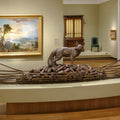
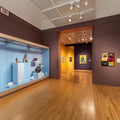
Installation view of 'Arts of Indigenous America,' at the de Young Museum, San Francisco, 2025. Photograph by Gary Sexton. Image courtesy of the Fine Arts Museums of San Francisco.
Among Alaska Native artworks – among all the artworks – a wall-sized screen from the Xeitl Hít (Thunderbird House) of the Wooshkeetaan Clan of the Áak’w Kwaan from Auke, Alaska painted by James Rudolf (Tlingit, 1858-1933) in 1907 makes a dramatic impression. The screen was previously on view at the Los Angeles County Museum of Art from 2018 to 2019. In 2019, LACMA repatriated the screen to the Central Council of Tlingit and Haida Indian Tribes of Alaska; it is now on loan to the de Young from the Tribe. The wall label for the screen was written by the Tribe.
In addition to the two completely new galleries of Native American art, galleries featuring Ancestral Maya art and mural fragments from the ancient Mexican city of Teotihuacan have also been updated.
“Visitors will experience light, bright galleries full of rich colors,” Olcott said. “They will encounter unexpected and beautiful artworks and will learn about these items from the descriptions and perspectives of the project team members, artists, and cultural practitioners. Overall, we hope that visitors will be energized and inspired by their time in the de Young’s Arts of Indigenous Americas galleries.”
Rose B. Simpson
Coinciding with the de Young’s newly renovated Arts of Indigenous America galleries, the museum also presents its first solo exhibition by a contemporary Native American artist. Earning that distinction is Rose B. Simpson (Santa Clara Pueblo, b. 1983).
“Rose B. Simpson: LEXICON” transforms the de Young’s public atrium into a celebration of the artist’s community in Santa Clara Pueblo, New Mexico. On display are two customized classic cars—Maria, a 1985 Chevrolet El Camino, and a newly commissioned 1964 Buick Riviera painted with pottery motifs, honoring both Pueblo pottery traditions and the Lowrider culture of northern New Mexico. Both cars are fully operational; it’s critical to Simpson’s conceptualization of these works of art that they can be driven.

Installation view of 'Rose B. Simpson LEXICON,' at the de Young Museum, San Francisco, 2025. Photograph by Gary Sexton. Image courtesy of the Fine Arts Museums of San Francisco.
Maria (2014) was painted with a matte and gloss black-on-black motif inspired by Tewa pottery designs. The name is an homage to the renowned Tewa artist Maria Martinez (San Ildefonso Pueblo, 1887–1980), who with her husband, Julian Martinez (San Ildefonso Pueblo, 1885–1943), revived and popularized a style of reduction-fired pottery with a distinctive black-on-black finish.
Growing up in the Española Valley, New Mexico—the self-proclaimed “Lowrider Capital of the World”—Simpson had always dreamed of having her own custom classic car. After receiving an MFA in ceramics from the Rhode Island School of Design, she enrolled in the Automotive Science program at Northern New Mexico College. Simpson recognized that the Lowriders she sees throughout her community—classic cars with lowered chassis and decorated with eye-catching paint jobs—are works of art, and that cruising them is a form of performance.
Like Pueblo pottery, the cars are part of the visual landscape of her home and expressions of the multifaceted and multicultural history of New Mexico.
At the de Young, the cars are surrounded by an expansive site-specific mural evoking the environment of the Southwest and transforming the space into a representation of a pottery vessel. Pottery is a vessel – for water, for food – cars are a vessel as well – for people, for groceries.