Artists Then and Now Humanize California's Migrant Agricultural Workers
By Chadd Scott on
Scorned migrants from far away come to California’s agricultural fields looking for a better life. Not an easy life. Nothing easy about this work they perform in the sun, hunched over, on their feet. Endless hours of manual labor. A better life.
In the 1930s, Dorothea Lange (1895–1965) photographed Okies blown in from the Great Plains by the Dust Bowl. Her iconic Migrant Mother (1936) photograph of the era, of the people, of the plight, may be the most recognized picture in American history. The weary, yet resolute woman. Her hungry children cling to her. The only safety and security they know.
The vast human tragedy of the Great Depression in one image.
Full title: Destitute pea pickers in California. Mother of seven children. Age thirty-two. Nipomo, California.

Dorothea Lange, Migrant agricultural worker's family. Seven hungry children. Mother aged thirty-two. Father is native Californian. Nipomo, California. 1936. Courtesy of US Farm Security Administration.
Today, another generation of artists carry on Lange’s mission of humanizing migrant workers. Not only Okies come to California, Mexican and other Latinx immigrants arrived from the south. Their work, just as hard. Their pay, still meager. Their reception, still hostile in many quarters.
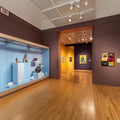
Coinciding with the 90th anniversary of the Works Progress Administration, the federal jobs program which employed Lange and thousands of artists during the Great Depression, “Last West: Dorothea Lange’s California Revisited” at the Sonoma Valley Museum of Art through January 4, 2026, uplifts current movements for dignity in the lives of migrant populations upon which California’s economy and agriculture depend. The exhibition points to the eerily contemporary issues that Lange photographed nearly a century ago: mass migrancy and shelterlessness, damage to soil and landscapes, and internment.
“The connections between the past and present are a constant reality for Californians with a social conscience perspective,” Sonoma Valley Museum of Art Deputy Director Margie Maynard said. “The mirroring in many cases is remarkable. The issues that American farmers faced in the 1930s – a depressed economy, technology changing farming practices and the job market, climate change, soil management challenges, migrancy, even unconstitutional detentions and incarcerations of its citizens – are all issues that have recurred and continue to exist in California and remain unresolved to this day.”
Placing Lange’s photographs of California alongside contemporary artworks from California artists reveals how similar conditions remain for the state’s marginalized agricultural workers upon whom the entire nation relies on for food production. Agriculture is a $50+ billion industry in California producing roughly half of the nation’s entire supply of fruits and vegetables.
Half.
All that food doesn’t end up in your grocery store as the result of magical food fairies. It’s picked. Largely by hand. Migrants doing the lion’s share of the work then and now.
At the Sonoma Valley Museum of Art, this story takes on heightened significance.
“Sonoma grapes and produce are being harvested as I write (this). Harvesting takes place at ALL times of the day and night,” Maynard explained via an email interview for this story, the “ALL” all-caps emphasis her own. “There is a sudden influx of workers and work going on in the vineyards and fields, and at night there are often large glows of work lights in the vineyards to illuminate the work, while in other areas, individual workers wear headlamps and safety vests.”
Does that sound like anyone “taking advantage” of America? Exploiting “the system” looking for a free ride or any of the other racist tropes hurled at migrant workers from south of the border?
“Housing for migrant workers is varied. Some landowners provide temporary housing on the property, or workers may sleep in their vehicles that they park on the property. Still others stay with relatives that have permanent housing nearby,” Maynard continued. “Recently there have been several stories about the H-2A temporary work visas that California issues and the challenges, and sometimes life-threatening circumstances that result. Recently, of course, concerns about ICE raids abound.”

Warren Chang, Invisible People, 2021, oil on canvas. Private collection.
It Takes Two
Lange wasn’t alone when documenting California’s migrant Dust Bowl laborers. Her husband, Paul S. Taylor (1895–1984), a social economist working for the University of California, interviewed workers and gathered data to support the images.
Before meeting Lange, Taylor was working separately for the WPA researching the living conditions of poor Americans living in rural areas and reporting back to the federal government. When he saw Lange’s photos taken between 1932 and 1934 of economic hardship across the country, photos predating the WPA, he was inspired and recognized how Lange’s images could increase the impact of his data and written accounts.
Upon meeting, the pair fell quickly in love and would both divorce – from painter Maynard Dixon in Lange’s case – and then almost immediately remarry each other in 1935.
Combined, the duo – working together – made a compelling and unforgettable record of the human and environmental toll of the time. They sent pictures and reports back to the federal government, in one such report writing, “Words cannot describe some of the conditions we saw.”
Fortunately, thanks to Lange, they didn’t have only words. They had pictures, and those pictures moved President Franklin D. Roosevelt to act swiftly in providing resources for improved camps, living quarters, food, and sanitation facilities for California’s migrant laborers.
Lange was working for the federal government’s Resettlement Administration, later the Farm Security Administration, when she shot Migrant Mother.
Taylor’s words and Lange’s pictures proved a pairing multiplying the power of both, similar to how Lange’s photographs, and those of her contemporaries, are each paired with a contemporary artwork in the Sonoma Valley show. One of Lange’s photos in the show is a spinetingling wide shot of the “Migrant Mother,” her family, and the tent they called home. The full picture cropped out from the famed Migrant Mother image.
Harrowing.
“Dorothea Lange liked to pair up her photographs to tell a more compelling or complete story. She did this specifically in her 1939 book with Paul Taylor, ‘An American Exodus: A record of Human Erosion,’” Maynard said. “(For the exhibition) we started by sourcing the available Lange photographs, taken in California, and looked at the themes of those images, the issues that resonated the most with our immediate community here in Sonoma Valley, and went from there. We were already aware of several artists whose work focused on migrant farm work.”
Those artists are photographers Erik Castro and Ken Light, painter Warren Chang, and mixed media artists Hung Liu and Narsiso Martinez. Work from Joel Daniel Phillips, Bruce Haley, and Lewis deSoto were later added to the exhibition.
Light (b. 1951) and Liu (1948-2021) are and were directly influenced by Lange. Light is a documentary photographer and head of the photojournalism department at UC Berkeley. He is a Lange scholar.
Liu immigrated from China in the 1980s and was known for making paintings based on found historical photographs from China. In one of her last projects before she died, Liu studied Lange's images at the Dorothea Lange Archive at the Oakland Museum of California and formed a strong personal connection to Lange's work. Before emigrating, Liu lived and worked on a farm as a forced laborer in China under Mao Tsedong.
Again, Lange’s photographs and the contemporary artworks bear a striking – shocking – resemblance.
“The realities of harvesting produce and wine grapes have not changed much at all in the last 90 years,” Maynard said.

Erik Castro, Paso Robles, California. Gelatin silver print. 2024. Courtesy of the artist.
‘Last West’
The exhibition also includes a video installation and live theater performances based on the book “Last West: Roadsongs for Dorothea Lange” (2020), written by Tess Taylor, directed by Ciera Eis, with video projections by Ryan Yu.
“For her book, Taylor retraced Lange's automobile route from the southern border of California, north to Marysville in the north end of the Central Valley,” Maynard explained. “The route was made known via Lange's ‘Photographer's Report’ journals, which are now in the Dorothea Lange Archive at the Oakland Museum of California.”
The 55-minute play will be performed in a space just behind the exhibition gallery with a 55-seat capacity. Set against a projection of moving and collaged Lange images, five actors tell the story of Lange’s life and journeys, guiding visitors to see how her journeys might help us understand today’s contemporary crises.
Public performances will be held in November and December.