Essential West Magazine
- Featured Artists
- Event Calendar
- Artist Biographies
- News & Press
- Educational Videos
- Podcast
- Essential West
- Learn
Learn about the latest Medicine Man Gallery happenings; all about our artist, see our educational videos about native American art and fine art, watch podcasts with your favorite artists and check out art and history-related links we think you'll enjoy.
Exploring Art, Literature, History, Museums, Lifestyle, and Cultures of the West

It amazes me that four letters - W-E-S-T - have the ability to evoke an instantaneous emotional image. Simply the act of reading these four letters has caused you to form a narrative of your west.
Can the West be distilled to its essence - a simple direction or region? I believe not; it is a deeper dive of consciousness. How America sees itself and the world defines us. Diverse cultures, strong individualism, open spaces, and raw natural beauty marinated in a roughshod history have formed this region’s unique milieu.
Our online magazine’s primary focus is to feature relevant topics in art, literature, history, museums, lifestyle, and culture; lofty goals for any publication. No single magazine can be the beckon of all things western; it is a diverse, evolving paradigm that cannot be pigeonholed. As the publisher, I hope to be the buffalo that grazes the wide expanse of western sensibility and relay to you a glimpse of how I perceive our Essential West.
- Mark Sublette
Featured Article
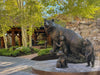
Grizzly 399 Monument Unveiled at National Museum of Wildlife Art
Grizzly 399 was born in 1996. She successfully birthed 18 cubs in her lifetime including a rare four-cub litter during the COVID-19 pandemic. Her last cub was born when Grizzly 399 was 24, a record birthing age for the species. She represented more than numbers. Often seen with her cubs near roadsides across Grand Teton National Park and...
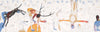
San Francisco's de Young Museum Debuts Reinstalled Arts of Indigenous America Galleries
San Francisco’s de Young museum debuted completely refreshed Arts of Indigenous America galleries on August 26, 2025. Artworks on view span from Alaska to Central America. The presentation begins, however, in California. The Fine Arts Museums of San Francisco – the de Young and the Legion of Honor – are located on land unceded by the Ramaytush Ohlone, the original inhabitants of what is now the San Francisco Peninsula. The inaugural installation in the first gallery explores the interconnection between art, ceremony, and the land in the Hupa, Karuk, Tolowa, Wiyot, and Yurok communities of northwestern California. “Rooted in Place:...

Marie Watt's Big Week
How’s this for a good week? On September 9, a press release went out announcing Marie Watt (b.1967; Seattle) as one of two winners for this year’s Heinz Awards for the Arts. The Heinz Awards recognizes six individuals annually, two each working across the arts, the economy, and the environment. Artists are selected after having produced a body of work displaying excellence enhancing the human experience. Established in 1993 to honor the memory of U.S. Senator John Heinz, the selection includes a $250,000 unrestricted cash prize from the Heinz Family Foundation. Being so honored would serve as the achievement of...
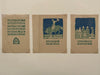
Gustave Baumann Beyond Woodblock Prints
Art lovers have a deep roster to choose from when picking a favorite artist for representing northern New Mexico’s landscape. In my starting five along with Louisa McElwain (1953-2013) and Victor Higgins (1884-1949) is Gustave Baumann (1881–1971). Baumann’s woodblock prints perfectly capture the soft yellows of the region’s turning cottonwoods, aspens and chamisa. He nails the adobe, the sky, the hollyhocks. Opposite McElwain’s dramatic movement and grandeur, Baumann’s landscapes are still, produced on a small scale, possessed of an undeniable warmth. Somehow, they’re inviting. Like northern New Mexico itself. I was astounded to learn how much more artwork besides the...
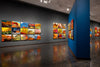
James Lavadour is Nature
James Lavadour is nature. In his artwork. Lavadour’s tumultuous, abstract landscape paintings depict the effects of fire and wind and erosion on the land. Powerful, dramatic forces. Forces he mirrors in paint with a brush in his hand. The surface is the land, the paint the elements, Lavadour the forces of nature and time. "In paint there is hydrology, erosion, mass gravity, mineral deposits, etc.; in me there is fire, energy, force, movement, dimension, and reflective awareness,” Lavadour has said. Brushed, poured, scraped, and dripped, Lavadour’s painting echoes the movements of earth, water, and stone, reflecting the elemental energy of...
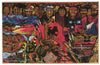
National Hispanic Cultural Center Breaks New Ground in Art History with "Voces del Pueblo"
You can Google anything. Or so it seems. When Ray Hernández-Durán tried Googling information about first generation Chicana and Chicano artists in New Mexico at the beginning stages of researching an exhibition on the subject, the professor of Spanish colonial art and architecture in the University of New Mexico’s Department of Art was stunned to discover how little information was available. “Everybody knows bultos and retablos and santos. They know the Pueblo artwork. They know the white modernists, but when it came to this generation of the Chicano movement, there was nothing I could find,” Hernández-Durán said. “I Googled the...
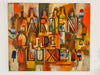
Humor in Contemporary Native American Art
Humor. Dark humor. So dark you could develop film in it. Anyone looking for knee-slappers at “Reservation for Irony: Native Wit and Contemporary Realities,” an exhibition of Native American art at the Institute of Contemporary Art in Santa Fe (906 S. St. Francis Dr.), won’t find any. Well, maybe David Bradley’s (b. 1954; Minnesota Chippewa) Land O’ Bucks Revisited (1990-92). Bradley’s send-up of the idealized Native woman on old Land O’Lakes butter packaging takes her commercialized features to absurd, buxom levels, turning the sweet, feathered, fetishized “Indian maiden” into a tawdry pin up girl. Bradley’s vivid, densely composed paintings critique the commodification...
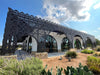
Visiting San Antonio's World Heritage Center
San Antonio celebrated 10 years of World Heritage Site designation for its five Spanish missions by opening a World Heritage Center in February of 2025. The project was a collaboration between the city and the mission-descended community. The Center does not attempt to recreate the missions – they still exist – its purpose is distilling their character in a contemporary way, introducing visitors to what will be experienced on site at the missions, and acting as a gathering and celebration space for the local residents. Admission is free. San Antonio’s missions continue being used by residents as churches to this...
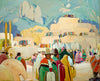
Anschutz Collection Provides a Double View into the Past
Visiting Denver’s American Museum of Western Art – The Anschutz Collection, is to see Western art and the West the way both used to be seen: narrowly. The personal art collection Denver-based billionaire Phillip F. Anschutz (b. 1939) amassed between the 1960s and early 2000s presents a mindset of collecting as much as individual artworks. A museum of an idea of Western art. Among the hundreds of paintings over three floors hung cheek to jowl salon style, I counted one by a Native American artist, a classic Fritz Scholder portrait depicting an obscured Native figure with an American flag draped...
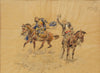
Exhibition Examines Influence of Western Art on Western Movies
Fort Worth’s Sid Richardson Museum, specializing in the artwork of Charles Russell (1864–1926) and Frederic Remington (1861-1909), presents “The Cinematic West: The Art That Made The Movies,” an exhibit examining the influence of these two most famed Western artists on the silent film era and the early mid-century Golden Age of Western cinema. The “Cinematic West” explores the connection between Remington and Russell and the birth of Hollywood’s Western film genre demonstrating how their depictions of the American West—its landscapes, characters, and mythology—directly shaped early Western films' visual language and narrative conventions. The Museum’s access to one painting in particular...
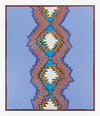
Art Bridges and Crystal Bridges Museum of American Art Add Work by Contemporary Native Artists
A movement or a moment? That’s the nagging question – the doubt – lingering in the back of the head of advocates for contemporary Native American art. Is the genre’s recent mainstream attention a lasting movement or a fleeting moment? Since America’s social awakening to historic injustice in the aftermath of 2016’s Dakota Access Pipeline protests and George Floyd’s murder in 2020, contemporary Native American art’s profile has experienced a boom. Curators and museums looking to highlight stories of oppression and resistance found Native artists telling them in fresh and insightful ways. Contemporary Native artists are being featured in group...