'Visualizing K’é’ with Marwin Begay at Wheelwright Museum
By Chadd Scott on
For Marwin Begaye (b. 1970; Navajo Nation) it starts with birds. Birds are the foundation of his art making. His connection and interest goes back to childhood.
“When you herd sheep, there's nothing, but you, sheep, and the birds, and the clouds, and that curiosity,” Begaye said.
Begaye’s curiosity in birds encouraged him to study their significance to Navajo culture later in life. He spoke to elders. He researched. He read. Anthropological reports from the Navajo Nation in the late 1800s and early 1900s continually referenced Hastíín Klah (1867-1937).
In Navajo, “hastíín” means “mister;” “klah” refers to the left-handed. Hastíín Klah: Mister Lefthand.
Klah was a revered Diné ceremonial leader and knowledge keeper as well as a prolific rug weaver and sand painter.
The birds led Begaye to Hastíín Klah and the voice recordings Klah made of Navajo oral histories recorded between 1927 and 1932. The recordings were a collaboration between Klah and Mary Wheelwright; they became the foundation for the Navajo House of Prayer museum they co-founded, first opened in 1938, now known as the Wheelwright Museum of the American Indian in Santa Fe.

The Wheelwright Museum Hastíín Klah Recordings
Marwin Begaye was aware of the Wheelwright’s recordings and, understandably, was interested in listening to them. That’s easier said than done.
“These recordings are not for everyone which is why I had to get permission (from Navajo Nation) because the information is sacred,” Begaye explained.
Permission granted, he and museum officials selected a random assortment of recordings to review.
“It was a very powerful experience. One, just to hear his voice, to hear him talking about the information,” Begaye said. “It made me even more curious.”
What was on the recordings, all spoken in Navajo?
“They convey a connection to the relationship that we have with the mountains, with the air, with the rain, with the clouds,” Begaye explained. “There were some songs that were familiar, that I have heard during ceremonies.”
The recordings energized him.
“I'm sketching like you wouldn't believe,” Begaye shares in a video accompanying the exhibition. “That's how I process information. All of my dreams, everything was about this project. I started not holding back in trying to get these compositions to work.”

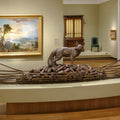
Installation view of 'Visualizing K’é’ at the Wheelwright Museum of the American Indian. Photo by Chadd Scott.
Critical to Begaye receiving permission to hear the recordings, and then produce artwork from what he heard, was his intention to not literally represent what was shared on them.
“I wrote in my proposal that I would stay away from figurative work, keeping the abstract, not to depict the narrative in the information. That would allow me to have more of a conversation,” Begaye said. “(Through abstraction) I was able to deal with the cadence of how (the oral histories) were delivered. I would turn that into line. I would see colors shifting. It allowed me to play with the layers more because that’s what happens when you witness these ceremonies. There's these layers as things kind of fade away and things are kind of merging to the front. I was able to capture those layers.”
He discovered some of the shapes he’d been using for years in his artwork were recalled by what he heard on the tapes.
“To find out the deeper meaning of these shapes was huge,” Begaye said on the exhibition recording. “I used that shape in the right context in this piece, or I should stop using that shape within this context because they don't go together.”
After listening to a selection of the recordings, Begaye produced six black-and-white drawings in response to the experience, converting what he heard into abstract artworks. Those drawings can be seen during “Visualizing K’é,” an exhibition of the drawings on view through March 28, 2026, at the Wheelwright Museum.
Drawings that take most museum visitors as close to the Hastíín Klah recordings and Navajo oral histories and ceremonies as they’ll ever come.

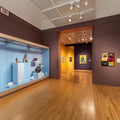
Installation view of 'Visualizing K’é’ exhibition at the Wheelwright Museum of the American Indian. Photo by Chadd Scott.
Visualizing K’é
How do you picture what cannot be seen?
How do you draw what can only be heard and then felt?
“These pieces that I've created for this exhibition are about my exploration understanding the language of Navajo songs and prayers,” Begaye explains on the exhibition video. “It's about documenting through shapes, through lines, that feeling, hearing something that hits to the core.”
Visualizing k’é.
Along with the six black-and-white paintings inspired by the recordings, the Wheelwright exhibition displays nine of Begaye’s spectacular bird portraits. Look for the repeating symbols: cloud forms, stars, diagonal patterns, triangles, floral designs, diamonds. Each of these references a specific person, place, event, story, or legend from Navajo history. The Warrior Twins. Spider Woman. Changing Woman. White Shell Woman.

Marwin Begaye, 'Morning Greeting (Meadowlark),' 2024. Screen print, woodblock, ink, and acrylic on dyed paper on view at Wheelwright Museum of the American Indian. Photo by Chadd Scott.
Begaye’s black-and-white screen print Transformation (2025) shows Monster Slayer’s lightning arrow shooting monster bird, splitting it in two. One half becomes the eagle, the other, the owl. Birds.
Pick up the Wheelwright’s small exhibition catalogue for “Visualizing K’é” at the front desk for more decoding insights.
“The essence of this exhibition is understanding that idea of k’é; k’é meaning the relationship, that reference to self and words that becomes important to understanding these shapes that appear in my work,” Begaye said.
The exhibition catalog defines the concept as, “both a noun and a verb in Diné bizaad (the Navajo language), k’é is an active organizing principle that refers to the process of maintaining kinship.”
Abstraction as an embodiment of knowledge, shapes and line encoding specific cultural meanings carried over from the recordings.
“There are relationships between shapes and characters rooted in our philosophy,” Begaye writes in his artist statement for the exhibition. “These shapes are regularly found within our many forms of creativity such as rugs, jewelry, and adornment – even how we tie our hair. Navajo philosophy has different ways of learning and expression, including oral history, songs, stories, art, and language. The relationships between these many forms of cultural expression produce an understood Navajo aesthetic system.”
A visual language beyond letters.
Begaye shares a story in the exhibition video about shapes found within Navajo cultural objects, the “Navajo aesthetic system.”
“My grandmother was a weaver, and I asked her, ‘How do you know what shapes to use in your rugs,’” Begaye recalls. “She said the person has to dream about it. I remember thinking these images are gifts.”
So too are the images he’s created for “Visualizing K’é.”
Images that return him to his birds.
“The foundation of my work are the birds,” Begaye said. “I'm still finding out how they played the different (cultural) roles and so with some of the images in ‘Visualizing K’é,’ I took out the birds and just let the emotion and the lines and the shapes and different layers be the voice.”
For Marwin Begaye, it starts and it ends with birds.
“It's all of my loves,” he said. “It's my love of line, my love of color, and my love of birds.”
On October 24, 2025, the Wheelwright hosts a tour of ‘Visualizing K’é’ with curator Hadley Jensen. On November 1, 2025, Begay joins Jensen for another tour of the exhibition. Both tours begin at noon and are included in museum admission. On November 2, admission to the Wheelwright is waived and Begay will host a printmaking workshop for $10.