Portland Art Museum Opens Expansion with Focus on Northwest Art
By Chadd Scott on
The Portland Art Museum opened its $110-plus million Mark Rothko Pavilion to the public on November 20, 2025. The glass building provides a new main entrance for PAM, new terraces and display spaces, a new gift shop and café, and connects its two historic buildings.

Portland Art Museum's Grand Gallery inside Mark Rothko Pavilion.
Mark Rothko (1903-1970), icon of mid-century New York Abstract Expressionism, seems like a random figure to name anything in Portland after until informed that he grew up there. His family emigrated from Latvia when he was 10. Rothko took classes at the Museum’s art school. He attended high school about a half mile from PAM, which also hosted his first solo exhibition in 1933.
Some 50 Rothkowitz descendants continue living in the area and a small Rothko painting from 1930 at PAM, likely depicting Portland, is signed “M. Rothkowitz.” A new lending agreement will see the Rothko family loan a rotation of major paintings from its private collection to PAM over the next 20 years for display in a specially designated gallery space.
From monumental figures with roots in Portland who achieved international acclaim elsewhere like Rothko and Carrie Mae Weems (b. 1953; Portland), to contemporary art superstars with stops in Portland like Mickalene Thomas (b. 1971), contemporary art superstars with studios in Portland including Wendy Red Star (b. 1981; Apsáalooke) and Marie Watt (b. 1967; Seneca Nation of Indians) and Otis Kwame Kye Quaicoe (b. 1988; Accra, Ghana), plus historic regional artists and rising contemporary voices, no encyclopedic art museum in America puts a greater emphasis on its region than PAM.
PAM is the Portland art museum, not simply an art museum in Portland.
“When I came here in ’06, globalism was very prominent,” Brian Ferriso, The Arlene & Harold Schnitzer Director of the Portland Art Museum, said. “The art fairs–Basel, Miami–we're taking a grip of the museum world, especially in modern and contemporary art, and almost creating this Starbucks of museums. You start to go around to these museums, you see the same thing, the same thing.”
There’s nothing wrong with the same thing. Everyone loves seeing a Monet Water Lillies–PAM has a great one–or Georgia O’Keeffe or Kehinde Wiley, the problem becomes when the same thing is the only thing. Art museums mirroring commercial FM music radio stations playing the same handful of songs from the same handful of artists, all carefully vetted and approved by boards and gatekeepers to appeal to mass audiences with no acknowledgement or recognition of local tastes and interests.
Notoriously quirky Portland, thankfully, went another way.

Claude Monet Water Lilies painting on view next to two paintings of eastern Oregon at Portland Art Museum.
A Focus on Northwest Art
“I came here and interviewed for the job, and I was like, ‘Oh my goodness, there are artists here I've never seen before,’” Ferriso remembers. “Portland very much embraced its sense of place, the artists who were here in addition to the global artists. You will feel and see and understand Oregon and this part of the world in a different way through this art museum.”
Much credit for that goes to Arlene Schnitzer (1929-2020), namesake of the endowed Arlene & Harold Schnitzer Director of the Portland Art Museum position. Arlene Schnitzer, and the Schnitzer family, have their names on cultural institutions and civic buildings across Portland and throughout the Pacific Northwest.
You’d be hard pressed to find another family anywhere in America whose philanthropy has done more to uplift a city’s cultural institutions than the Schnitzer’s in Portland. The family gave $13.5 million toward PAM’s latest capital campaign to construct the Rothko Pavilion. Arlene’s son Jordan D. Schnitzer carries on the support. While expanding the Schnitzer real estate development empire, he’s built perhaps the finest private collection of modern and contemporary art prints in the world, artworks his foundation loans liberally across the country, including to PAM presently.
Arlene Schnitzer had more than money, she had taste. She owned one of the city’s first art galleries and amassed a fine art collection. She also had a vision, a vision for the Portland Art Museum to uplift the best regional artists.
“Arlene went to art school here and she became friends with all these artists. She loved the creative community,” Ferriso said. “She was very specific that she was going to create a curator of Northwest art, an endowment for Northwest art, an endowment for Northwest acquisitions, an endowment for a program, and an endowment for a whole wing devoted to Northwest art. It was very purposeful.”
“Northwest” doesn’t equal “second rate.”
Artists from the region are routinely overlooked, but not overmatched. Solo exhibitions on view now for Rick Bartow (1946-1915; Wiyot) and Mary Henry (1913-2009) in PAM’s Northwest Wing prove that.
Pacific Northwest Highlights at Portland Art Museum
The Portland Art Museum’s entire collection was reinstalled to coincide with the opening of the Mark Rothko Pavillion. A stunning group of beaded flat bags made across the Columbia River Plateau in the early 20th century stands out as a highlight.
The bags were collected by Arlene Schnitzer and she was especially fond of heart-shaped bags with rose decorations–appropriate for Portland, the Rose City. Appropriate too as the bags were acquired from Rose Quintana, longtime co-owner of Quintana Galleries, Portland’s leading gallery for Native American art from the 70s through the 2010s. The gallery carries on on-line and is run by Rose’s daughter.

Arlene Schnitzer's collection of beaded flat bags from the Columbia River Plateau on view at Portland Art Museum.
As an aside, PAM employs arguably the most well-respected and influential curator of Native American art in the country: Kathleen Ash-Milby (Navajo). Milby is responsible for the recent Oscar Howe retrospective that uplifted his career and Jeffrey Gibson’s (b. 1972; member of the Mississippi Band of Choctaw Indians and of Cherokee descent) presentation representing the United States at the Venice Biennale in 2024.
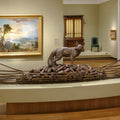
PAM’s Rothko Pavilion features two Gibson artworks, collaborations with Portland’s Bullseye Glass. They overlook the Pavilion’s striking Grand Gallery, a soaring, light-filled atrium for the display of large sculptural work. A 10-foot Dzunuk’wa Feast Dish from approximately 1900 carved in cedar and painted by Charlie James (1870-1938; Kwakwaka’wakw) leaves a dramatic impression. It lies next to a fire engine red glass sculpture by Dale Chihuly (b. 1941)–another Pac Northwest artist (Tacoma) with global renown.
Inside PAM’s Pacific Northwest galleries, the same exhilaration of artistic discovery Ferriso experienced nearly 20 years ago can be had by visitors as one delightful painting after another from artists with names unfamiliar to most are found. Twentieth century landscapes from around Oregon will be especially enjoyable to devotees of Western art. Even within our regionally focused genre, the Pacific Northwest gets short changed.
Not at the Portland Art Museum.
At PAM, Northwest is best, and the artists back it up.