Gallup, NM's County Courthouse Doubles as an Art Museum
By Chadd Scott on
Are art and culture amenities in civic life like swimming pools and tennis courts? Or are they essential, like clean air and public transportation?
The United Nations lists art and culture as universal human rights. In the aftermath of World War II, a complete collapse of humanity, the newly formed United Nations established the “Universal Declaration of Human Rights.” Article 27 states: “Everyone has the right freely to participate in the cultural life of the community, to enjoy the arts and to share in scientific advancement and its benefits.”
Enjoyment of the arts as a human right.
Art and culture defined as essential to the human experience.
At one point in American history – but only one point – art and culture and supporting artists and cultural workers was seen as essential to American life. To sustaining and rebuilding American life. Essential like public education. Not merely an amenity, nice to have, but first to go when budgets are tight.
That one glowing period of robust American investment in public art and artists occurred between 1935 and 1943 – the Great Depression – under the administration of Franklin D. Roosevelt. It was part of the Works Progress Administration, Roosevelt’s massive, nationwide jobs program. Those jobs went to artists, too.
The best and most promising artists of the day. Artists whose work had and would shape the cultural foundations of the country and the world. Artists like John Steuart Curry, Stuart Davis, Willem de Kooning, Philip Guston, Allan Houser, Gene Kloss, Jackson Pollock and Lee Krasner, and Jacob Lawrence. A partial list from the first half of the alphabet.
Federal support was also provided to architects, playwrights, poets, photographers, and musicians.
A great anecdote here courtesy of the Public Broadcasting System, an essential cultural resource in America that has had its funding obliterated by the Trump regime and Congress: when federal support of artists under the WPA was questioned, director Harry Hopkins answered, “Hell! They’ve got to eat just like other people.”
Indeed they do.

The Works Progress Administration had numerous sub-programs supporting the arts, the most prominent of which was the Federal Art Project. It employed more than 5,000 artists at its peak in 1936. According to Encyclopedia Britanica, it “produced 2,566 murals, more than 100,000 easel paintings, about 17,700 sculptures, nearly 300,000 fine prints, and about 22,000 plates for the Index of American Design, along with innumerable posters and objects of craft. The total federal investment was about $35,000,000.”
That’s about $830 million in today’s dollars.
WPA arts programs led to the creation of the National Foundation for the Arts and the National Endowment for the Humanities, two more essential federal arts support programs having their funding obliterated by the reigning anti-culture administration.
WPA Art in Gallup, NM
Works Progress Administration artworks did not go to museums or collectors, they decorated public buildings across the country. Courthouses and post offices. Art for the public. Art in civic spaces. Art as an essential aspect of life in America.
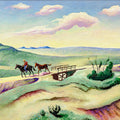
Gallup, New Mexico hosts an extraordinary collection of extant WPA artworks in its courthouse and public library. The town’s McKinley County Courthouse stands as a shrine to the WPA and public art. The building itself was a WPA project.
Gallup New Deal Art Project Director Rose Eason hosts free guided tours of Gallup’s WPA artworks on the last Saturday of each month; tours will not be held in November or December. Visit the organization’s website for 2026 schedule information. Eason has also developed a fantastic Gallup WPA art virtual museum for those unable to visit in person.
The next time you’re in a courthouse in America, as likely as not to be a sterile administrative building designed wholly for function, lacking any sense of design or decoration, think about the McKinley County Courthouse and how your experience that day would be elevated by art like it has.
Imagine walking into a courtroom and seeing something like Lloyd Moylan’s (1893-1963) 360-degree Untitled (Allegory–History of the Region) (1940) mural surrounding you. Welcoming you. Moylan is the most prominently represented artist in the city’s collection. He believed public art had the capacity to, “bring about what’s growth provoking in the spirit of humanity.”

Lloyd Moylan mural inside New Mexico's McKinley County Courthouse. Photo by Chadd Scott.
Lord knows America’s spirit of humanity needs a great deal more growth in 2025 from where it’s recessed to.
Art and culture can do that.
Moylan’s mural shares the story of north central New Mexico from prehistoric times – notice the pterodactyls – to his present day. The Pueblo Revolt of 1680 features prominently over an exit door. A section recalls the Navajo Long Walk, the western version of the Trail of Tears. One Navajo woman painted under the looming watch of a U.S. soldier is the only figure among those in Moylan’s mural to make eye contact with onlookers – you.
Easel paintings by Moylan and others – including Gene Kloss – line the hallway outside the courtroom.
Despite being a public building and public space, access to the historic, second-story courtroom and areas just outside are controlled by police who don’t give high priority to arts visitors so your best opportunity to view the works comes via Eason’s tours.
Navajo Sand Painting
On the courthouse’s first floor – also with limited public accessibility – an equally extraordinary artwork can be found, along with a mystery. Painted throughout the hallways are replica Diné (Navajo) sand paintings. Window Rock, AZ, the political/governmental capital of Navajo nation, sits 20 miles from Gallup.

Replica sand painting by a Diné artist once known inside McKinley County New Mexico Courthouse. Photo by Chadd Scott.
The identity of the painter is sadly no longer recalled. Eason’s research has uncovered one newspaper account from 1939 when the courthouse was being built mentioning “a young Navajo painter” in coordination with the project. She continues searching for his identity.
Whoever it is did a remarkable job. This was no “Sunday painter,” making the artist’s anonymity all the more vexing. The color, the line, the composition are all first rate. Professional. How was it possible this artist’s name was not recorded, or that his talent didn’t lead him to other projects for which this one could be identified by?
The first answer to that question can’t be attributed to simple racism. Other Native artists including Houser and Harrison and Timothy Begay were credited by name for their contributions to the WPA. They have signed paintings across the street from the courthouse in Gallup’s public library.
Along with the newspaper article, Eason’s study of Navajo art and culture does leave her nearly certain the painter was Diné, not an outside artist copying the sand painting style.
“The design scheme and the way that the symbols are employed in this space is the same as how they were used in actual sand paintings,” she said. “There's understanding there of the symbology and of the meaning, and they're not just applied as if they're decoration. They're applied in a manner that bestows a sense of protection or blessing on the space.”
Eason’s tours offer fascinating, detailed explanations of the various painted symbols across floor.
“The artist is taking guardian symbols like the ripener beetle or the buffalo people and placing them on either side of the doorways. There's a sun and a moon on either side of the (public entry) lobby, the two thunder beings on either side of the staircase,” she explains. “They always come in pairs, and they're always being used to flank passageways or doorways. It's done in a really cohesive and thoughtful manner that indicates, again, some level of deeper understanding of these designs. They're not just designs. They are symbols and they carry resonance.”
Understanding someone outside the tribe brought to Gallup as a WPA artist at that time would be exceedingly unlikely to have.
Equally as enticing, the painter was clearly an artist. The level of skill could not have been achieved simply by any Diné person familiar with seeing sand paintings.

Replica sand painting by a Diné artist once known along with tilework and Spanish colonial style tin chandelier inside McKinley County New Mexico Courthouse. Photo by Chadd Scott.
“They don't look like copies from a book of some kind or a photograph,” Eason explained. “The way that the artist lays out the scheme and then has those two sand paintings that look more like Western art in a sense (on opposite sides of the former public entrance), and one is quote/unquote, traditional or classic, and the other is a whole new conception of sand painting also leads me to believe that it was an artist working in this space and really responding to the assignment, thinking about the tradition he was coming from and advancing it, being creative in this that process.”
Someone – many people – in the 80-plus years since the paintings were produced had the good sense not to paint over the artworks when repainting the hallways. It seems obvious now, but great public artworks – including WPA artworks – have been painted over, removed, demolished and otherwise destroyed by a society that doesn’t value them. That views art as an amenity.
More information and examples of Diné sand paintings can be found at the Gallup Cultural Center five blocks from the courthouse. Admission there is free as well.
Also unmissable on the courthouse’s first floor are vibrantly colored waist-high, corner-to-corner decorative tiles with Pueblo motifs, and replica Spanish colonial style painted tin chandeliers, referencing the area’s invasion by the Spanish in the late 1500s and 1600s. These artists were also uncredited and remain unknown today.
Taken together – the Moylan mural, the sand paintings, the easel paintings, the tile work, the architecture of the building – one of the most remarkable non-art specific public art spaces in the country takes shape. Museum caliber.
Eason and colleagues around Gallup are lobbying toward that end, hoping to convince city officials to move government offices and functions out of the building and convert it into a museum.