Loveland, CO: Sculpture City, USA
By Chadd Scott on
With all due respect to the great Western wildlife painters from Carl Rungius to John Potter, animals in sculpture hit different than their two-dimensional counterparts. I don’t feel the same about figurative painting vs. sculpture, but seeing animals embodied in three dimensions in stone or bronze or glass gives a sense of their stature flat depictions simply can’t.
For quality and quantity of wildlife sculpture, two destinations stand out: the National Museum of Wildlife Art in Jackson, WY and the Benson Sculpture Garden in Loveland, CO.
The National Museum of Wildlife Art is a straightforward art museum with a focus, obviously, on wildlife art. It specializes in Western subject matter, particularly Rungius paintings. Its location opposite and overlooking the National Elk Refuge adjacent to Grand Teton National Park makes for an animal-lovers dream come true inside and out.
Loveland’s artistic roots extend back to the 60s. The town’s Colorado front range location 50 miles north of Denver attracted hippies and outdoor enthusiasts. Highway 34 connects the city to Rocky Mountain National Park’s east entrance in Estes Park 30 miles to the west.
Loveland also attracted a Hewlett Packard manufacturing plant in 1959. In 1965, a LEGO manufacturing facility also opened there.
Some of those HP and LEGO engineers and employees, tinkerers by nature, skilled in the making of things with their hands, took an interest in sculpture.
Coincidentally, over the same period, three sculpture foundries developed in Loveland. Foundries to produce high-quality fine art sculptures and public monuments – especially large pieces – are few and far between in America. Loveland became a national epicenter for the creation of sculpture. Still is. Talk to a sculptor working in bronze anywhere in the country today and they’ll tell you all about Loveland’s foundries.

Parker McDonald, 'Taking Watch,' cor-ten and stainless steel. On display at the Benson Sculpture Garden. Photo by Chadd Scott.
“Sculpture in the Park”
Loveland’s sculptural “big bang” came in 1984 with the debut of “Sculpture in the Park” Show and Sale. The event was created with the collaboration of five Loveland sculptors: George Lundeen, Dan Ostermiller, George Walbye, Fritz White, and Hollis Williford, along with representatives from the City of Loveland and Chamber of Commerce, and community members. The weekend festival showcased and sold works from the Loveland sculptors and their circle of colleagues. Approximately 2,000 people attended that first festival with $50,000 of sculpture from about 50 artists sold.
From those humble beginnings evolved the largest outdoor juried sculpture show and sale in the U.S. Revenue generated from the event, then and now, goes toward the purchase of sculptures for placement in Loveland.
Much of that sculpture is wildlife. Most of which can be seen on permanent outdoor display at Loveland’s 10-acre Benson Sculpture Garden where the festival also takes place each August.

Vince Valdez, 'The Chase,' bronze, 1988. On view at Benson Sculpture Garden. Photo by Chadd Scott.
Doubling down on “Sculpture in the Park,” also in the early 1980s, local residents and officials made a conscious decision to distinguish their city as an arts haven, establishing the state’s first municipal “percent for art” program. The funding model has been borrowed by arts meccas like Seattle and Santa Fe, NM, and has subsequently been recreated across Colorado.
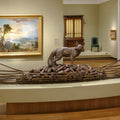
The public art funding measure coincided with a local building boom, resulting in a collection that now exceeds 500 pieces – about two-thirds sculpture – on view throughout the town. Aside from sculpture, a fantastic Clyde Aspevig winter landscape hangs behind the ticketing desk at the Loveland Museum.

Steve Kestrel, 'Spectre of Ancient Pathways,' bronze, 1989. On display at the Sculpture Garden. Photo by Chadd Scott.
Visiting Benson Sculpture Park
Benson Sculpture Park is roughly three miles from Loveland’s little downtown. Nearly 200 sculptures valued at over $5 million are on permanent, public display there. Entry is free. The park is mostly flat with paved sidewalks making it unusually accessible for an outdoor venue.
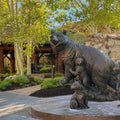
Wildlife sculptures abound, constituting about 80% of all artworks on view. Western wildlife in particular: moose, bighorn sheep, bison, wolves, rainbow trout, and especially, mountain lions.
Most people will never see a mountain lion in the wild; these artistic depictions at life size – sometimes larger – in three dimensions bring the animals safely into human proximity. The rippling muscles in their haunches. The paws, which can’t be that big in real life, can they? Their tales, which can’t be that long and thick in real life, can they?
Art lovers and animal lovers will flip over Benson Sculpture Park.
When graced with a brilliant blue Colorado sky overhead and the snow-capped Rocky Mountains in the distance, give yourself hours to linger in the outdoor museum.

Parker McDonald, 'Taking Watch,' cor-ten and stainless steel. On display at Benson Sculpture Garden. Photo by Chadd Scott.
Make your sculptural odyssey to Loveland complete with a tour of Art Castings foundry available Thursday mornings at 9:30 for only $5. Guests will be led through every step of the sculpture manufacturing process from molding to patina application. Disney Pixar fans will be particularly delighted.
Smell the wax. Feel the weight of a brick of bronze before it’s melted down. Stick your hand in a vat of sandblasting sand. Watch the foundry’s artists and technicians bring the sculptors’ vision to life as they work.
Lastly, equally remarkable and unexpected in Loveland, save time for the Chapungu Sculpture Park at Centerra, an outdoor display of 82 monumental stone sculptures from Zimbabwean artisans spread across 26-acres of natural and landscaped gardens – the largest single site collection of stone sculpture from Zimbabwe in this country.