When Ansel Adams Photographed Los Angeles
By Chadd Scott on
In the winter of 1940 and ‘41 Ansel Adams received an assignment from “Fortune” magazine to photograph Los Angeles, specifically workers in the city’s booming aviation industry. Military aviation. Giants of weapons manufacturing like Douglas, Lockheed, and Northrop.

Ansel Adams, 'Lockheed Plant in Burbank From Afar,' view3. Courtesy Los Angeles County Public Library.
Adams didn’t much care for the job or the finished product. His autobiography mentions how miserable the conditions were during the three or four weeks he was there and how the constant drizzle robbed him of the tonality and color and light he was used to working with in the expansive wilderness settings he’d become known for. He took the gig because he needed the money. Ansel Adams wasn’t a world-famous photographer in 1941.
After completing the assignment, Adams sent all the negatives to “Fortune,” more than 200. The magazine used about a dozen in the article then shipped all the negatives back to Adams.
It seems as though he just put them in a drawer and filed them away. Out of sight, out of mind. Only when he moved from San Francisco to Carmel in 1962 did he “rediscover” the images. Upon doing so, he offered them to the Los Angeles County Public Library with an accompanying letter.
“He was not happy with the work, and he expresses this in the letter,” Chris Rupp, interim director at the Westmont Ridley-Tree Museum of Art in Santa Barbara, said. “He basically said while he doesn't like the images, and didn't think they were super successful, they do have a lot of historical value; he recognized that. He even says in the letter if the city doesn't want them, or the public library doesn't want these images, they can find their way to the incinerator – I'm totally fine with that.”
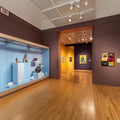
Fortunately, the city didn’t send Adams’ negatives to the incinerator and while they’ve scarcely been seen publicly in the 65 years since he took them, they are on display now at the Westmont Ridley-Tree Museum of Art in an exhibition Rupp curated, “Beyond the Wilderness: Ansel Adams in 1940s Los Angeles,” through March 28, 2026.
 Ansel Adams, 'Lunchtime for Douglas Company employees,' view 7. Courtesy Los Angeles County Public Library.
Ansel Adams Los Angeles Photographs
Rupp only became aware of Ansel Adams LA series in 2008 watching an episode of the PBS show “California’s Gold with Huell Howser.” The program reveals hidden aspects of the state’s history, people, and culture.
LA’s industrial past qualifies.
Unlike the city best known today for Hollywood and celebrity and wealth and glamour, LA had a pronounced industrial side mid-century. The LA Adams captured in the lead-up to World War II was working class. Factories. Gritty even. More Cleveland than Beverly Hills.
Bowling leagues.
Out of the 217 images Adams took, two images that have double or triple exposure. One of them comes from a bowling alley where Adams photographed the aviation employees enjoying some downtime after their shift. The images show workers in the motion of throwing their balls down the alley.
“You could say, ‘Oh, his camera jammed and it double exposed,’ but why did it double expose in this incident where there's movement,” Rupp said. “He's capturing motion in a very different way. All the other 217 images, his camera didn't jam. Maybe it's a coincidence. Maybe he was being very experimental and doing something he wouldn't normally try.”
Adams was too good for coincidence.

Ansel Adams, 'Brown Derby on Wilshire Boulevard,' view 1. Courtesy Los Angeles County Public Library.
It’s also important to recognize that he was more than exclusively a landscape photographer. Yes, he’s best known for sublime images of pristine wilderness, the Sierra Nevada Mountains, Yosemite, the Grand Tetons, and Grand Canyon, but he also produced a devastating series of pictures from the Manzanar Japanese-American concentration camp in 1943.
Nature wasn’t Adams’ only gear.
“The way our gallery is set up, we have an entry gallery that you come right into, and then a main portion of our gallery. In our entry gallery, we borrowed a number of original Ansel Adams photos, some of his most famous ones,” Rupp explained. “The juxtaposition of these images in the entryway gallery with the ones in the main gallery of LA, there is a big, striking difference. I've had a number of people come in and say those images don't look like Ansel Adams images.”
They don’t. Not the Ansel Adams pictures reproduced endlessly in coffee table books and on posters and calendars.
Beyond subject matter, another reason they don’t look like Adams is because the LA images only exist on negatives. He did not make finalized prints of these images. The Westmont Ridley-Tree Museum did that, making prints from high resolution digital scans of the negatives.
“They're removed from Ansel; they're his straight shot,” Rupp said. “He was known for doing a ton of wet, dark room work to get his images to look a certain way. That part is taken out. We don't know how Ansel would have printed them had he done it himself. They look different in tonality. They don't have the rich black and the whitest white like he normally would have.”
Adams only made one print for wider distribution from the 217 LA series photographs: the Angel of Sorrow statie at the Sunnyside Cemetery in Long Beach. Interestingly, during the assignment, Adams photographed far and wide around LA beyond the factories and hangouts of the aviation workers. In doing so, he was introduced to the giant wooden oil derricks – many five and six stories tall – erected everywhere across the city. Their presence made an impact.
“LA at the time had thousands upon thousands of oil wells throughout the valley and big towers, wooden derricks, that were really an eyesore. He latched on to that,” Rupp said. “A lot of images have oil derricks in them, and it's not just because maybe there was an oil derrick there. He purposefully wanted to get oil derricks in the background of certain images. One image called Kid’s Paradise has an oil derrick in the background; that juxtaposition of is this really kids paradise when there's oil derricks here? The image he ended up printing himself of the Angel of Sorrow in the cemetery, the Angel of Sorrow is the main part of the frame, but the whole background of the image is all oil derricks.”
Again, Adams was too good a photographer for coincidence. This is commentary. Commentary on the societal and environmental costs of oil extraction. Commentary that while commonplace today, was a good 30 years ahead of its time in 1940, particularly with America gearing up for World War II, explosive economic growth, and superpower status, none of which would have been possible without full exploitation of the country’s unrivaled natural resources, oil primary among them.
Much of what Adams photographed around LA is gone. Some remains. One prominent example is the May Company building at the corner of Wilshire and Fairfax that is now the Academy Museum of Motion Pictures. Only the lettering out front has changed on the historic landmark building since Adams photographed it.
Rupp and a colleague visited LA attempting to recreate the shots Adams took for “Fortune” magazine. Those efforts can also be seen in the exhibition which is free to visit.