60 Years of Gemini G.E.L. Prints in Los Angeles
By Chadd Scott on
The biggest names in late 20th and early 21st century art have come through the doors at Gemini G.E.L.’s Los Angeles printmaking workshop. Roy Lichtenstein, Ellsworth Kelly, Jasper John’s, Frank Gehry, Ed Ruscha, David Hockney to scratch the surface. John Baldessari, Philip Guston, Julie Mehretu, Bruce Nauman, Isamu Noguchi, Claes Oldenburg, Robert Rauschenberg, Frank Stella, Richard Serra. Those type folks.
Since its founding in 1966, Gemini G.E.L. has been a place where artists are given the freedom to test and explore new ideas, materials, and scale, expanding the possibilities of printmaking with each generation.
“They never limit the artist's imagination or vision,” curator Susan Dackerman said. Dackerman has organized an exhibition of artworks produced at Gemini in celebration of the printmaker’s 60th anniversary on view now in the workshop’s two on-site galleries. “They invite great artists and the philosophy there was, if you give them the room, if you give them the resources, if you provide the expertise of a master printer, you're going to get a great artwork. That's what they have consistently done over 60 years; they are open to figuring out how to produce whatever an artist is interested in seeing come to fruition.”
Gemini is responsible for producing and publishing some of its era’s most celebrated editioned multiples through lithography, etching, screen-printing, woodcut, and various sculptural media. Collaboration is strictly by invitation, and many artists return over decades to embark on new projects, reflecting the longstanding relationships and innovative spirit that define the workshop.
The artists bring their ideas, Gemini’s master printers bring them to life.

Roy Lichtenstein, ‘Sunshine Through the Clouds,’ 1985. (RL85-1122). 36-color lithographwoodcutscreenprint. 55 12” x 40” (141 x 101.6 cm). Edition of 60. Courtesy Gemini G.E.L.
“(Artists) come and they have an image in mind that they want, suppose it's a multi color image,” Dackerman explains. “It's then up to the master printer to figure out how to separate those colors out for individual printing matrices, whether they're lithographic plates, or copper plates, and then they do that part, the execution. The vision belongs to the artist, and the execution is enabled by the master printer.”
Gemini G.E.L. Artists Respond to Los Angeles
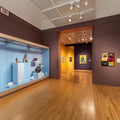
“Impressions of Los Angeles: 60 Years of Printmaking at Gemini G.E.L.” honors the workshop’s history of cutting-edge creativity. The Los Angeles focused exhibition is divided into two major themes: the city’s atmosphere and the city’s street life.
“When especially the New York based artists arrived in Los Angeles, the atmosphere is so different from New York,” Dackerman explained of the penchant Gemini-invited artists had in turning their creativity to the host city.
The figurative and literal atmosphere.
“There's a kind of freedom and permissiveness here that isn't in New York, isn't in the hierarchical, more structured atmosphere of the art world in New York,” she continued. “Gemini would invite artists to come out here, to stay for an extended time, put them up. People would discover the city, and it's how the city became the subject of so much of the work that was created in the studio.”

Ken Price, ‘Western Sunset,’ 1993. (KP92-5199) 7-color screenprint. 26 x 20 38 (66.04 x 51.75 cm). Edition of 70. Courtesy Gemini G.E.L.
Take Robert Raschenberg as an example.
“Born in Texas, New York-based when he was working, ended up in Florida, (he) would come out to Los Angeles and be entranced by the street life, by the light, by the billboards, it’s a very media heavy city, even at the street level,” Dackerman said. “He soaked it all up and then spit it out again in these great artworks.”
To this day, West Hollywood’s Sunset Strip is an overstimulated smorgasbord of coming-attraction billboards for movies and TV shows unlike anything else in the country. A fertile landscape for an artist’s imagination, particularly artists interested in other media and the saturation of images in American society like Rauschenberg.
The “atmosphere” section of the exhibition includes Tacita Dean’s lithographs highlighting the beauty of the light in Los Angeles with soft, wispy clouds against a striking blue sky and a gentle, glowing sunset. Claes Oldenburg’s Sneaker Lace in Landscape series (1991) centers the palm trees. Vija Celmins’ Drypoint–Ocean Surface–2nd State (1985) and Roy Lichtenstein’s Nude on a Beach (1978) focus on the Pacific.
David Hockney’s Weather Series (1973) showcases the atmospheric conditions Angelenos know so well: mist, sun, and rain.

David Hockney, ‘Mist,’ 1973. (DH73-502) 5-color lithograph. 37” x 32” (94 x 81.3 cm). Edition of 98. Courtesy Gemini G.E.L.
“Hockney captured what happens in the bright sunlight, as well as what happens when a fog descendants on the city and creates its own kind of misty, spooky atmosphere, all of a sudden, all the clarity is gone, it’s the opposite of what you're used to seeing; he caught it in one of these great lithographs,” Dackerman said.
Artworks in the second gallery, in a building designed by Frank Gehry in 1976-79, highlight street life in Los Angeles. Selected works include Ed Ruscha’s Pico and Sepulveda (2001), a screenprint of a major intersection in West LA, and Rauschenberg’s iconic LA Uncovered series (1998) depicting the city through a kaleidoscope of images. This section also features two House Studies (2016) by Frank Gehry, a longtime collaborator with Gemini.
Now stewarded by the families of co-founders Sidney B. Felsen (1924–2024) and Stanley Grinstein (1930–2014), Gemini G.E.L. continues inviting and working with the most influential artists practicing today. Los Angeles proves no less captivating than ever.
Sprawling seemingly limitless over a county spanning 4,000-plus square miles, the most populous county in America – nearly 10 million people – across 88 incorporated cities from Long Beach to Malibu and downtown, from the ocean to the mountains, LA will never stop being a global hub of creativity, a source of inspiration for artists. Here’s hoping Gemini will be helping those artists realize their vision for another 60 years.