'Mystics' or Moderns? You Decide in Seattle
By Chadd Scott on
In 1953, a reporter from Life magazine traveled from New York to Seattle to review the Pacific Northwest art scene. The magazine had never done this before. The article focused on four local artists: Mark Tobey, Kenneth Callahan, Guy Anderson, and Morris Graves.
The unaligned group were referred to by the reporter as “mystics,” their spiritual engagement with nature and perceived alignment with Asian and Northwest Coast Native cultures amplified in the story. Today, the characterization would be insulting, dismissive, and more than a little racist, as if Asian and Indigenous cultures and artwork inspired by them are “mystical,” “strange,” “other.” But this was the 50s and the Pacific Northwest was a lot further removed from New York than it is today.
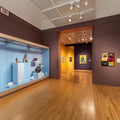
Using the Life article for inspiration, the Seattle Art Museum presents “Beyond Mysticism: The Modern Northwest,” an exhibition examining how regional artists working in the midcentury were not isolated “mystics,” but rather every bit as engaged with broader trends in American Modern art of the period as their East Coast counterparts. Those trends included Social Realism, Surrealism, and Abstract Expressionism.
“Beyond Mysticism” details how artists in the Pacific Northwest created a unique form of American Modernism shaped by the region’s landscape and rapid urban transformation. The presentation also highlights how the Seattle and regional art scene extended well beyond the four artists featured in Life.
“In the early 20th century, the Puget Sound was home to a highly progressive artistic and cultural scene, shaped by the region’s rapid urbanization, its singular natural environment, and its orientation to the Pacific Rim,” exhibition wall text states.
Asian American Seattle
“Beyond Mysticism” opens with a section entitled “The City and Industry.”
“During the years leading up to World War II (1939–45), many Puget Sound artists adapted the realist style that dominated Depression-era American art to the specific experiences of this region,” wall text reads. “Their works reflect Seattle’s development—its infrastructure, its economy, and, whether directly or implicitly, its people.”
Social Realism as a genre sees artists commenting on societal conditions in a realistic style. Simple enough. What was not simple was the unprecedented changes these artists – and all of Seattle – were experiencing around them.
“Between 1880 and 1930, Seattle and the land underneath it were more profoundly and completely altered than any other place in the United States,” wall text explains. “City planners and civil engineers oversaw the conversion of impassable terrain into traversable roads and inhabitable property, the razing of old-growth forests to generate lumber for building, and the transformation of tidal flats into harbors for commercial fishing and shipping.”
Artworks in this section show how Seattle’s changing landscape and rapid urbanization radically altered the region’s look and feel. Jacob Elshin’s 1934 Mill stands out. The painting shows Seattle’s industrial harbor – docks, boats, and warehouses. Dominating the scene is Fisher Flouring Mills, established in 1911, one of many built to process the grain supply for Washington’s growing settler population.

Jacob Elshin, ‘Mill,’ 1934. Public Works of Art Project, Washington State. Oil on canvas, 29 x 38 in. (73.7 x 96.5 cm). On view at Seattle Art Museum. Photo by Chadd Scott.
The dramatic changes also, of course, affected the people living there. Among those people were Asian Americans, immigrants and natural born citizens alike. Paintings by Takuichi Fujii, Kamekichi Tokita, and Kenjiro Nomura further distinguish “The City and Industry.”
Nomura’s 1932 Street shows a view of Yesler Way, the epicenter of Nihonmachi, Seattle’s large community of Nikkei, emigrants from Japan and their US-born descendants.
“Deep perspectival space emphasizes Yesler’s steep slope and the multistory buildings lining it, as well as the tracks for the streetcars that carried workers from downtown Seattle to suburbs to the east,” the wall text reads. “These tracks expose the racial segregation that led to the formation of Nihonmachi. Seattle’s streetcar suburbs were historically restricted to white homeowners by legally binding deeds, or covenants, that dictated property use and ownership.”
Throughout the country, this institutionalized segregation through real estate and zoning was known as redlining.
“These barriers were reinforced by the state’s Alien Land Laws, which prevented people labeled ‘aliens ineligible for citizenship’—mainly Asian immigrants—from owning or leasing land,” the wall text continues. “Although Seattle promoted itself as the gateway to Asia, anti-Asian racism and exclusionism prevailed.”
Nihonmachi was almost the only place in Seattle where the city’s Japanese American residents could build businesses, livelihoods, and community.
It would get worse for Seattle and the West Coast’s Asian American residents before getting better.
1942’s Executive Order 9066 authorized the forced removal of persons deemed a national security threat from their homes on the West Coast to concentration camps in the interior West. More than 100,000 legal American residents and American born citizens of Asian ancestry were forcibly taken out of their peaceful lives – without reasonable suspicion or due process – and sent to the camps.
Fijii was sent to the Minidoka War Relocation Center in Idaho. He documented his unconstitutional imprisonment in an illustrated diary, a rare firsthand account of wartime detention by a Japanese American prisoner. Nomura and his family were also imprisoned at Minidoka. They spent three years behind barbed wire there, returning to Seattle in 1945. The artist’s wife never recovered from the trauma and committed suicide in 1946.
Prior to being shipped off to Idaho, many Japanese American citizens from the Seattle area were first sent to Puyallup and the fairgrounds there for processing. Yvonne Twining Humber’s Spoiled Carnival (1946) depicts the Puyallup Fairgrounds. When commissioned to paint the setting, she imagined joy.

Yvonne Twining Humber, ‘Spoiled Carnival,’ 1946. Eugene Fuller Memorial Collection. Oil on canvas, 22 x 38 in. (55.9 x 96.5 cm). On view at Seattle Art Museum. Photo by Chadd Scott.
“This all changed when she learned of the site’s role in the incarceration of Japanese Americans during World War II,” exhibition wall text states. “Known as Camp Harmony, it was used as a waystation for detainees awaiting mandatory imprisonment at facilities in Tule Lake, Washington; Hart Mountain, Oregon; and Minidoka, Idaho. Rather than enjoy the amusement park’s many delights, the crowd rushes to take shelter from a sudden storm.”
Grand Coulee Dam & Pike Place Market
Z. Vanessa Helder moved to Spokane from Seattle in 1939 to teach at the newly established Spokane Art Center. Grand Coulee Dam on the Columbia River northwest of Spokane was well under construction by the time she arrived.
Built between 1933 and 1942, the project was the largest initiated under the New Deal. It generated the hydroelectric power required to manufacture aluminum for western Washington’s airplane industry and to harness irrigation for eastern Washington’s agriculture; it also destroyed the salmon fishing and natural river resources and ecosystems the area’s Indigenous people had depended on since time immemorial. They were not consulted.
Helder was captivated by the enormous dam’s construction and gained access to the site—the only woman so privileged. She was not permitted to draw there, however. In producing her magnificent Gand Coulee Dam watercolor paintings, the artist made field sketches of the dam from elevated vantage points nearby. Her finished artworks are crisp, graphic, colorful, and remarkably vibrant despite their age.

Z. Vanessa Helder watercolor paintings of construction of Grand Coulee Dam on view at Seattle Art Museum. Photo by Chadd Scott.
As are Mark Tobey’s masterful scenes of Pike Place Market, now one of Seattle’s top tourist attractions. Tobey brilliantly captured the frenetic activity – the ordered chaos – and the site’s laborers during the early 40s.
Seattle street scenes, Pike Place workers, Grand Coulee Dam, “Beyond Mysticism” achieves its peak with local artists depicting local scenes in the Social Realist style. These paintings are the most distinctly Pacific Northwest. The work on display in exhibition galleries devoted to Surrealism and Abstract Expressionism is exceptional, but what was being created in the Pac NW in those styles is indistinguishable from what could have been found then, and can be found today, in Chicago or Philadelphia.
Alexander Hogue
“Beyond Mysticism” is a massive exhibition featuring more than 150 paintings. While most artworks come from regional artists, jewels from major international figures like Georgia O’Keeffe and Salvador Dalí are also included. As is a spectacular painting by Archibald Motley from the Art Institute of Chicago.
Highlighting the loans, however, is a pair of paintings by Alexander Hogue (1898-1994). Both paintings are large – more than 40 inches tall by more than 60 inches wide – and both depict the ruin of the Dust Bowl on the Southern Plains. Hogue grew up in Texas and launched his art career in Dallas. He was familiar with scenes of postapocalyptic agricultural devastation brought on by unsustainable farming practices. By deforestation. By tilling. By removing native grasses and replacing them with wheat. By the soil eroding and blowing away.

Alexander Hogue Dust Bowl ruin paintings on view at Seattle Art Museum. Photo by Chadd Scott.
In a section entitled “Northwest Landscape Through an Ecocritical Lens,” Hogue’s two great masterpieces, Erosion No. 2--Mother Earth Laid Bare (1936) and Crucified Land (1939), are on view side-by-side. Both paintings come from Tulsa – Crucified Land the Gilcrease Museum and Erosion from the Philbrook Museum of Art – but they are rarely seen together. Their pairing makes “Beyond Mysticism” worth going far out of your way for whether or not you have any interest in the Pacific Northwest.
These are America’s two greatest painted indictments of the nation’s unsustainable agricultural and economic practices, the unsustainability of American society, and, really, the unsustainability of America as practiced in the 19th and 20th century. Paintings of logging in the Pacific Northwest hang nearby.