Clyfford Still: Western Artist
By Chadd Scott on
Western artwork by artists not considered “Western” fascinates me. Particularly the early and mid-century American masters. Marsden Hartley, Stuart Davis, John Marin, Thomas Hart Benton, Jackson Pollock, Richard Diebenkorn. A-listers associated with Modernism, with American art, but never the art of Western America.
Georgia O’Keeffe, too.
Despite her deep engagement and decades spent living and painting the West, she’s never thought of as a “Western” artist. This exclusion comes at the hands of American art historians, curators, and writers, and at the hands of Western art historians, curators, and writers.
I will never understand why so many devotees of Western art seek to define its boundaries as narrowly, instead of as widely, as possible.
Artists don’t have to be all one thing or another. O’Keeffe wasn’t exclusively a Western artist. She wasn’t only a Western artist. But she was a Western artist. She could paint a Manhattan skyscraper as well as a bleached-out cattle skull against a northern New Mexico landscape.
The Western art world misses countless opportunities to broaden its appeal and relevance by excluding historic and contemporary artists not singularly devoted to the genre. Artists born in the West. Artists who visited the West. Artists inspired by the West.
Artists like Clyfford Still (1904-1980).

Clyfford Still, PP-241, 1936. Pastel on paper, 12 1_4 x 9 3_4 in. Clyfford Still Museum, Denver, CO. © City and County of Denver-ARS, New York
Still, more than most of the 20th century icons mentioned, feels “Western.” For starters, he was born in North Dakota and grew up in Spokane and on a wheat ranch in Alberta, Canada. The expanse of the wheat fields and sky. The vastness. The colors; the tans and ochres. Their earthiness. Still’s enormous abstractions for which he’d become famous always felt at least partially Western to me.
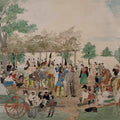
What’s more, before moving East full-time, to New York and then Baltimore, Still studied at Spokane University, earned a Master’s degree at Washington State College – what became Washington State University – and taught there after graduation. During this time, Still was undoubtedly a “Western” artist. Paintings from three summers spent with the Colville Indian community in the mid-1930s as a young art professor on view now at the Clyfford Still Museum in Denver prove this definitively.
They are as “Western” as Russell or the Taos Founders.
Clyfford Still in Colville
After first visiting the Colville Reservation in east-central Washington in 1936, Still and his faculty supervisor, Worth Griffin, co-founded a summer art program there the following year. Still formed relationships with the Colville Tribal people and the landscape.
While culturally distinct and diverse, the twelve bands of the Confederated Tribes of the Colville Reservation, Chelan, Chief Joseph Band of Nez Perce, Colville, Entiat, Lakes, Methow, Moses-Columbia, Nespelem, Okanogan, Palus, San Poil, and Wenatchi, share cultural practices and 1.4 million acres of land.
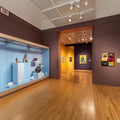
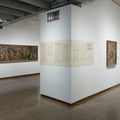
Still produced more than 100 sketches, paintings, and photographs during the summers of 1937 and 1938. A selection of these most “Western” artworks can be seen through May 10, 2026, during “Tell Clyfford I Said ‘Hi:’” An Exhibition Curated by Children of the Colville Confederated Tribes, co-curated by the Still Museum with youth from the Colville Confederated Tribes. Installed in all of the Museum’s galleries, the show highlights the perspectives of Colville children on Still’s depictions of their home and ancestors, as well as the artist’s abstract works.
In Colville, Still painted Indigenous people. He painted the landscape. He painted the Grand Coulee Dam, then under construction across the Columbia River – the Tribes’ lifeline choked in the name of “progress.”

Clyfford Still, PH-624 (Coulee Dam, Washington), 1936. Oil on canvas,27 7_8 x 34 in. Clyfford Still Museum, Denver, CO. © City and County of Denver-ARS, NY
Still’s Colville years should be celebrated in Western art. One of America’s most prominent modern artists, born in the West, raised in the West, educated in the West, painting the West. Instead, they’re absent.
Museum staff began working with Colville Tribal representatives in 2021 to learn more about this part of his career from their perspectives and explore partnership opportunities. “Tell Clyfford” comes from Tribal leadership’s desire for the Museum to collaborate with Tribal youth on an exhibition.
On the Verge of a Breakthrough
Still hadn’t landed on his signature style in Washington, but he was close. His massive canvases – routinely over 10-feet on a side – with their jagged, abstract, color patches and streaks, would debut in 1944. They would make him famous.
They had to be, at some level, inspired by Colville.
“We think this was a really important time,” Nicole Cromartie, Clyfford Still Museum Director of Learning & Engagement, said of his Colville years. “(Still) has a living daughter, Sandra, who has talked at length about the impact this community had on her father, and that was something that he talked about, how important his time on the reservation was for his work.”

Clyfford Still, PP-486, 1936. Pastel and crayon on paper, 9 x 12 in. Clyfford Still Museum, Denver, CO. © City and County of Denver-ARS, New York
How, exactly, Still’s summers with the Colville people influenced his work remains unclear.
“What specifically did his time on the reservation do to inform the rest of his career? The short answer is, we don't know,” Cromartie said.
One of the Colville students who helped on “Tell Clyfford I said ‘Hi’” had an idea historians never thought of.
“The second gallery in the exhibition is called ‘Our Family, Our Culture,’ and it's mostly works from the 1930s that (Still) made on the Reservation, but there's a huge abstract work in there,” Cromartie explained. “A fifth-grade student approached it and was like, ‘That's a pow wow blanket,’ with full certainty. She said, ‘It reminds me of a pow wow blanket that my mom made.’ That was incredible. It was so definitive. There's all of these art historians (wondering) how, what are the concrete ways (time on the Reservation influenced Still), and then this fifth-grade child is just like, ‘This is what this is.’”
Still would never return to Colville after 1938. He bummed around in the 40s, spending much time in New York, but also on the West Coast, before moving East for good in 1950.
As his career took off, he became increasingly grouchy and isolated. Long, soul-bearing interviews about his life and work never took place. Upholding the mystique, he famously used an alpha numeric titling system with dates to name his artworks – 1957-D-No. 1 for instance – further obscuring their meaning.
In the case of Clyfford Still, Western artist, you simply need believe your eyes. The Colville paintings are undeniably “Western;” the abstractions, too. At least to those of us with an eye for a Western art world as expansive as possible.