Georgia O'Keeffe's Connection to the Amon Carter Museum
By Chadd Scott on
Georgia O’Keeffe’s history with New Mexico is well known.
In 1929, O’Keeffe first visited the state with her artist friend Rebecca Strand. They stayed for three months in Taos with famed arts patron Mabel Dodge Luhan. At this time, O’Keeffe (1887-1986) was living in New York City and spending summers upstate at Lake George.
O’Keeffe fell in love with northern New Mexico, a deeper love than she had for her husband, photographer and gallerist Alfred Stieglitz. She returned almost every year in the late spring and summer until Stieglitz died in 1946, then moved there permanently.
Lesser known is O’Keeffe’s connection to Texas and its influence on her life and career. O’Keeffe first moved there in 1912 to teach drawing at Amarillo High School. In 1916, she became head of the art department at West Texas State Normal College, now West Texas A&M University in Canyon, where she’d stay until 1918.
During her tenure in Canyon, Georgia O’Keeffe wrote: “A week ago it was the mountains . . . and today it is the plains. I guess it’s the feeling of bigness in both that carries me away.”
The Wisconsinite who attended the School of the Art Institute of Chicago before moving on to New York was captivated by the West Texas terrain. She felt at home there despite how dramatically different it was from anywhere she’d lived before.
“That was my country,” O’Keeffe said. “Terrible winds and a wonderful emptiness… but I belonged.”
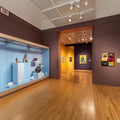
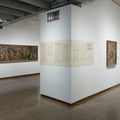
The quote comes from wall text at the Amon Carter Museum of American Art in Fort Worth which presents “Georgia O’Keeffe and the Carter,” an exhibition on view through September of 2027 exploring O’Keeffe’s formative years in Texas, her enduring connection to the state, and her close friendships with the Museum’s founder, Ruth Carter Stevenson, and first director, Mitchell A. Wilder.
The Carter’s connection to the artist begins with O’Keeffe’s landmark 1966 retrospective, “Georgia O’Keeffe: An Exhibition of the Work of the Artist from 1915 to 1966.” The current exhibition includes a beautifully hand-written letter from O’Keeffe to Wilder sent from Abiquiu, NM dated 3/14/64 inviting Mitchell and “Mrs. Johnson,” the future Mrs. Carter Stevenson’s then-married name, to stay at O’Keeffe’s Abiquiu home when visiting next month to select paintings for the retrospective.

Georgia O'Keeffe 1964 handwritten letter to Mitchell A. Wilder. Collection of the Amon Carter Museum of American Art.
The current exhibition includes Carter Stevenson’s descriptions of meeting and spending time with O’Keeffe in 1964, as well as two paintings, Black Patio Door (1955) and Dark Mesa with Pink Sky (1930), both acquired directly from O’Keeffe after her 1966 Carter retrospective.
O’Keeffe was not then the global icon she would become – by no means anonymous, and by no means famous. The show would help renew interest in her career. O’Keeffe and Carter Stevenson co-curated the exhibition, establishing The Carter as one of the first institutions to revere and promote O’Keeffe as an essential figure in American modernism.
Producing the retrospective further encouraged Carter Stevenson and Wilder to acquire major artworks by O’Keeffe and Stieglitz, as well as their circle of New York friends/artists, famed modernists including John Marin, Marsden Hartley, and Arthur Dove.
“Georgia O’Keeffe and the Carter” brings together the Museum’s holdings of O’Keeffe paintings and works on paper alongside personal letters, rare ephemera from her career, and photographs of the artist by Laura Gilpin, Eliot Porter, and Stieglitz. Together, the materials illuminate her personal and professional ties to the Museum.

Georgia O'Keeffe 1964 handwritten letter to Mitchell A. Wilder. Collection of the Amon Carter Museum of American Art.
Ruth Carter Stevenson
The lives of Ruth Carter Stevenson (1923-2013) and her father Amon G. Carter Sr. (1879–1955), the Museum’s namesake, read like Paul Bunyon tales. Surely it can’t all be real.
Carter was good friends with Will Rogers. Rogers turned Carter on to Fredric Remington and C.M. Russell. Carter personally, and the museum subsequently, would purchase a treasure trove of paintings and sculptures from the famed duo, the backbone of The Carter’s permanent collection.
Carter also knew FDR, Charles Lindberg, and Eisenhower.
His initial fortune was made in the newspaper business, working his way up to President and Publisher of the Fort Worth Star-Telegram. He acquired the rival Fort Worth Record from William Randolph Hearst.
He was an early advocate of air travel. He struck oil in New Mexico.
You get the picture.
Stevenson’s life is no less remarkable. She was “solely responsible for seeing that her father’s wish to establish a museum for the city of Fort Worth was realized,” as boldly stated by the Museum’s website. She saw to it that the Amon Carter Museum of American Art opened to the public in January 1961.
Carter Stevenson’s engagement with the arts began as a teen when she became close friends with future Fort Worth Circle artist Cynthia Brants and through an art history course at the Virginia boarding school she attended. Like O’Keeffe, Carter Stevenson was uncommonly well traveled for someone in mid-century America, especially a woman. She and Brants attended Sarah Lawrence College in New York, frequenting the galleries and museums. Carter, then unmarried, would attend law school at Notre Dame, marrying for the first time and taking on the Johnson surname.
Notre Dame is in northern Indiana, not far from Chicago. She visited the great Art Institute of Chicago in 1947 for an exhibition of Impressionism, purchasing an artwork from French Impressionism’s only American, Mary Cassatt, the following year at a gallery in New York.
Carter’s collecting and engagement with the Fort Worth art scene accelerated through the 1950s and 60s after moving back to her hometown. Locally, the highlight of this period is the opening of the museum named after her father; nationally, it’s her inclusion on the board of the National Endowment for the Arts at the invitation of Lady Bird Johnson – fellow Texan and then First Lady. She would later serve on the boards of both the National Gallery of Art and the National Trust for Historic Preservation.
From the Johnson’s to the Rockefeller’s and Mellon’s, Carter, like her father, mingled in the nation’s highest echelons of political, business, and social strata.
Unlike her father, Carter’s interest in art trended toward Modernism, as evidenced by her purchase of the Cassatt and co-curation of the O’Keeffe show. While interested in regional artists and “Western” art, the ultra-conventional “cowboys and Indians” stuff her father prized was not her bailiwick. She had a broader view of American art – O’Keeffe and her New York circle, Stuart Davis, Alexander Calder.
As a result, The Carter museum, with father’s crown jewels from Russell and Remington, and daughter’s wider perspective and emphasis on Modernism, stands as one of the nation’s elite Western and American art institutions.