Harry Fonseca and Coyote
By Chadd Scott on
In 1987, Margaret L. Archuleta (Tewa/Hispanic) wrote her Master of Arts in American Indian Studies thesis at the University of California, Los Angeles, about Harry Fonseca (1946-2006; Portuguese, Hawaiian and Nisenan-Maidu descent). The document proves insightful about prevailing opinions regarding Native American art from two generations back. Opinions that seem shocking today.
“American Indian culture has been treated as an exterior impulse rather than an interior force of the development of Contemporary American Indian art,” Archuleta wrote. “Previous studies analyzed Contemporary American Indian art as a motif rather than an intricately entwined cultural statement based on traditional beliefs that reflect and respond to contemporary situations.”
Native American art, Native American culture, Native American life are one in the same. White colonial scholars have not typically understood this and sought to compartmentalize the three, as if they were distinct, as they are in white culture. Anyone wanting to understand Native American culture need only look at the art, and vice versa. Anyone wanting to understand Native American life can do the same.
Mainstream white society segregates art from life and culture. Artists are separate. Doing their own thing.
“Historically the experts – anthropologists, ethnologists, art historians, patrons, traders and promoters of Indian art – have determined the authenticity of Indian art, not the artists themselves,” Archuleta continued. “The experts also defined what constituted ‘real’ Indian art. According to the experts only ‘acceptable’ Indian art was real Indian art. The rules of acceptability included: (I) acceptable media such as pottery, basketry, weaving, jewelry and 'traditional' painting; (2) acceptable artistic styles, qualities of naivete, flat, two-dimensional, and linear; and (3) acceptable subjects (ceremonial, religious and spiritual dances, associated paraphernalia and overly romanticized views of the Indian's oneness with nature).”
No James Luna photography. No George Morrison abstract painting. No Truman Lowe sculpture. No collage or film.
Ridiculous.
When a Native American makes art, it becomes Native American art, whatever the media or motif or style.
“There is much more to Indian Art than pretty, stylized pictures,” legendary Yanktonai Indian painter Oscar Howe (1915-1983) wrote in 1958. “We are to be herded like a bunch of sheep, with no right for individualism, dictated as the Indian has always been, put on reservations and treated like a child, and only the White Man knows what is best for him.”
No race or ethnicity owns or is excluded from any artistic medium.
“Contemporary American Indian art has been analyzed as a motif rather than an intricately intertwined cultural statement based on traditional beliefs that reflect and respond to the contemporary situations,” Archuleta added. “Because of this, the misconception that contemporary American Indian art is not traditional and therefore, not acceptable was established.”
Contemporary Native art, no matter how avant garde the subject or medium, is no less grounded in cultural heritage than “traditional” – as defined by (white) scholars and curators – Native art.
Archuleta defines Contemporary American Indian art as, “having its roots within cultural traditions, regardless of whether or not immediately recognizable 'Indian' symbols (i.e. feathers, blankets, arrows and beads) are present.”
One of the most recognizable ‘Indian’ symbols is Coyote.
One of the most radical Contemporary Native artists was Harry Fonseca.

Harry Fonseca, ‘When Coyote Leaves the Res,’ 1979. Serigraph; 33 x 23 14 inches. Edition of 150. Courtesy Babst Gallery Los Angeles.
Coyote and Fonseca
The coyote as trickster figure appears across many Native American cultures.
“Among the Maidu of northern California, however, Coyote is more than just a spoiler. He also acts as the benevolent teacher,” Archuleta wrote. “The importance of Coyote is directly evidenced in the great number of Coyote tales within the Maidu oral traditions, and it is the oral tradition that provides the foundation for Fonseca's contemporary representation.”
The Nisenan-Maidu homelands were located at the northern end of the Sierra Nevada Mountains. John Sutter and white settlers to Northern California drove them out in the mid-1800s. Between 1846 and 1870, California’s Indigenous population declined from 150,000 to 30,000. They died from a combination of disease, starvation, forced labor, and state-sanctioned genocide.
Coyote was also a central figure in traditional Native dances in Northern California. Beginning in 1847, Native dances were made illegal under Federal legislation. It wouldn’t be until 1978 that Native Americans would receive protections under the American Indian Religious Freedom Act to legally resume their dance rituals.
America as a nation was founded on principles of religious freedom. Freedoms taken away from the nation’s Indigenous inhabitants for 140 years.
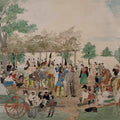
Fonseca regularly painted dancers. Deer Dancers. Coyote dancers. Bear Dancers. Bear dancers in snow because during a 1976 Bear Dance ceremony he participated in, it snowed.

Harry Fonseca, ‘Bear Dancers,’ 1984. Acrylic on canvas. 48 x 60 inches. Image courtesy Babst Gallery Los Angeles.
In the mid-1970s, he started transforming Coyote from oral tradition into a visual image. He debuted prints, drawings, and paintings depicting Coyote in contemporary dress.
"[Coyote] he's a character of tremendous vitality,” Fonseca said in 1984. “He's like salt on the boiled egg of life!"
Nothing is more traditional in Native American culture than Coyote. Nothing is more contemporary in Native art than Fonseca depicting Coyote in sneakers, jeans, and a black leather jacket.
Coyote Leaves the Res, NY NY, 1982.
Fonseca portrayed Coyote against a wall.
Up against the wall. Struggling.
Coyote in the Mission, San Francisco, 1983.
Coyote with a gay undercurrent.
“Fonseca's Coyote is contemporary and it is traditional,” Archuleta wrote. “By being both, it answers what is ‘Indian’ about contemporary American Indian art. Artistic styles or media do not determine Indianness. The artists themselves determine their Indianness. And how they choose to express their Indianness is a personal decision and statement.”
Fonseca's Coyote reveals his astute observation of contemporary society and its effects on us. Coyote's antics reveal Fonseca's personality and acute sense of humor.
Fonseca wrote: “All right, let’s go, Coyote, let’s go, let’s do a whole new mythology. Let’s bring you up from the past and bring you up to date and let’s just do it!
“The older Maidu tribes-people looked at my paintings of Coyote and immediately they were delighted. They recognized Coyote for what he is… They are survivors who have clashed with contemporary society and have had to adapt. Just like Coyote.”
In 1981 Harry Fonseca developed Rose, a female Coyote. Although not present in traditional stories of Coyote, Fonseca modeled Rose, “modern hip, brassy, singing, dancing trickster star of her own show,” after the female women of his Tribe.
Harry Fonseca Exhibition
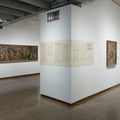
The Pacific Design Center Design Galleries (750 N San Vicente, West Hollywood) presents an exhibition of more than 30 Fonseca paintings, prints, and works on paper, through July 3, 2026; many of the artworks are being shown in California for the first time. ''Harry Fonseca: Portrait of the Artist as a Young Coyote'' charts the evolution of Fonseca’s alter-ego, the Trickster Coyote.

'Insallation view, 'Harry Fonseca Portrait of the Artist as a Young Coyote, at Pacific Design Center Design Galleries. Image courtesy Babst Gallery Los Angeles.
Fonseca often represented Coyote as a great artist, sometimes wearing Jackson Pollock’s denim shirt or Van Gogh’s blue jacket. Nods to Picasso, Botticelli, and Hokusai appear in Fonseca’s work. He was deeply influenced and in dialogue with art history. Theatre, too. And ballet.
“Portrait of the Arist as a Young Coyote” was curated by Babst Gallery in Los Angeles. Archuleta’s work on Fonseca’s career, which also included curating his nationally traveling retrospective in 1988 and 1989, proved instrumental in producing the show. Babst Gallery reached out to Archuleta for her assistance as it began planning the exhibition, but she had fallen ill and passed away in 2023.
Upon Fonseca’ death, half of his remaining artworks and his personal archive were acquired by the Autry Museum of the American West in Los Angeles. The collection included over 500 original works of art as well as Fonseca’s journals, papers, and sketchbooks, most of which had never been exhibited, researched, or published. The other half went to Fonseca’s tribe, the Shingle Springs band of Miwok Indians.
Babst assembled the show by going through the archives and finding pieces one by one through old letters and sales slips. Fonseca’s friends and Tribe were instrumental in researching the show. In a near miracle, Koshare with Cotton Candy was found in a candy store in Jeffersonville, Indiana on Instagram. The owners lent their piece to the show and made it to L.A. for the opening.
Alongside Fonseca is ''Sedej Tuulémisé (Blood Relations),'' an exhibition of paintings by emerging artist Deerstine Suehead (b. 1996; Nisenan/Maidu/Seneca). Suehead lives and works in Sacramento. In addition to being a visual artist, Suehead is a traditional tattoo practitioner. She is the founder of Póombokom Tuulémɨsé, a cultural collective that supports, enhances and protects the continuity of regional Tribal material culture via intergenerational learning and the transference of cultural protocol and norms.
Born 50 years apart, these artists draw from their Nisenan heritage and recontextualize traditional imagery within contemporary settings.