Thomas Marcus: Wildstyle Graffiti Meets Tohono O'odham Basket Weaving
By Chadd Scott on
Public murals and petroglyphs.
“Wildstyle” graffiti and woven baskets.
Thomas “Breeze” Marcus’ (b. 1980) artworks bring these seemingly disparate worlds naturally together. Beautifully together. The Tohono O’odham artist observed the world around him, his Indigenous world from the Salt River Pima Maricopa Indian Community and the street culture he grew up in in Phoenix. He made a cultural connection.
“In graffiti, it's about this form of communication in the public – unsanctioned, against the grain, all of those things – but regardless, it is a form of communication through symbols and visual storytelling,” Marcus explained. “To me, it was no different than how my ancestors created rock carvings in the mountains, petroglyphs. It's the continuation of that through a spray can or a brush mural. If I'm on a giant lift painting a five-story building, it's me continuing that legacy.”
Artists – the best of them – help us see the world in a different way. See how murals are a continuation of petroglyphs. See how “Wildstyle” carries on Tohono O’odham weaving. Marcus saw and learned “Wildstyle” graffiti as a young man in urban Phoenix. He saw baskets from his home community. He saw the relationship.
“The Tohono Odham people in southern Arizona, traditionally, we're known as basket makers. Taking the concept of basket making, you're taking desert materials, and you start to coil, and you start to weave these geometric patterns together. I also found inspiration in that,” Marcus said. “The weaving and the coiling and the merging of all these lines and design work and composition coming together as one giant painting or wall. It's a blend of all worlds. It's ancestral, it's traditional, but it's also very contemporary – graffiti, street art.”

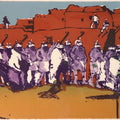
Thomas Marcus coyote painting. Courtesy of the artist.
What does this have to do with “Wildstyle?”
“In the graffiti world, we have an old term that described when you could take your lettering and abstract it to where it's almost unreadable, but still has a great flow; they call it ‘Wildstyle,’” Marcus explained. “So, (the idea is) how complex you can get it. How almost to the verge of unreadable, but still readable, like a coded language to others who are participants.”
The line work Marcus has developed in his paintings over the past 20 years marries these creative traditions. Shows people a new way to see. Once explained, you’ll recognize it straight away and never look at a “Wildstyle” tag or mural or petroglyph or basket the same way again.
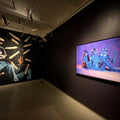
Marcus extended the reach of his vision on June 5, 2026, opening Earth Maker Gallery in a small, street level space beneath his downtown Phoenix studio.
“That's what I hope to achieve (with the gallery), bringing something that maybe people had never even thought of before, merging the two together, and I'm a perfect example. I'm a product of that coming from both those worlds, but I'm not the only one,” he said.

Thomas Marcus painting. Courtesy of the artist.
Earth Maker Gallery
Despite Phoenix’ explosive population growth over the past 40 years, its gallery scene has contracted.
“With such a large population, and being downtown, you would think there would be a gallery that focuses on contemporary Native work and beyond, but there are none, and definitely none that are Native owned,” Marcus said. “We used to be known as a downtown art city and had many galleries, and they've left. It felt like a necessary thing for me at this point in my career, to fill a void in downtown Phoenix.”
A gallery void.
A void in contemporary art. A void in contemporary art influenced by street art and graffiti. A void in contemporary Native art. Those are the artists and artworks featured at Earth Maker Gallery. Not exclusively Native, but exclusively contemporary and from the area.
“I want to highlight and give platform to other emerging artists and introduce that work to a demographic that may not even know they're there, that they are an art collector, or maybe they are collectors, and they just don't have anywhere to go,” Marcus said.

Opening night at Earth Maker Gallery in Phoenix. Photo courtesy of Thomas Marcus.
Wearing his gallerist hat, Marcus identifies a core reason why Phoenix has lost galleries over the past 20 years: generational change. For the past 40 years, art galleries have largely catered to Baby Boomers. The first Baby Boomers turned 30 in 1976. The last Baby Boomers turned 30 in 1994. From the 80s into the 2000s, art galleries targeted the enormous Baby Boom generation with its shared cultural touchstones and mass of disposable income as members progressed into adulthood.
It was an obvious and smart strategy. But galleries nationwide rode that horse until it couldn’t carry them anymore without a succession plan.
“As a working artist myself, for the last couple of decades, I have observed that with successful galleries here and in the Southwest, their collectors start phasing out, just getting older, and either passing on or selling off their collections,” Marcus said. “It feels like they've run their course.”
The Baby Boom generation is passing. Members are trying to get rid of art – and antiques – not buy more. Their kids don’t typically want what they collected because tastes have changed – in art, in music, in movies, etc. The galleries who hitched their wagons exclusively to the members and tastes of the Baby Boom generation are struggling to reinvent themselves, retiring along with their customers, or closing.
Today, undeniably, street art and graffiti are the most popular forms of artwork in the world. Cities are covered in murals. Graffiti and street artists have the biggest followings on social media. Artwork some in the Baby Boom generation still look at as vandalism.
“Go to any major contemporary fair, whether that's in Miami or wherever, guaranteed, you're going to find street art, graffiti art-influenced work by artists who are established in those fairs, represented by those galleries. There are a handful of names that everybody knows, like the Shepard Fairey’s and the Banksy’s, but there's plenty of others,” Marcus has observed. “It is the generational cultural thing, and that's part of that void, again, a void in understanding how popular mural painting has become, how popular street art has become in the last two decades, but how there is no accessibility to it other than viewing it in the public, while people are wanting to acquire and collect.”
Marcus knows the culture, knows the artists, and hopes Earth Maker Gallery will connect the creative side with the consumer side. To do so, he’s willing to nurture a new generation of art collectors. Art lovers who may not even consider themselves “collectors,” that being such a seemingly pretentious, Upper East Side, term.
He wants to educate new collectors, show them how the artworks in his gallery connect to the visual cultural expressions they relate to. It’s a long game. Nurturing. The work extinct and fading galleries never invested in to assure their success beyond the Baby Boom.
Art continues being made. People continue loving art. But the gallery model has never been more precarious. The traditional gallery model. The galleries finding success now are finding customers in new places, finding artists in new places, expanding their services to include education and events not exclusively “salesy.”
This website’s namesake gallery, Medicine Man Gallery in Tucson, is a prime example. Medicine Man Gallery pours massive amounts of time and energy into social media, podcasts, education, and birddogging new artists from across the West. Medicine Man Gallery and Thomas Marcus have begun working together after having been introduced years ago by icon of Arizona contemporary Western art Ed Mell, and Mell’s studio and gallery director, Ken Richardson.
New artists. New influences. New artworks. New galleries.
Evolution.
“I am a contemporary Native painter, but I experienced my first art making as a graffiti artist, as a youth in Phoenix,” Marcus said. “I have a street art, graffiti art background. I have a lot of peers over the last three decades who have their own success as artists, whether that's from the mural, street art, graffiti world, they maintain a living, they have their career, but I want to highlight that genre (in a gallery setting), blurring the lines and seeing how those genres cross over, how they relate to each other, how they inspire one another.”
And how they inspire a new generation of collectors.