From Navajo Nation to the Whitney Biennial: Nani Chacon's Transmission Tower Sculptures
By Chadd Scott on
Nani Chacon (b. 1980; Diné) has been captivated by the incongruous similarities between traditional depictions of Diné deities in sand paintings and the electrical towers used by coal refineries across the Navajo Nation since she was a little girl. Chacon was born in Gallup and raised on the Navajo reservation and in New Mexico. The images of Diné gods are composed with ideas of completeness, beauty, and sacredness, while the towers are utterly utilitarian.
In an imagined future where clean energy has replaced polluting fossil fuels and the towers no longer transmit power, what new function could they serve? Can they be reclaimed somehow? Should they?
Chacon latest body of work – a sculptural series – considers these questions.

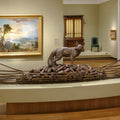
Installation view, ‘Nani Chacon... And I’ll say, it could be worse (reflections on light through dark times),’ Timothy Hawkinson Gallery, 2025. Photo by ofphotostudio.
“You see them everywhere. They're a very significant part of the landscape, and that was a large part of why this was such a big motivation to make this work,” Chacon said of the oddly humanoid transmission towers, often engineered as if standing on two legs with outstretched arms. “As Diné, we look at the landscape to understand our being and placement in the world, that idea of harmony and balance, and when we look at the land, and specifically our region, which is called Dinétah, how do we begin to reconcile or think about the transformations of that landscape when it's littered with industrial blight?”
How can a people of the earth be healthy when the earth is sick?
Dinétah, the Diné’s ancestral homelands, the Four Corners, northeastern Arizona and northwestern New Mexico, is sick. Sickened by over 100 years of mining. Mineral extraction. Coal. Uranium. Oil shale. Spills.
“Everybody who lives in those regions knows every hill, knows every mark of land, knows every 10, 20, 50-mile radius around them and what exists there,” Chacon explained.
What has been invisible in the air and underground has not always been understood. The effects, however, have. The 1979 Church Rock tailings spill on the Navajo Reservation resulted in elevated levels of lung cancer and birth defects for decades from radiation exposure. One prominent example among uncountable abuses to the land – and the people who live there – delivered by industry.
“There is something very strategic about placing instruments of industrialization out in rural landscapes because (society) doesn’t immediately have to confront them,” Chacon said.
This is environmental racism. Environmental injustice.
Why trash incinerators and toxic waste sites and coal ash dumps and heavy industry is cited as far from city centers and country clubs as possible.

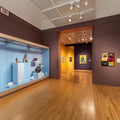
Installation view, ‘Nani Chacon... And I’ll say, it could be worse (reflections on light through dark times),’ Timothy Hawkinson Gallery, 2025. Photo by ofphotostudio. II
From Navajo Nation to New York City
Three monumental versions of Chacon’s towers are currently installed in the Whitney Biennial in New York City. The Biennial is the most prestigious survey of American contemporary art and has been for over 50 years.
“An interesting thing about making these works and them being included in the Whitney Biennial was how much of a response I got from people noting that either they didn't know what (transmission towers) were – what the reference of those were – or that they had a slight reference from maybe a road trip they took through some rural part of America,” Chacon said. “Folks don't necessarily know the process of where the electricity comes from. When the lights come on in a big city like New York, they don't know that process.”
When the lights come on in Los Angles, or Phoenix, or Las Vegas, or San Diego, or Albuquerque, where Chacon lives now, that electricity often originates – or originated – from coal mined and burned in Dinétah and the Hopi Reservation. That power was then transmitted hundreds of miles through high tension lines strung from transmission towers connecting source to user.
In the big city, you just flip the switch.
As solar power increasingly replaces coal, the Diné have a new problem stemming from the industry.
“Something we have to consider with all industrial infrastructure is – we need them to have as part of our livelihood – but at the same time, are we just creating a lot of industrial waste,” Chacon wonders.
Industry, particularly polluting industries like heavy manufacturing and resource extraction, have never given much – if any – thought to the end of life of their infrastructure. The answer to the question of what to do with the mine or derrick after it has been tapped out and used up has too often been “leave it.” Leave it to someone else to clean up. To the local residents, the government, taxpayers.
More than one million orphaned gas and oil wells exist around the nation. While no longer in use, they continue polluting the air, particularly with methane emissions.
After the Biennial closes August 23, one of Chacon’s sculptures will be installed on the land of the Navajo Nation. Prior to its second installation, radio broadcasting equipment will be added, broadcasting intentions stated by community members of the Navajo Nation for the future into the world.

New Sculptures, Paintings, and Neon
Chacon’s sculptures can also be seen at Timothy Hawkinson Gallery in Los Angeles through May 9. The medium is new to her. It was just over two years ago she began studying fabrication and learning how to weld.
Previously, paintings and murals – like the enormous lowrider mural on Albuquerque’s Arrive Hotel – were Chacon’s claim to fame. That mural brilliantly combines her Diné-Chicana heritage through background pottery patterns, the foregrounded lowrider, and a blooming prickly pear cactus honoring her homeland. Outlasting her piece in the Whitney Biennial and also in New York, find a ten-by-ten foot painting from Chacon installed at the Brooklyn Museum for next three years.
At Timothy Hawkinson Gallery, Chacon further debuts new “Bed Rot” series paintings reflecting on the current unending sequence of catastrophes being perpetrated and experienced worldwide. Beds are meant to be places for rest, for sanctuary, but the adoption of this new slang deflates that original connection. The term introduces the notion that beds can also be a place to hide from the world, to deteriorate, to wither away, and lose momentum. Chacon uses the beauty of Diné blankets in taking back rest and beds from those who wish to corrupt them.
Additionally, a new neon piece is included in the gallery exhibition. “Náátsʼíilid Biyáázh” is the deity responsible for connecting earth and heavens. The name in this rendition translates into “Baby Rainbow” in English. Chacon envisions what a new depiction could look like in the modern world. Its rainbow hues and twinkling stars emanate goodwill.