Art Helps Reconciliation efforts at Fort Lewis College
By Chadd Scott on
Reconciliation.
A coming together.
An understanding.
An apology.
Reconciliation with and for Indigenous communities in the United States aims to address the historical and ongoing legacy and impacts of U.S. settler colonialism on Indigenous communities, repair relationships between Indigenous and non-Indigenous peoples, and foster healing for Indigenous communities.
Reconciliation at Fort Lewis College in Durango, CO is a comprehensive process acknowledging the institution’s troubled origins while establishing respectful and reciprocal relationships with Tribal Nations and Indigenous communities. Fort Lewis College began in the late 19th century as Fort Lewis Indian Boarding School, a site of violent, assimilative, and other harmful practices prevalent in the federal Indian boarding school system.
Central to reconciliation is respecting the self-determination and sovereignty of Tribal Nations. The ongoing work at Fort Lewis College is a shared responsibility centering Indigenous voices, where community members actively participate in collaborative efforts to advance meaningful institutional change. The College’s reconciliation framework seeks an impact across four priority areas: Tribal Nation Building, Indigenous Culture and Knowledge, Language Reclamation, and Health & Wellness.
“Fort Lewis is (pursuing reconciliation) the best way I've seen by taking it seriously and taking their time, confronting the history of the circumstances that have led us to the privileges we have, and not letting that stop us, to keep moving forward, but to let us understand the way that history set us up (for) how we treat each other now,” scholar, writer, and independent curator Meranda Roberts (Yerington Paiute, Chicana) said. “It's a long process of getting things right, getting things wrong, and hopefully a future where we have our land back and we have our sovereignty returned to us in more ways than we have right now.”

“The Wild Wild West,”oil on paper, 2021, Karen Clarkson (Choctaw). Image courtesy of Blue Rain Gallery.
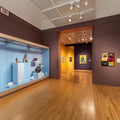
Roberts is assisting Fort Lewis College with its reconciliation efforts through the production of “Constellations of Place,” a major exhibition rooted in the landscapes and layered histories of Southwest Colorado. The presentation features a selection of over 60 textiles, pottery, beadwork, 2D, video projections, and mixed media from the Center of Southwest Studies at Fort Lewis College museum and archival collections alongside the work of 13 invited contemporary Native American, Indigenous, and Latinx artists. The show is free and open to the public through December 18, 2026.
Southwest Colorado and Fort Lewis College
Southwest Colorado holds stories in its mountains, rivers, and canyons—stories long predating colonization. For generations, the Nuuchiu (Ute), Diné, Apache, Hopi, and Pueblo people lived in relation to this land, moving through networks of kinship, trade, and care.
In time, these routes were crossed and redirected by settler expansion. Trails became highways; rivers were renamed, and the region was romanticized as a land of beauty and freedom—narratives that erased both displacement and exploitation. Yet movement also carried memory: routes of return that endured even through separation and loss.
The land itself is a witness.
Fort Lewis College sits at the heart of this story. Once a military outpost and later a federal Indian boarding school (1891–1911), it is now a public institution serving Indigenous, Native American, and Latinx students who continue navigating that legacy. FLC is one of the country’s most diverse campuses with over half its students identifying as people of color; it is federally designated as a Native American-Serving Non-Tribal Institution. Though its role has changed, its foundations remain shaped by histories of removal and assimilation, and by the perseverance, creativity, and love that endure.
As Colorado marks 150 years of statehood and the United States its 250th anniversary, “Constellations of Place” invites visitors to look closely at how we understand place, memory, and belonging. The exhibition title comes from seeing the region not as a single story, but as many points of light that only take shape together.

Included artists are interconnected through their roots in the region. Artworks on view hold space for grief and endurance, rupture and repair, beauty and burden, and remind us that survival is not passive, but an active practice of creation, adaptation, and care.
Active.
Participatory.
“From a curator point of view, I'm speaking to a non-Native person, inviting them to take some responsibility in learning more about the history, not just taking it for granted, not just romanticizing it,” Roberts explained of the exhibition’s intent.
“Constellations of Place” asks something of guests beyond looking then leaving. Beyond reflection toward responsibility. The show asks guests to engage personally in the work of reconciliation.
Are you willing?
Taking Responsibility for Reconciliation
Rather than treating reconciliation as a conclusion, “Constellations of Place” understands it as an ongoing responsibility—one requiring institutions, communities, and individuals alike to step into deeper forms of belonging.
To take action. To do something. To do the work. To sustain it.
The exhibition is an invitation. A starting point.
Roberts wants visitors to question what does Southwest Colorado hold; what have we been taught about the place and taught to forget?
Take borders as one example.
The exhibition uses both Native American, Indigenous and Latinx in describing artists’ backgrounds, recognizing – reminding – that the political borders of the Southwest demanding those silos are settler colonial inventions. Contemporary distinctions. Insider/outsider. Native American on this side, Latinx on that side, Indigenous on either side.
The people and cultures with ancestral homelands in the Southwest predate the United States and Mexico by thousands of years.
“I'm inviting people in to learn something new, not an attack, not something to feel bad about, to understand our stories a little deeper than what you want,” Roberts said. I hope that's what the artwork leads (visitors to) thinking about. I hope they look at that artist and try to get to know about that artist's story and about the history that they come from and how expansive that is. A different point of view of the Southwest from a different artist.”

“Bleeding Sky,” acrylic on canvas, 2008, James Joe (Diné), Center of Southwest Studies permanent collection, 2008104.001
What other truths about the Southwest remain unspoken, unsettled, or obscured? How might we carry these truths – together – into a future honoring the beauty the region while confronting its layered histories and deepening our responsibility to one another and the land?
“This exhibition is here to remind you that Native American, Indigenous, and Latinx art and aesthetics are to be cherished and loved—but love alone is not enough,” Roberts’ curatorial statement reads. “To truly honor these practices, you must also fight for our rights, stand with our communities, and refuse the systems that continue to harm us.”
Reconciliation To Do List
What can you do to assist the work of reconciliation with Indigenous people in the United States? Plenty.
I am a white person who has taken a personal responsibility to understand, support, and advocate on behalf of Native people over the past 10 years or so. To be an ally. It is a daily effort I have committed the rest of my life to. I take it seriously.
Through my writing here at “Essential West” and elsewhere, I have the extreme privilege of talking to Indigenous artists and curators like Roberts. You may not have that opportunity, but countless other avenues exist to take responsibility toward reconciliation. Let those efforts begin with art.
Art is the people’s history. Indigenous artists worldwide share their history, beliefs, and stories through art. I have learned more about Native America and Native Americans through art than any other vehicle. Start with T.C. Cannon, Jaune Quick-to-See Smith, Shonto Begay, Roxanne Swentzell, Wendy Red Star, and go from there.

For art museums, the Seattle Art Museum and Denver Art Museum have the best Indigenous/Native American collections I have seen among encyclopedic institutions. Among Native art museums, I always learn something new when visiting the Wheelwright Museum of the American Indian and the Museum of Indian Arts & Culture, both located in Santa Fe on Museum Hill.
Among non-art museums, the First Americans Museum in Oklahoma City, the Field Museum of Natural History in Chicago, and both locations of the National Museum of the American Indian – New York and Washington, D.C. – are exceptional in the presentation of Native history and culture. Countless others can be found across the nation.
Read.
My “Essential West” articles share stories of Native art and culture almost weekly.
Matika Wilbur’s “Project 562” book offers beautiful insights into Native America.
Dee Brown’s “Bury My Heart at Wounded Knee: An Indian History of the American West” (1970) may be the best place to start doing the work of reconciliation.
Read the news. Read about what the United States government is proposing for Chaco Canyon, not far from Durango.
Listen and watch.
Medicine Man Gallery founder and owner Mark Sublette’s “Art Dealer Diaries” podcast and YouTube channel has shared stories from Native American artists for years.
Go.
Visit a Native nation or reservation. Go to Pine Ridge Reservation in South Dakota. Look over the field where the Wounded Knee Massacre occurred. Doing so will change your life.
Attend a powwow, feast day, or Indian art market. They occur throughout the year across the country. Go to Indian Market in Santa Fe. Doing so will change your life.
Do these things.
Do them daily.
Doing so will change your life.