Back to School Lessons for Budding Artists from Dwayne Manuel
By Chadd Scott on
Dwayne Manuel (b. 1984; On’k Akimel Oʼodham / Salt River-Maricopa Indian Community) has lessons for aspiring artists heading back to school. First among these lessons is the value of a traditional arts education. The value of teachers and peers and figure drawing classes and learning perspective and something of art history.
“The experience of getting to work with not only your fellow students, who are also learning the same thing you're learning, but also working with these professors, these professional artists,” Manuel said. “People tell me nowadays you can learn it all on YouTube, but working with somebody who's a mentor, working with a person who's been through it, still doing it, knows their stuff, and you get this honest feedback from them for your work.”
Manuel was born with a talent for drawing. He can’t remember a time when he didn’t have a pencil in his hand. Still, he pursued a traditional fine arts education. He earned a Bachelor of Fine Art degree from the Institute of American Indian Arts and a Master of Fine Art degree from the University of Arizona School of Art.

Dwayne Manuel, 'Shield in Blue-Green and Brown,' (2026). Courtesy of the artist.
“The whole studio learning environment was another benefit, because again, you can learn stuff on YouTube, but it's a different environment when you're working as a team, all learning the same thing and you get to hear all these different conversations,” Manuel explained. “The instructor can stop you all at any point and demonstrate something. That's missing nowadays, at least from my experience – the teacher – because we are primarily virtual. I miss the in-person environment because it's a whole different atmosphere.”
Manuel teaches painting and drawing at the Tohono O’odham Community College in both Sells, AZ and Phoenix. Manuel first attended community college following high school. Another lesson. Four-year schools can be expensive. Community college allows students to make sure they’re ready, committed, and interested enough in art – or any field – to stick with it through university.
“I really didn't know what I (wanted to do when I) graduated high school. I knew that I liked creating artworks, drawing,” Manuel said. “I live on the reservation in Salt River, and growing up there, my friends and family who were a similar age, moving on to the next step, they weren't talking about college. I was like, ‘What do I do here?’ I felt like I needed to do something positive for myself, my family, and community… and I wanted to explore what art really was.”
With the encouragement of family and friends, community college gave Manuel the opportunity to explore. He liked what found.
At IAIA, he loved what he found. Part of it, anyway.
Manuel bombed out.
Another lesson.
“It was a lot of fun, for sure, but there were repercussions for that fun,” Manuel said. “I was out of balance. I was young, I was away from home, I started to make friends and meet people, and I started to feel the excitement of the nightlife. I took it full throttle.”
Manuel was hardly the first or the last young person to attend college and find the social aspects more interesting than the classwork. Don’t let a bad semester or a year of partying derail a potential lifelong career. Another lesson. These are the kind of mistakes at 19, 20 years old budding artists can overcome.
Manuel got his act together, overcame his bad start, earned his undergraduate degree and went on to get his Masters.
As a professional artist, he has received major public and private mural commissions in Phoenix and Tucson, worked with Nike on a project for the 2023 Super Bowl, and is increasingly picking up gallery attention. He also teaches. Another lesson. No matter your talent, no matter your degree, no matter your hustle, most professional artists will need to supplement their artmaking income in other ways. Don’t feel bad or lesser than because of that.

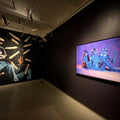
Dwayne Manuel mural at Tucson Museum of Art. Courtesy Tucson Museum of Art.
O’odham Basket Paintings
Influences of graphic novels, street art and graffiti, anime, and computer games and graphics are found in Manuel’s art. His O’odham background as well, of course. His O'odham basket paintings meld all these inputs.
“Those are explorations, me trying to find visual language utilizing these traditional O’odham designs,” Manuel explained.
His IAIA professors encouraged Manuel to venture into his identity as a Native person. To explore how he could contemporize his heritage as fine art. Make it his own.
“What I was always told by my mother, who was a basket weaver, ‘The designs are for you. These are your people. Use them if you like,’” Manuel remembers. “For me, as a male, in my culture, males traditionally weren't making baskets. You're not supposed to make a basket because it was a woman's role. That's what I thought coming up.”
College showed him how he could make baskets through painting.

Dwayne Manuel, 'Our World After the Floods,' (2017). Courtesy of the artist.
“They were a contemporary way for me to utilize the O’odham designs as an arena to explore tradition versus contemporary times,” Manuel said. “Salt River, we are definitely in a very special location, because we are pressed up right against these urban cities like Scottsdale, Tempe, and Mesa. I started looking at the landscape of those, and everything was geometric. I started merging geometric shapes, the traditional basket designs – which are usually circular or curved – but (incorporating) also abstracted elements of natural happenings in the world.”
Manuel eventually scaled up his O’odham basket paintings from canvas to wall, swapping brush for spray can, using techniques learned from time spent as a street artist and graffiti writer. He has stepped back from the mural game now to focus on his studio practice.
Perhaps that’s the greatest lesson for budding artists to take from Manuel: evolution. From community college to a Masters degree. From O’odham baskets to contemporary painting. From graffiti to galleries. From student to teacher. A career in art requires evolution, flexibility, experimentation. Rarely is it a direct route.
Think about your personality. The life you want to lead.
Are you adaptable? Can you handle the ups and downs? The uncertainty of an entirely uncertain and unpredictable profession?
When thinking about artmaking as a profession, you may be able to make art, but can you make art work for you? Those are two very different things.