Paul Burlin: A New York Modernist in Santa Fe
By Chadd Scott on
Paul Burlin first visited New Mexico in 1910. Like other painters occupying New York’s modern art community at the time, he was fascinated by the prospects of the Southwest. By the light. The Indigenous cultures. The vast landscape. Stories and paintings from other Eastern artists who’d been.
This was also an era in which avant-garde American artists were looking to break from European traditions. They sought to create a distinct, American art. But nothing comes out of nowhere, so they looked west. To the mountains and canyons and plains. To the Indigenous people who had artistic traditions based on this continent going back thousands of years.
The Taos Society of Artists, Stuart Davis, Marsden Hartley – countless turn of the century artists went to New Mexico from “back East” in search of an “authentic” American art form. Burlin (1886–1969) was among them. He was distinguished by his age. The painter was 24 when he first made the trip.
It would not be his last.

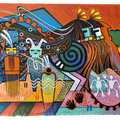
Paul Burlin, ‘Untitled (Indian Ceremonial Dance),’ n.d., oil on canvas, 36 × 139 14 in. New Mexico Museum of Art. Bequest of Frances M. Harris. © Courtesy of the Paul Burlin Trust. Photo by Addison Doty.
Captivated, he returned in 1913, choosing to stay this time. He’d live in New Mexico until 1921. Santa Fe. Though Burlin came to the state through Taos and connections to famed arts patron Mabel Dodge Luhan who lived there – and later brought Georgia O’Keeffe and numerous other icons of Modern art to the area – Burlin preferred the more cosmopolitan state capital.
Burlin met his wife, Natalie Curtis, there. They married in 1917. She was an ethnomusicologist specializing in Native American music. It was Curtis who provided Burlin immersion with the Pueblo people and their ceremonies.
Ceremonies he would paint.
Paintings that expanded to murals that would end up back in New York. Paintings that found their way back to New Mexico in 2016. Paintings now at the center of an exhibition at the New Mexico Museum of Art in Santa Fe, “Paul Burlin: An American Modernist in the Southwest.” On view through October 18, 2026, the presentation highlights Burlin’s deep and formative relationship with New Mexico and illuminates his role in shaping the distinctly American modern art he and his peers were in search of.

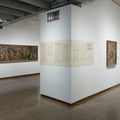
“Paul Burlin An American Modernist in the Southwest,” Clarke Gallery, New Mexico Museum of Art, on the Plaza in Santa Fe, New Mexico, March 21 - November 29, 2026. Photo by Addison Doty.
Modern Art Meets New Mexico’s Pueblos
Between Burlin’s first and second trip to New Mexico, his career took a decisive turn in 1912 when married collectors George A. Harris (1889–1960) and Lillian D. Harris (1892–1922) acquired his painting Figure of a Woman. That initial encounter sparked decades of patronage and collaboration, resulting in an extraordinary body of commissioned murals, paintings, and Southwest-inspired scenes.
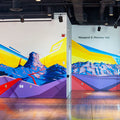
At the heart of the exhibition are Burlin’s early mural paintings—Stone Age, Rhapsody, and Awakening—created for the Harrises’ Manhattan apartment and profoundly shaped by Burlin’s 1910 visit to New Mexico. The murals reveal Burlin’s remarkably early engagement with European modernism. Fauvist color, the structural rigor of Paul Cézanne (1839–1906), and cubist-inspired geometry converge with imagery drawn from Pueblo life along the Rio Grande. The result is an artist already forging new terrain between international avant-garde ideas and American subject matter.
“What makes this body of work especially compelling is how deeply rooted it is in New Mexico,” Alexandra Terry, New Mexico Museum of Art’s Head of Curatorial Affairs, said via press release. “He wasn’t simply borrowing from European modernism—he was transforming it through his experience of place, light, and culture in the Southwest.”
At this point, what would come to be known as “Modern” art had yet to “break” in the United States. That would happen in 1913 at the watershed Armory Show. The significance of the 1913 Armory Show – and Burlin’s participation in it – is captured perfectly by Payton Wright gallery, which continues representing Burlin’s work: “The revolutionary exhibition of avant-garde European work that can be credited with introducing modern art to the United States and stimulating the development of modernism in America. There, Burlin’s work was exhibited alongside works by such artists as Picasso, Monet, Cézanne, and Duchamp.”
American art existed in one fashion before the Armory Show and in a distinctly different fashion after it. Burlin – still in his mid-20’s – was one of the few artists who could legitimately say his work saw the transition coming and also helped create and bridge the transition. Despite this, Burlin has fallen through the art historical cracks, an overlooked figure in American Modernism.
Burlin’s Southwestern, Pueblo-inspired murals created for the Harris’ apartment were carefully preserved by successive generations of the family and brought into the museum’s collection in 2016. They were then conserved, bringing out their original splendor.
“In each of these mural paintings, he's trying different things, different palettes, different contexts in each one,” Terry told me. “He makes these paintings that go around the top of the walls of their Manhattan apartment, which is why they were in the condition they were in, people were smoking. They were in the city. It was this super industrial period, so they were darkened and grimy.”
Together, these works position Burlin as a pivotal figure bridging continents and cultures, helping to shape a modern art rooted in place yet conversant with the most radical ideas of his time.

“Paul Burlin An American Modernist in the Southwest,” Clarke Gallery, New Mexico Museum of Art, on the Plaza in Santa Fe, New Mexico, March 21 - November 29, 2026. Photo by Addison Doty. 2
Paul Burlin in Santa Fe
In Santa Fe as in New York, Burlin hung out with the cream of the artistic crop. In New York, it was the crowd around Alfred Steiglitz – the future Mr. Georgia O’Keeffe – and his Gallery 291.
“(In Santa Fe) he's showing with (Marsden) Hartley. He's showing with Andrew Dasberg – I'm sure Cady Wells and BJO Nordfeldt – he had a studio right across the road from us at Palace of the Governors, which is now part of the history museum,” Terry explained. “He's in the thick of it, and he's exhibiting at the New Mexico Museum of Art, which was the Museum of Fine Art then, regularly. He's also engaging with our founding director Edgar Hewitt.”
The “lone genius” artist working in complete isolation pulling artistic innovations out of the sky is a myth. Artists are influenced. All of them. They are at their best when working in a community and that goes for the Renaissance through the French Impressionists, the Abstract Expressionists and countless generations of Native potters and weavers.
Burlin’s time in New Mexico not only coincided with the period where American artists were looking for an authentic American art, but an ethnographic period defined by “capture before extinction.” This was the belief among white intellectuals that Native American cultural history and stories and objects needed to be captured and catalogued before the inevitable extinction of Indigenous people in the United States. Think Edward Curtis photography.
Burlin’s paintings of Native American ceremony reflected this mindset. A subject matter for white artists controversial even then, verboten now.
“The mural paintings are depicting Pueblo ceremony, and there was a lot of conversation then about whether that was acceptable or not. I did read about this exchange between Mabel Dodge Luhan and Paul where she's saying it's not okay to depict these private ceremonies and these intimate moments that are not ours to share,” Terry said. “Paul's feeling was that he felt like an ally, and I think that eventually did come through his wife Natalie Curtis. He felt that by representing these special and unique moments of ceremony and life, that it would garner more interest in these communities in an attempt to protect them. What we understand now is a different story about sovereignty as to what to depict and how.”
Burlin and his wife left New Mexico for Paris in 1921, disgusted by the United States’ return to isolationism following World War I. Natalie died in a car accident almost immediately upon relocating. Paul Burlin was broken. He moved back to New Mexico, but it didn’t soothe him, and he shortly moved back to Europe.
The future trajectory of his paintings bore little resemblance to what he created in New Mexico.
“What most people recognize Berlin for is decades of abstraction and almost Abstract Expressionism moving out of his time in Europe and then and then back in New York,” Terry explained. “The period in which he was working here, and in New York prior to his move to Santa Fe, that period of work is remarkably different from what he ultimately moved into.”