From Oklahoma to Philly and Everywhere in Between: Ron Tarver's Black Cowboys
By Chadd Scott on
Who remembers the old Barbara Mandrell song “I Was Country When Country Wasn’t Cool?” It was her response to the Urban Cowboy craze of early 80s when city slickers nationwide were accessorizing with Nocona boots and Stetson hats. Mandrell wanted people to know she was about that life long before John Travolta rode a mechanical bull in the 1980 movie.
Consider Ron Tarver (b. 1957) the Barbara Mandrell of Black cowboy culture.
Before Beyoncé, before Little Nas X, before Jamie Foxx, Tarver was working to bring Black cowboy culture to the mainstream. It was 1993 when he first began photographing Philadelphia’s legendary Fletcher Street Riding Club – latter brought to national attention in the movie “Concrete Cowboy” (Netflix, 2021) – as a staff photog at The Philadelphia Inquirer.
Tarver’s engagement with Black cowboy culture goes back even further. To childhood. He was born in a little rural ag town in northeastern Oklahoma, Fort Gibson. His grandfather was a cowboy. He worked on farms and ranches as a teenager, even rounding up cattle on a dirtbike.

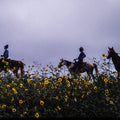
Ron Tarver (b.1957), ‘Texas Trail Ride (Multicultural Western Heritage Trail, Brackettville to San Antonio, TX),’ 1994. Pigment ink print. Courtesy of Ron Tarver.
Having worked at the Philly paper over 40 years, most assume he’s from there. Nope.
“I didn't really think it was anything special. There’s a rodeo ground right up the street from the house where I grew up. Saturday night, that’s what you did,” Tarver said about growing up around Black cowboys. “It wasn't until I did the story for the Inquirer that I found out that it was such a rarity, that people didn't know anything about it. That's what got me going on the project.”
Tarver’s project, “The Long Ride Home: The Black Cowboy Experience in America,” documents the rich visual narrative of Black cowboy life. Initiated at the newspaper over 30 years ago, the photography series has become a book published in 2024 and now an exhibition, “Black Cowboys in America: Photographs by Ron Tarver.” The Hudson River Museum in Yonkers, NY provides the first museum presentation of the Pulitzer Prize–winning photographer’s pictures of Black cowboy life on ranches, at rodeos, and in urban streetscapes.

“I didn't think about (cowboy culture) in terms of black or white. You grew up in a town like (Fort Gibson) and people herd cattle through your yard,” Tarver explained. “I wouldn’t have had it any other way. I don't have any connection to urban culture. Now I've been (in Philadelphia) 43 years working for the paper, I've definitely experienced it, but that wasn't my upbringing. I wouldn't know what it would be like to grow up on the streets of Philadelphia. It's a whole different experience.”
Black Cowboys in America
Black cowboys played an active role in building the American West working alongside white and brown cowboys wrangling horses, branding cattle, and steering herds long distances on cattle drives. A full 25% of men who labored on the ranches of Texas and participated on cattle drives before the Civil War through the turn of the 20th century were Black. An astonishing figure. Significantly higher than the country’s total population of Black inhabitants. Mexicans and Hispanic vaqueros accounted for even more, perhaps a third. That means white cowboys were the minority. They didn’t become the majority until Hollywood got involved.
Black cowboys – all cowboys – lived a nomadic and often lonely life, one that helped shape the myth of the American cowboy in popular culture as a symbol of this country’s rugged individualism. Yet, until recently, thanks in part to Beyoncé’s Cowboy Carter album (2024) and Pharrell Williams’s Louis Vuitton collection (2024) helping shine a spotlight on the proud history of Black cowboys, their existence has been little acknowledged.
“This kind of ebbs and flows. Every once in a while Black cowboys will be discovered to some extent. What made this time different was the infusion of the culture into pop music with Lil Nas X (‘Old Town Road,’ 2018), and then Beyonce came out with her album, and Shaboozey turned it into rap,” Tarver explained. “The infusion into pop culture made this one really blew up. A friend of mine just sent me a ‘Vogue’ magazine where they were featuring Black cowboy fashion. This time seems different. If I had published my book when I wanted to, in the mid-90s – I tried several times to publish this book – it wouldn't have had the same impact.”
Tarver’s photographs are a tribute to a way of life both old and evolving, capturing the beauty, romance, and visual poetry of cowboy culture while reflecting a renewed interest within the Black community in reclaiming its Western roots.

Ron Tarver (b.1957), ‘Worn Felt Hat (Multicultural Western Heritage Trail, Brackettville to San Antonio, TX),’ 1994. Pigment ink print. Courtesy of Ron Tarver.
“It is an American story. Although it is a Black story – the Black community has really embraced it – this is an American story. It's about America. It's about inclusion. It's about who built this country, who did the hard work to drive the cattle back at the turn of the 20th century. All those things led to the development of this country,” Tarver said. “I give talks at museums and the majority of the audience tends to be white, and they have a lot of questions. There's a genuine interest in how the Black western heritage has formed and shaped this country. I'm happy to see that. I'm so heart warmed to see that turnout and inquisitiveness.”
Members of Tarver’s cowboy side of the family continued to be involved in ranching. That side is Cherokee. Tarver’s cowboy grandfather was on the Dawes Rolls. Tarver himself is a member of the Cherokee Nation. His mother had a quilt that traveled the Trail of Tears.
Indian Removal. Indian Territory. Cherokee freedmen. Oklahoma. Freedmen’s towns. The Dawes Rolls. Assimilation. Other American stories for others to pick up.
“Black Cowboys in America,” along with a further examination of contemporary Black life from an artist still based in Oklahoma, Robert Peterson, can be seen at the Hudson River Museum through August 30, 2026.