Contemporary Native American Art Goes Global at Yorkshire Sculpture Park
By Chadd Scott on
Having finally secured a place in American mainstream art and popular culture on its own terms, contemporary Native art is going global. Jeffrey Gibson’s representation of the United States with a solo show at the 2024 Venice Biennale – the every-other-year global Olympics of contemporary art – broke that layer of the “buckskin ceiling,” a term coined by Jaune Quick-to-See Smith for the historic limits placed on contemporary Native artists. Gibson was the first Native American so honored at the U.S. pavilion.
Nicholas Galanin was featured in the 2023 Liverpool Biennial. Wendy Red Star had a gallery show in London in 2024. Now, a landmark exhibition of contemporary Native American art on a scale never before seen in the United Kingdom.
“Hold to This Earth: Works by Contemporary Indigenous North American Artists from Tia Collection” through April 2027 at Yorkshire Sculpture Park brings together 65 pieces by 38 artists spanning sculpture, film, photography, painting, ceramics, and fiber art. The expansive, cross-generational exhibition presents insight into the broad spectrum of work being produced by Indigenous North American artists today.
Located in north central England, Yorkshire Sculpture Park is arguably the world’s leading international center for modern and contemporary sculpture. Situated on a 500-acre 18th century estate, it is the largest sculpture park in Europe.

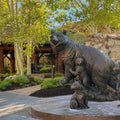
Raven Halfmoon, 'The Guardians,' 2026, on view at Yorkshire Sculpture Park. Courtesy of Tia Collection; Photo Copyright India Hobson, Yorkshire Sculpture Park.
Santa Fe-based Tia Collection had lent non-Native works to Yorkshire Sculpture Park previously. Founded in 2007, Tia Collection is a private global art collection supporting artists and institutions through acquisitions and loans. It has been dedicated to Indigenous art from the outset. Roughly a third of its 5,000 items are Native American. Beginning in 2015, Tia Collection honed its focus to uplift contemporary Native artists.
“Tia Collection is broadening the reach of contemporary Native art; we are seeking to bring Native art to Europe in a major way,” DC Allen, Tia Collection’s Cultural Liaison, Native American Collection, and artist, said. “There is not another organization doing the work that Tia Collection is doing supporting Native arts.”
Allen, a painter and Institute of American Indian Arts graduate living in Santa Fe, who has an artwork in “Hold to This Earth,” assisted Yorkshire Sculpture Park staff with the exhibition’s installation. He started with Tia Collection in 2021 as its first ever Native Arts fellow and has worked his way up the ranks through assistant registrar and now his current position which sees him building connections between Native artists and the Tia Collection, helping advocate for Native art and Native art voices, and finding partnerships and building networks with museums.
“Hold to This Earth”
The title of the exhibition is drawn from “Defend Sacred Mountains,” a series of text-based monoprints by artist, activist, and teacher, Hock E Aye Vi Edgar Heap of Birds. It is a call to action evoking resilience, continuity, and connection.
A new outdoor commission called Bear’s Tipi by Heap of Birds honors eight tribal nations for whom the extraordinary titular magma monolith is held sacred. Featuring their names – Cheyenne, Kiowa, Lakota, Arikara, Hidatsa, Mandan, Crow, and Arapaho – the work takes the form of eight street signs arranged in a circle, asserting presence and indigenous sovereignty within the landscape and calling for the protection of natural monuments that are being desecrated.
The initial concept for “Hold to This Earth” was limited to outdoor sculpture. The vision expanded greatly from there. Ultimately, artists representing over 30 tribes referencing and honoring ancestral knowledge through steadfastly contemporary work, asserting a powerful presence and countering narratives of erasure that too often position Indigenous cultures only in terms of the past, were included. The unifying theme is a deep, complex, and enduring relationship between people and land. Though distinct across each Nation, Indigenous cosmologies center the earth as a living and nurturing entity where everything is interconnected. Across the works displayed, land is not a passive subject – it is pervasive and fundamental, acting as witness, participant, collaborator, and material.

Installation view 'Hold To This Earth' at Yorkshire Sculpture Park with artwork by Marie Watt, left, and Rose B. Simpson. Courtesy of Tia Collection. Photo Copyright India Hobson, Yorkshire Sculpture Park.
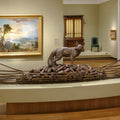
Sited in relationship to a statuesque ash tree, Trade Canoe: King of the Mountain (2025) by Jaune Quick-to-See Smith honors the rare white bison known as Big Medicine that held great symbolic significance for Smith’s community. His remains were confiscated for taxidermy and display by the US government. The Salish and Kootenai Tribes of the Flathead Valley fought for years for his return, underscoring enduring struggles over cultural stewardship.
Alongside ancestor artists including Allan Houser, George Morrison, and Smith, “Hold to This Earth” features elders like Heap of Birds, Bob Haozous, Kay Walkingstick, Emmi Whitehorse, and Roxanne Swentzell. These artists put the work in during the 70s and 80s and 90s, helping establish contemporary Native art without the ballyhoo it receives today.
Following in their footsteps, also on view in “Hold to This Earth,” are the Native artists who stood on their shoulders and surged into the mainstream: Gibson, Red Star, Galanin, Cannupa Hanska Luger, Virgil Ortiz, Cara Romero, Rose B. Simpson, Marie Watt, and Dyani White Hawk.
The show highlights heavyweights of contemporary Native American art with works emblematic of what they are best known for. Hits.
Coming up behind them, another generation taking contemporary art into exciting, new directions. They’re included in the presentation as well. Melissa Cody, Yatika Starr Fields, Raven Halfmoon, Eric-Paul Riege, and Zoë Urness among them.
‘Faces of Our Land’
Following his popular “Vanishing” series, Allen used downtime during the pandemic to think more deeply about his practice.
“I felt like I hit a wall,” Allen said. “I had some commercial success; Santa Fe treated me very well. My previous series had kind of run its course. The gallery representation in Santa Fe was strong with that. However, the ‘Vanishing Series’ wasn't breaking into museums, it wasn't breaking into public art spaces.”
That’s where Allen longed for his work to be. Places like Yorkshire Sculpture Park.
“Vanishing” artworks centered on contemporary Crow people engaged in customary Crow culture. Powwow imagery. From the reservation. Allen next wanted to explore contemporary Native culture in more urban settings. Inform audiences that Native people are contemporary people living life in contemporary ways. More Pop Art influence. Street art influence. Text, graphics, corporate logos. Edge. Attitude.
With roots in art history.
This would become his “Faces of Our Land” series.
Allen’s painting in “Hold to This Earth” is an ode to Saint Sebastian, a popular subject during the Renaissance. Saint Sebastian was an early Christian martyr tied to a tree and shot through with arrows.

Installation view of 'Hold to This Earth,' 2026, at Yorkshire Sculpture Park with DC Allen painting center. Courtesy of Tia Collection. Photo Copyright India Hobson, Yorkshire Sculpture Park.
“This is a historical painting that has had a lot of references in pop culture. Muhammad Ali was posed and photographed in a similar posture for a 1968 Esquire magazine article,” Allen explained.
Allen’s “Saint Sebastian” features Crow tribal member and language educator Rusty LaFrance.
“He also is a cultural preserver. He beads and makes his own regalia,” Allen said. “In his painting, he's wearing all handmade regalia from his own practice; that includes leggings, includes the shield that he made, the moccasins, the paint on his face is from his making, and from his family.”
LaFrance isn’t the only story being told by the painting.
“Behind Rusty is an actual poster from 1910 advertising Indian lands that had been stolen and we're going to be auctioned off,” Allen explained. “These are real ephemera. This is a poster that was made and put to public, and in there you see all the different acreages, the price points. Not many people realize that these Indigenous lands were stolen and then sold at that scale. There are millions of acres listed on that poster. My grandmother and her parents grew up just after this; it's not so far removed from our histories.”
Allen using the poster in this way also nods to Native ledger art, “a reclamation of that knowledge, that power, that system, an ode to Indigenous art history, taking it back and reclaiming it.”
Colonialism. Capitalism. Extraction. Land. Identity. Resistance. Resilience. Survivance. Cultural memory.
Allen looks forward to European audiences making connections between the Indigenous experience in the United States and the experience of other indigenous people around the world. How their stories are the same.
“A global reckoning with these important issues,” Allen said. “The humanity in indigenous peoples and the global connection between people.”
Exhibition organizers hope the presentation will travel across Europe through 2030 with additional stops in Germany, Italy, and the Netherlands.