'At Home in the Sunlight:' Painting California in the Early 20th Century
By Chadd Scott on
“The last living outdoor paradise.”
California’s civic leaders pitched this fantasy to the nation and the world in the early 20th century hoping to lure new residents, industries, and tourists.
It was very successful.
A near total fabrication, but successful.
UC Irvine’s Langson Orange County Museum of Art’s exhibition “At Home in Sunlight: A State in Motion, 1897–1940,” begins with artworks reinforcing this mythic California.

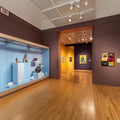
'At Home in Sunlight, A State in Motion, 1897-1940,' (installation view), 2026, UC Irvine Langson Orange County Museum of Art, photo by Eric Stoner.
“The first section is about climate and identity; I wanted to make a comparison of how artists were either confirming or denying this fantasy of California as the last living outdoor paradise,” UC Irvine Graduate Student Researcher and exhibition curator SeeVa Dawne Kitslis said. “In the early 1900s you have all these resorts and retreats for fresh air and health benefits springing up all over California and you have artists in this section who are only working in the landscape.”
A stunning landscape of mountains, ocean, spectacular trees, sunshine, and brilliant blue skies. California as “the last living outdoor paradise” isn’t a complete invention. There’s enough truth grounding it to stand on.
“I was thinking about the formation and success of Southern California's real estate boom, especially the L.A. area, which was largely fabricated by this inventiveness of civic leaders; they shaped the image and myth of what Southern California is to the world,” Kitslis explained.
Southern California having the perfect climate as an example. Never mind the mudslides and drought and rainy winters. The best myths have some basis in reality while erasing the nuance. Propaganda 101.
Early 20th century artists in California painted – and promoted – this idyll.
Clark Hobart (1868-1948) has a painting in the show. His work was included in contemporary exhibitions presented by the early Los Angeles Chamber of Commerce. You can imagine the picture of the region it wanted to share.
“In his work, (Hobart) confirms and shapes the early promotional California because he's looking at California with this idea that it's unspoiled nature,” Kitslis said. “His work in this section props up these booster myths.”
By the time Hobart’s painting in the 1910s, chunks of natural California had been wrecked for decades by gold miners. He’s painting only 10 years after the catastrophic 1906 San Francisco earthquake. No mention of that.
“I wanted to include him in the show because his work was used by civic leaders (to reinforce) the glorious California landscape that we all know, his work had this function,” Kitslis added.
While major urban centers like San Francisco, Los Angeles, and San Diego competed to establish themselves as dominant Pacific trade hubs to Asia, waves of artists arriving westward from Europe and the U.S. Midwest after the turn of the century – like Hobart from Illinois – sought to capture the state’s landscape. From Canada, too, like Henrietta Shore (1880-1963).
Shore was fascinated by Southern California’s native succulents, which to her eyes, were exotic. Paintings of succulents were routinely used by magazines and boosters to promote the state, further uplifting the “last living outdoor paradise” mythology. L.A. as desert oasis.
Then came the palm tree.
All of California has only one native palm species and it is found far from L.A.
“It was not until Southern California's turn-of-the-twentieth-century gardening craze that the region's leisure class introduced the palm as the region's preeminent decorative plant. Providing neither shade nor marketable fruit, the palm was entirely ornamental. Its exotic associations helped reinforce what Kevin Starr describes in ‘Inventing the Dream’ as ‘Southern California's turn-of-the-century conviction that it was America's Mediterranean littoral, its Latin shore, sunny and palm-guarded.’”
The last living outdoor paradise.
Fantasy.
All those palm trees you see around Southern California are introduced. An invention. They look great though, don’t they?

Charles Payzant, ‘Olvera Street,’ after 1930. Watercolor on paper, 21 x 27 12 x 1 78 in. The Buck Collection at UC Irvine Langson Orange County Museum of Art.
Harbor Wars
The exhibition’s second section, “Harbor Wars,” focuses on California’s ports as sites of trade, labor, and geopolitical competition; the human and environmental stakes of California’s maritime industries. Reality introduced to the fantasy.
By 1914, the Port of Los Angeles was the largest center for commercial fishing in the country.
“There was so much economic growth happening here and I was wondering are artists noticing these economic trends? Are they documenting them? Does our collection denote any of this growth that's happening in the region? The answer is ‘yes,’” Kitslis said.

Paul Sample, ‘Inner Harbor,’ 1929. Oil on canvas, 34 18 x 36 18 in. UC Irvine Langson Orange County Museum of Art. Gift of The Irvine Museum.
Plein air painters went outside, and not only into nature. They visited and painted the urban environment. The industrial environment. The hustle and bustle of the harbor. Labor. Wisconsinite Donna Schuster (1883-1953) created hundreds of watercolor paintings of the Japanese fishermen and fishing boats in San Pedro. As did others.
This was not the picture of mythic Southern California the state’s civic hype men wanted disseminated, the diversity of the people who lived and worked there.
“During that time period there was a real bend towards wanting to portray the whiteness of Southern California and attract people to this whiteness version of the state,” Kitslis explained.
The fancy, well-to-do, garden club and sportfisherman Southern California.
Bunker Hill
California in the early 20th century experienced a rapid increase in population – people from all over the world – and industry. It might have felt like the entire, enormous state was a boomtown. Commercial fishing, agriculture, mineral and oil extraction, real estate, tourism, and soon the movies. These industries needed workers. Workers who weren’t always going to be living the good life.
“Urban Life—Contested Space” closes out the exhibition, highlighting the emergence of urban realism as artists grappled with the social and architectural consequences of modernization. These works capture the tensions of a rapidly expanding state where beauty and inequity coexisted within the built environment. No boosterism here.
“When you have this advancing population happening in a short period of time, this creates a lot of tension, cultural and social stress,” Kitslis said.
“At Home in the Sunlight’s” final section makes this clear. Miller Sheet’s (1907-1989) lithograph of Bunker Hill in the 1930s (Family Flats, 1934) reveals an L.A. neighborhood more closely approximating the crowded tenements of New York than “the last living outdoor paradise.” This ain’t paradise.

Millard Sheets, ‘Family Flats,’ 1934. Lithograph, 25 18 x 31 38 x 1 38 in. The Buck Collection at UC Irvine Langson Orange County Museum of Art.
“In this small neighborhood in the center of Los Angeles, Bunker Hill, it was host to working class Mexican, Indigenous, Filipino, Korean, and Chinese immigrants all living together in this small area,” Kitslis explained. “(Sheet’s artwork) showed that compression of space and people living on top of each other.”
No palm trees. No garden clubs. No life of leisure.
“It also tells a story about how, again, civic leaders want to shape the imagery of downtown. Civic leaders wanted to erase Bunker Hill because they wanted to present this cleaned up version of downtown, and for that reason, all those people had to move,” Kitslis continued. “In this painting, Millard Sheets is documenting those populations before they have to be moved and erased from downtown and moved and erased from the history of L.A.”
Of course, these people didn’t have to be moved and erased. It was only in continuing their promotion of the Los Angeles myth that civic leaders deemed they didn’t belong. The “Urban Renewal” and urban removal of Bunker Hill residents took place in the 1950s.
Artists saw and recorded all of it, over time becoming at least as interested in documenting the reality as the fantasy. As the years wore on and the Great Depression and World War II approached, California’s plein air “Scene Painters” took advantage of new mass transit mobility to take their watercolors into areas not previously considered for fine art.
“Instead of looking to the European masters and copying what was in Europe, they were looking at everyday life, the realities in the urban environment; the subject matter really changes,” Kitslis explained. “Urban infrastructure, Watts in the 30s, the trolley coming down, railroad infrastructure, the more grit of everyday life as a subject matter that really didn't exist before. They're doing plein air, but not in oil. They're doing it with watercolor. They're painting faster and more spontaneous, getting out in the city to do that instead of going off into pristine nature. They're creating a visual record of spaces in L.A. and Southern California and all over California that no longer exist today. These watercolors are even more real than photographs of the time because they're in this beautiful, full range of colors.”
Beautifully painted, even if the images themselves aren’t exactly beautiful and don’t uphold the mythic “last living outdoor paradise.”
“At Home in Sunlight: A State in Motion, 1897–1940,” along with a companion exhibition, “Breakdown/Breakthrough: Art and Infrastructure,” can be seen through May 9, 2026.