Exhibition Examines Influence of Western Art on Western Movies
By Chadd Scott on
Fort Worth’s Sid Richardson Museum, specializing in the artwork of Charles Russell (1864–1926) and Frederic Remington (1861-1909), presents “The Cinematic West: The Art That Made The Movies,” an exhibit examining the influence of these two most famed Western artists on the silent film era and the early mid-century Golden Age of Western cinema.
The “Cinematic West” explores the connection between Remington and Russell and the birth of Hollywood’s Western film genre demonstrating how their depictions of the American West—its landscapes, characters, and mythology—directly shaped early Western films' visual language and narrative conventions. The Museum’s access to one painting in particular – Remington’s 1897 A Misdeal, belonging to a private collection – takes this presentation where others similarly focused have not been able to venture before.

‘A Misdeal,’ Frederic Remington. Oil on canvas, ca 1897. Private collection. Image courtesy of the Sid Richardson Museum.
“That painting, we found out, was featured in a very early, 1918 silent Western film that John Ford (1894-1973) directed and starred Harry Carey (1878-1947),” Sid Richardson Museum Director Scott Winterrowd said. “I started delving in to that picture and learning about its history and I looked at the provenance and realized that Douglas Fairbanks (1883-1939) owned that painting for a number of years. Then, a number of years after he died, it was sold to movie producer Hal Wallis (1898-1986).”
Sidenote: Wallis produced “Casablanca” and “True Grit” among others.
Winterrowd continues: “Wallis was working on ‘Gunfight at O.K. Corral’ (1957) while he was buying Remington’s in the 1950s. Later, Hal Wallis put the picture in a 1961 Shirley MacLaine-Dean Martin film (‘All in a Night’s Work’). It became this kind of unraveled history of a painting that spent at least 80 years of the 20th century in Hollywood.”
A Misdeal’s depiction of a saloon gambling scene gone horribly wrong – bodies on the floor, guns drawn, gun smoke in the air – fallout from an imagined “misdeal,” was even taken whole cloth as inspiration for Ford’s 1918’s “Hell Bent.”
“In ‘Hell Bent,’ the movie kicks off with an author sitting at a table and he gets a letter basically saying that your character types are all too pure and too good, and they should be like regular people, they should be just as bad as they're good,” Winterrowd explains. “So, he gets up – and the title card actually says ‘A painting by Frederic Remington, A Misdeal’ – and he walks over, looks at this reproduction – it's not the actual painting, but we know that the painting was widely reproduced in 1897 – and he's looking at it, and the camera zooms in, and John Ford literally recreates the bar room scene – the brawl that's happening – on the screen, and it comes to life.”

Letter to Douglas Fairbanks, 'We Meet Again.' Courtesy CM Russell Museum.
Remington provided a nearly endless source of material to early Western filmmakers and actors. Also featured in “The Cinematic West” is a Remington painting on loan from the nearby Amon Carter Museum of American Art, also located in Fort Worth, also possessing a deep reservoir of Remington and Russell artworks.
“That was used in a 1917 Douglas Fairbanks film titled ‘Wild and Woolly,’” Winterrowd said. “That painting features a fantasy sequence where Fairbanks imagines himself in Remington’s painting His First Lesson, and he jumps up on a horse and bucks around the corral in that painting.”
That’s not all.
“Fairbanks utilized another Remington tableau in a 1920 film, ‘The Mollycoddle,’” Winterrowd continues. “At the very beginning, he references Remington’s painting Fight for the Water Hole, which is in the Houston Museum of Fine Arts.”
It wasn’t only Remington’s paintings that inspired early Hollywood Westerns.
“In 1917, John Ford's brother Francis Ford directed and starred in a version of Remington’s only novel and play, ‘John Ermine of the Yellowstone,’ so there was a lot of Remington going on between 1917 to 1920 in film,” Winterrowd adds.”
Amazing.
And those are only the direct references.
The “Golden Age” of Westerns began around 1939 with John Ford’s “Stagecoach” starring John Wayne. The exhibition includes the movie poster for “Stagecoach,” an image calling to mind another Remington in the Richardson’s collection, A Taint on the Wind. That picture depicts a stagecoach at night where the horses are rearing up from some unseen fear.
“I brought those pieces together because that painting was made in 1939, ‘Stagecoach’ comes out in 1939, and ‘Stagecoach’ is the moment when the genre of the Western gets elevated, and John Wayne goes from a B list actor to an A list actor – it's really the shift point for Westerns,” Winterrowd explains.
Furthermore, the exhibition displays a selection of Remington paintings featuring his cavalry subjects, and the movie poster for “She Wore a Yellow Ribbon” (1949), one of John Ford’s cavalry trilogy films also starring John Wayne.
C.M. Russell in Hollywood
C.M. Russell is most closely associated with Great Falls, Montana where he lived and painted for 24 years, but he and his wife wintered in the Los Angeles area from 1920 to 1926, becoming friends with many Hollywood stars, resulting in a cross-pollination of artistic ideas between painting and cinema. A wonderful photograph of Fairbanks and the Russell’s appears in the show.

Douglas Fairbanks, Charles Russell, Nancy Russell. Photo courteys of the CM Russell Museum.
“John Ford actually asked Harry Carey in 1924 to introduce him to Russell, and so he had a meeting with Russell; we don't know what transpired, or what was said, but I do think it's important to keep in mind that because Russell was out there in California, he was very much a touchstone for a lot of these western actors in that time, and that he met John Ford before his passing,” Winterrowd said.
Quoting from IMDB.com – the International Movie Data Base – biography of John Ford: “John Ford is, arguably, The Great American Director… (When Orson Welles) was asked who his three favorite directors were, he answered, ‘John Ford, John Ford and John Ford.’ Along with D.W. Griffith and Cecil B. DeMille, (these) first-generation pioneers created the narrative film in America, if not the world… an artist who helped define what America was on the silver screen.”
Ford won four Best Director Academy Awards, a record that still stands.
A legacy deeply influenced by Western art.
“What I've come to appreciate from the John Ford films is the way he was such a visual crafter of his films, he makes a really beautiful framing of the landscape that he utilizes, in particular when he's working in Monument Valley,” Winterrowd said. “I've really come to appreciate ‘Stagecoach’ in a way that I hadn't before because there's very much an artfulness to that film. One of the quotes I've read numerous times as I've been working on this is that Orson Welles says he watched ‘Stagecoach’ 40 times before he made ‘Citizen Kane.’ That speaks to the kind of artistry that is going on in Ford's classic westerns.”
Classic westerns owing a great debt to Western art, striking parallels between the artists' visual storytelling and the cinematic techniques employed by early filmmakers, examined in the exhibition through paintings, sculptures, and illustrations alongside clips of silent Westerns, vintage movie posters, and related ephemera.
More Cinematic West
The Booth Western Art Museum in Cartersville, Georgia also turns its attention to Western movies through a pair of exhibitions presently on view.
“Western Costumes from the Silver Screen: The Davey Collection,” features 24 iconic pieces of clothing and accessories worn by famous actors and actresses in Western films. These rare costumes are paired with Western movie posters, lobby cards, and historical photographs, offering a glimpse into the Golden Era of Western cinema and beyond. John H. Davey was a passionate collector of Hollywood memorabilia, amassing an extraordinary collection of over 3,300 Hollywood-related items, including Western costumes, personal items from legendary movie stars, and vintage fashion.

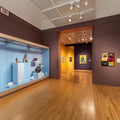
“Western Costumes from the Silver Screen The Davey Collection,” installation view. Courtesy Booth Western Art Museum.
Included in the show are the striped coat worn by John Wayne in “Dakota” (1945), the green dress worn by Elizabeth Taylor in “Giant” (1956) and a suit worn by Dustin Hoffman in “Little Big Man” (1970). The cowboy hat worn by Burt Reynolds and a shirt and pants worn by Dom Deluise in “Best Little Whorehouse in Texas” (1982) and leather jacket with fur collar worn by Jake Gyllenhael in “Brokeback Mountain” (2005) will also be on view. Vintage movie posters from “Giant,” “Little Big Man,” “Best Little Whorehouse in Texas,” “Brokeback Mountain” and other Westerns will be on view as well.
“Western Costumes from the Silver Screen” can be seen through September 21, 2025. A separate exhibition focused exclusively on Western movie posters from the Museum’s collection can be seen through October 26, 2025.