Anschutz Collection Provides a Double View into the Past
By Chadd Scott on
Visiting Denver’s American Museum of Western Art – The Anschutz Collection, is to see Western art and the West the way both used to be seen: narrowly. The personal art collection Denver-based billionaire Phillip F. Anschutz (b. 1939) amassed between the 1960s and early 2000s presents a mindset of collecting as much as individual artworks. A museum of an idea of Western art.
Among the hundreds of paintings over three floors hung cheek to jowl salon style, I counted one by a Native American artist, a classic Fritz Scholder portrait depicting an obscured Native figure with an American flag draped over the shoulder. The collection features countless paintings of Native Americans – Native subjects are a primary focus – but I saw only one by a Native American.
I lost count of the buffalo dancer pictures. Admittedly gorgeous paintings. One with a brilliant, abstracted, lime green, grape-purple, and pinky purple background by the fantastic Randall Davey (1887-1964) stood out.
Anschutz and his collection were clearly interested in Native people. Why, then, didn’t he welcome Native artists into his collection to tell their stories for themselves? Why were the perceptions of outsiders given preference?
During my visit to the museum in July of 2025, I registered three paintings by female artists: an O’Keeffe, one by a New Mexico artist I was unfamiliar with, Gina Knee (1898-1982), and a stunning – if all together out of place – purely abstract Helen Frankenthaler (1928-2011), Phoenix, 1976 (1976). Another by Grace Carpenter Hudson (1865-1937) is mentioned in the Museum’s free Gallery Guide.
I didn’t notice any paintings of or by African Americans, Asian Americans or Hispanics, all of whom have played important roles in the West.
Artworks in the collection, and the collection itself, takes an almost uniformly settler colonial, Manifest Destiny view of the West and Western art.

Thomas Hart Benton, ‘The Sheepherder,’ 1957. Courtesy American Museum of Western Art-The Anschutz Collection.
The Gallery Guide admits as much: “Early Western American art supported unfounded ideas, like Manifest Destiny. Manifest Destiny is the belief that White settlers were destined by God to settle the West with democracy and capitalism. It helped justify the removal of Indigenous peoples from their ancestral lands.”
This viewpoint of the West and Western art are increasingly – thankfully – being rejected. More than that, renounced.
Again from the Gallery Guide: “By viewing the West through a colonizing lens and emphasizing land over people, these artists implied that the West was largely uninhabited and open for American settlement and development.”
One of the reasons I spend so much time on “Essential West” writing about increased attention being received by contemporary Native American artists, by efforts in the field to expand narratives to include African Americans and Asian Americans and Chicanos, to highlight the work of women, is because that wasn’t always the case. The Anschutz Collection is the way it used to be. Western art and the West an inch wide and a mile deep.
Which is not to say I don’t recommend visiting. I do. The Museum displays an overwhelming assortment of magnificent, unforgettable paintings, many among the best of their kind.
I applaud the $5 entry fee. Compare that to the Denver Art Museum at $30 general adult admission a half mile away. The American Museum of Western Art – The Anschutz Collection is only open Mondays, Wednesdays, and Fridays from 10:00 AM to 4:30 PM with the last admission at 4:00. Children under eight are not allowed.

American Museum of Western Art-The Anschutz Collection, exterior. Courtesy Visit Denver.
Paintings in the Anschutz Collection
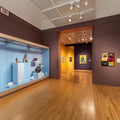
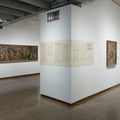
Artworks from the Anschutz Collection are displayed over three floors of the historic Navarre Building in downtown Denver across from the famed Brown Palace Hotel. Photography inside the Museum is prohibited.
I found the parallel between the Museum’s no photography policy and the no photography policy of the Pueblos in present day New Mexico, the subject of so many of the paintings… ironic.
The Museum presents no wall labels identifying artist names or artwork titles or dates. This information must be gleaned from frame badges, signatures on paintings, and information binders in the galleries.
The 19th Century: The Good, the Bad, and the Ugly
Guests enter the museum building below street level, ascending a flight of stairs to the first gallery space. There, you will find a barrage of dusty “cowboys and Indians” paintings. Cowboys fighting Indians to be more specific. Stereotypical “opening of the West” type stuff. The vanguard of Indigenous genocide in the West. Lots of horses.
The Gallery Guide highlights what the paintings do not: “The first cowboys in the U.S. were vaqueros, from a Mexican tradition of raising cattle.” It continues, “The profession itself attracted many Hispanic, Black, and Indigenous cowboys.”
None are shown in the artworks as far as I could tell.
More from the Gallery Guide: “Most of the painters and potential art buyers in the 19th century were predominately White, and by extension so were most of the depictions of cowboys. This omission of the diverse number of people working as cowboys in art persisted into the 20th century, giving a false sense that the cowboy profession was mostly white and male.
Highlights of the first gallery include a striking, five-foot-tall, two-foot-wide Indian Village of Acoma painting by Jules Tavernier (1884-1889) from the late 1800s that feels almost extraterrestrial. The foggy, ephemeral, Acoma ‘Sky City’ pueblo at dawn imagery I don’t recall seeing on canvas before.
A Thomas Moran (1837-1926) petrified forest painting in the same gallery is another iconic western subject I don’t recall having seen depicted in art previously.
Fredric Remington’s (1861-1909) snowy, grey, 1887 Return of a Blackfoot War Party proves bone-chilling in more ways than one. A fine Northern Plains C.M. Russell (1864-1926), The Scouts (1902), hangs next to it.
At the other end of the spectrum, Emanuel Leutze (1816-1868) offers a terribly patronizing and fetishized The Last of the Mohicans. What is a painting about Mohican Indians with ancestral homelands in the northeast doing in a Western art museum? Is its presence simply to reinforce the “disappearing race” mythology?
Leutze is best known for painting the monumental, ridiculous, Washington Crossing the Delaware (1851) painting on view at the Metropolitan Museum of Art. It is one of the most famous paintings in American art history despite its numerous problems, not least of which being that the “crossing” happened at night, not in broad daylight, and anyone who’s ever been in a small boat in choppy waters knows you don’t stand up. Silly. Propaganda.
Is the Mohicans painting an attempt to add another “big name” to the collection?
Worse still is Alfred Jacob Miller’s (1810-1874) The Crows Attempting to Provoke an Attack from the Whites on the Big Horn River, East of the Rocky Mountains. Pure white nationalism. Who’s attempting to provoke whom? The painting’s white traders are clearly intruded on to Native land.
The “artwork” is another example of propaganda, spin, lies, an effort to further sway public opinion into believing that Indians are bloodthirsty savages.
It’s also a mediocre painting; the figures are amateurish. Miller attempts to hide his marginal skill with grand scale. The painting is gigantic, more than six feet across.
Unsure of his ability to get the point across in the artwork, Miller explicitly spells out the narrative in the painting’s nonsensically long title.
If Picasso were a middling talent, he might have named Guernica (1937) – my choice for greatest painting of the 20th century – Nazi German Aircraft Attack the Peaceful Town of Guernica in Support of Fascist Franco’s Forces in Spanish Civil War to Devastating Human Effect. A supreme talent, Picasso simply named his artwork Guernica. The image tells the story, not the title.
Southwestern Landscapes and People
The Anschutz Collection achieves its apex on the third-floor where a breathtaking assortment of Northern New Mexico landscapes and paintings of Pueblo Indians are found. Weaken the knees type stuff. Nearly every painting an all-star.

Victor Higgins, ‘Pueblo of Taos,’ before 1927. Courtesy American Museum of Western Art-The Anschutz Collection.
Lots of Taos Society of Artists paintings including Walter Ufer’s (1876-1936) Autumn, a luminous, tender, double-portrait of an Indigenous couple – triple portrait if you count the dog – hung below an A+ landscape of his, Where the Desert Meets the Mountains.
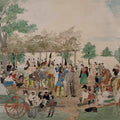
I was unfamiliar with Sheldon Parsons (1866-1943). I learned he was the first director of the New Mexico Museum of Art. His Springtime in Santa Fe bursts with spectacular colors, magnificent pinks and greens. Leon Gaspard (1882-1964) also puts pink to good effect in his San Geronimo Fiesta with dozens of figures aligned around the Pueblo’s courtyard.
Nicolai Fechin’s (1881-1955) Indian Summer combines action painting with still life. Depicted are kachinas, Indian corn, grapes, an apple, a vase – a mashup of traditional and unconventional still life motives – all done with electric blue, lapus lazuli highlights. One of the best still life paintings I’ve ever seen, and I’ve seen thousands, including from the Dutch Golden Age and Cézanne.
Three gobsmackingly good Birger Sandzén (1871-1954) Colorado paintings demonstrate why he’s the greatest landscape painter in American art history for my money. The very best Sandzén I’ve ever seen is found at the Denver Art Museum, but Anschutz’ three are of its caliber. The artist has built a foundation of rich, thick, heavy, almost goopy paint on the canvas, all of it in vibrant, high key colors. His paintings jump off the wall, delighting the eye. They look good enough to eat – visual gumdrops. Fantasy.
Contemporary Western Painting
The fourth floor hosts the collection’s most recent paintings, like the Frankenthaler. A classic Ed Mell (1942-2024) Flashing Storms (2009) hangs next to a large Maynard Dixon (1875-1946) across from the Frankenthaler.
While the Collection continues to be added to, those efforts are not undertaken with the gusto of previous spending splurges. As a result, the contemporary holdings are thin, scattershot, and augmented on display by earlier works.
The highlight here are two bangers of the Santa Fe Plaza from Kim Wiggins (b. 1959). Large, vibrant, detail-rich paintings produced in his classic wavy style, owing to Thomas Hart Benton (1889-1975). A Benton hangs nearby acknowledging the influence.
Among the mishmash of paintings on the fourth floor, a small one from John Gutzon Borglum (1867-1941) caught my attention. Not the painting, it’s only ok, but the artist. Borglum is best known as the sculptor behind Mount Rushmore. I’d never seen one of his paintings before.
He also happens to have been a card carrying Ku Klux Klan member.
The West, Western art, America, American History, complicated stories to put it mildly, all on display at the Anschutz Collection, who’s namesake, Colorado’s richest man, has a complicated story himself.