Wheelwright Museum Explores how the Vietnam War Shaped Native art
By Chadd Scott on
“That was the day I realized I am no longer that Michael who arrived into this country.”
Almost 60 years later, Michael Naranjo (b. 1944; Santa Clara Pueblo) still remembers it.
“One day we were out looking for Viet Cong – and of course they know we're coming, they saw the choppers, hear them, and they see these troops coming down the dikes – I came to this village and there was this old man in this one hut,” Naranjo recalled to me. “He's sitting there with his long mustache. You never (saw) young kids or women. This old man was sitting there facing the door with his little table in front of him and a teapot, two glasses. He smiles at me when I start approaching the door and my weapon’s pointed right at him. Imagine someone coming to your door over here and having a weapon pointing at you, and you're smiling at him.”
The old man offered Naranjo a cup of tea.
Naranjo refused.
“I pointed at the tea, told him to drink it. He drank it, poured some more, and offered me some more. I said ‘no,’” Naranjo said. “I took a quick look around inside a little thatch cut, but he was probably sitting on top of whatever was there. I didn't think about it till much later.”
Another day in Vietnam.
Not for Naranjo.
“I left at that moment (and) I thought, ‘Oh my God, what happened to me?’ I crossed that line of innocence into that preserving your sanity… you have to,” he said. “It's life. It's preserving your life, but it's disregarding the human dignity of another man. I found it very sad, but I had no choice at that moment, in the situation I was in.”
That situation: life or death.
Naranjo’s experience mirrored that of the roughly 2.7 million Americans who fought in Vietnam. Self-preservation, disassociation, compartmentalization, call it what you will, when faced with the brutal horrors of war daily, the only way of surviving is by shedding the humanity of “home” and adopting the shell of “here.”
Every combat soldier loses a degree of their humanity. How much depends on the soldier.
“By the time I left, I still had some of me inside, enough of me,” Naranjo remembers.
This reality, the survival instinct, doesn’t excuse soldiers from their behavior. It doesn’t excuse collective punishment or cruelty. It certainly doesn’t excuse My Lai or leadership from the President on down to platoon leaders who pushed – and always have and still do – young men to lean into their evolutionary savagery to commit unspeakable violence on behalf of their county.
A country that, in the case of Naranjo and the more than 42,000 Native Americans who fought in Vietnam, waged war on the homeland for more than 200 years with a ferocity and barbarity against its indigenous people equaling – and typically exceeding – anything it did overseas.
Which necessitates the following question: with everything this country did to Native people, why did he serve?
“When your country calls you, you serve,” Naranjo said.
No more thought than that.
“You go. You don't say ‘I can't,’ and say ‘I have a foot injury’ or something,” he added.

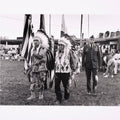
Zig Jackson Tom Yellowtail, 'Veteran Honor Song, Dance.' Image Courtesy of the Wheelwright Museum.
Losing his Sight, Finding Clay
Michael Naranjo was 22 when he was drafted into the Army. A young man’s feeling of invincibility dissolved fast in Vietnam.
“Once you're there, in a very short period of time, you come across these horrific situations,” he said.
Then you take part in horrific situations.
“I remember the first two Viet Cong that I saw that were dead – I was looking for weapons on their bodies around them, and they were half submerged in mud, the muddy water is slightly blood colored, and I had to walk away for a second before I threw up, and then I went back and checked around their bodies,” Naranjo said.
Just like that.
Another day in Vietnam.
Not even a full day.
“Some minutes later, I was shooting at a Viet Cong without any second thought. You see a man and he starts running away and you shoot him,” Naranjo said.
Just like that.
“I described it as when I used to hunt with my brother, that buck jumps up, and you shoot. You're hunting men is what you're doing out there. It's sick. It's not real,” Naranjo explained. “You're thrown into this unreal situation of life, the disregard of another man's life because you're protecting your own and the guy standing next to you because you don't know when you're going to need him.”
Naranjo’s platoonmates knew they needed him. All that time in the woods and hunting deer with his brother growing up in northern New Mexico around Taos equipped him for “hunting men.” In his unit, Naranjo walked point.
“My squad wouldn't go anywhere without me before I got out in front,” he remembers. “When we got out of the choppers, they were just standing there, so I had to go get them.”
The day he nearly lost his life from a grenade blast during an ambush at 23, being out front actually saved him.
“I kept charging towards the jungle,” Naranjo said.
The worst of the fighting ended up being behind him.
Another day in Vietnam.
Naranjo wasn’t killed, only maimed.
Lucky, in a way.
His time in the jungle was over.
Naranjo initially went to Japan for recovery, then Fitzsimons General Hospital in Denver.
After a while, he was well enough to catch the bus to Taos and go back home on weekends.
“Walking into town, people would come up and hug me and cry on my shoulder,” he remembers. “After a while, I didn’t want to go to town because I didn't want people crying on my shoulder.”
Michael Naranjo is one of 10 children. His mother Rose is matriarch to arguably the most prominent family of Indigenous artists from the Southwest, a lineage that includes Jody Falwell, Susan Falwell, Roxanne Swentzell, and Rose B. Simpson to name, but a few. Michael Naranjo credits his familial support network for preventing him from descending into the self-pity and self-destruction tens of thousands of other Vietnam vets experienced after their service.
In Japan, Naranjo asked for modeling clay.
Clay was life to his family and people.
With only his left hand, he began sculpting. He always wanted to be a sculptor. In the family he came from, he knew his future would be in the arts.

Michael Naranjo, 'Deer Spirit,' 1972. Image Courtesy of the Wheelwright Museum.
‘Outburst’
Michael Naranjo’s work and story are one of many shared at the Wheelwright Museum in Santa Fe through April 17, 2027, during “Outburst,” the first exhibition exploring the intersection of activism, creativity, and the effects of military service on Native American art from the 1970s. Naranjo was among a staggering number of Native American artists to serve in Vietnam. Not Sunday painters or hobbyists, mind you, legends: T.C. Cannon (Kiowa, Caddo), Doug Hyde (Assiniboine, Nez Perce, and Chippewa), Dugan Augilar (Mountain Maidu, Pit River, and Walker River Paiute), Rick Bartow (Wiyot), Bob Haozous (Warm Springs Chiricahua Apache).
Naranjo’s featured sculpture depicts a standing soldier with a wounded soldier draped over his shoulder. While not an image he saw, he experienced the sentiment.
“Over there, he's your brother,” Naranjo said. “You were truly brothers and sisters. Only once did I see two guys have a disagreement, and 10, 15 minutes later, they're sitting down playing a game of cards.”
The work of veterans is complimented by contemporaries and others to characterize this period through the experiences of Native veteran-artists. The late 60s and 70s wasn’t defined only by Vietnam, it was the height of the Red Power movement. The Black Panthers, the Chicano movement, feminism. Assassinations. Uprisings. Streets and dinner tables across the United States erupted in protest, violence, and calls for equality.

Angelo John, 'Spirit of Warriors,' 1968. Image courtesy of the Wheelwright Museum.
This was the backdrop all Native artists – all artists – worked against. The era also saw an increased interest in, and rise in value of, traditional and contemporary Native art. The Institute of American Indian Arts had produced its first classes of graduates determined to break existing barriers confining them to what collectors and institutions saw as appropriate for them.
“Outburst” is accompanied by a documentary made in collaboration with filmmaker Kelso Meyer (Diné). The film features six American Indian artists and scholars. Interviewees share personal and candid stories of experiencing war or living through the Vietnam era (1961-1975), providing an Indigenous perspective of the 1960s and 1970s. Some of these individuals found art as a coping mechanism once they returned home while others were part of the American Indian civil rights movements.
On Thursday, December 10, from 5:30 to 7:00 pm, one of America’s preeminent thinkers and scholars, Dr. Philip J. Deloria (Yankton Dakota), Professor of History at Harvard University and Trustee of the Smithsonian Institution’s National Museum of the American Indian, will give a lecture on the subject at the Wheelwright Museum.