See the West in Florida at James Museum
By Chadd Scott on
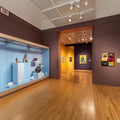
Three monumental contemporary Western art masterpieces greet visitors to the James Museum of Western and Wildlife Art in St. Petersburg, FL. Dan Namingha’s (b. 1950; Hopi-Tewa) nearly 15-foot-long triptych Passage III (1999) first receives guests arriving to the second-floor galleries. Awesome.
Namingha’s painting represents a spiritual journey through Hopi symbolism. Find the Butterfly Maiden. Colors representing the four cardinal directions: yellow (north), red (south), white (east), blue (west). Passageways to other worlds. Spirals of human migration.
The vibrant, abstract painting surely confounds many first-time visitors’ expectations of cowboys and cattle drives.
Hanging next to Passage III leading down a hallway toward the bulk of the artworks on view are Tony Abeyta’s (b. 1965; Diné) Untitled (2012) New Mexico landscape and Billy Schenk’s (b. 1947) A Mirror Image of an Imperfect World (2000) Utah mesa.
The Abeyta painting is my favorite of his. That’s saying something because I’ve seen dozens of his paintings and he’s one of my favorite artists. Abeyta was among the first Native artists I was turned on to when developing my interest in art. That interest was likely stirred in part from this painting. Abeyta deploys his iconic rusty color palate, textured surface, and Cubist-hinting stormy sky in capturing the look and feel of his homelands with such astonishing authenticity you can taste the dust.
The clouds have burst. Prayers have been answered. Life giving rain is on the way.
As close as you can come to New Mexico in Florida.

Tony Abeyta, 'Untitled,' 2012, at James Museum of Western and Wildlife Art.
Photo by Chadd Scott.
Despite covering Western and Native American art for publications like this one and Western Art Collector magazine and Native American Art magazine and Forbes.com, I live in Florida. Fernandina Beach on the Atlantic Ocean. I visit the West as often as I’m able to and in between trips cherish any opportunity to visit The James for a Western Art fix.
The James houses the personal collection of longtime Raymond James financial services CEO and Chairman of the Board Tom James, items acquired over decades of collecting which began in the 80s during ski trips across the West. The James’ focused their collecting on living artists. They have a Dixon and some Taos founders, but the heart and soul of the collection are late 20th and early 21st century artists like Namingha, Abeyta, Schenk, Shonto Begay, John Nieto, Paul Pletka, and Earl Biss.
Old Friends
The James Museum of Western and Wildlife Art introduced me to my favorite artist: Earl Biss (1947-1998; Apsáalooke). Two paintings changed my life. A pair of frosty, goosebump raising paintings depicting his Apsáalooke Montana homelands.
Magic Thunder in the Northern Sky (1986) simulates immersion in the Aurora Borealis along with a band of Crows. It’s cosmic, spiritual, kaleidoscopic.
Biss employed a unique palette of colors ranging from variations of white to fuchsia. A close inspection of the canvas shows a wide variety of paint applications. You’ll find heavily impastoed streaks of color, splatters and dabs, paint put on delicately and deliberate, rough and fast.
Biss was a medium. Through his artwork Apsáalooke past and future communed with the present. That may sound like metaphysical, woo-woo, mumbo-jumbo; regard the artwork and deny it.

Fritz Scholder painting (left), Allan Houser sculpture, and Earl Biss painting at James Museum of Western and Wildlife Art. Photo by Chadd Scott.
A couple paintings down hangs Winter Sunrise Circle of the Big Sky People (1985). This was acquired by the James’ in 1985 at a Colorado gallery where they first met Biss. It was their first Native American art purchase, sparking a passion for Western art. It’s easy to see why.
A string of ancestral Crows on horseback recede through deep snow toward the horizon. One spectral figure turns to look back at the viewer as if asking, “are you coming?”
Are you?
While part of you can’t help feeling attracted to the romance and freedom of Native people, wanting to join them, another part of you knows what fate has in store for these figures, the same grim fate faced by all Native people at one point in the U.S. This part holds you back.
Where the gathering of figures in Magic Thunder welcomes the viewer to join in, a difficult choice has been placed on the observer by Biss in Winter Sunrise. Spend time with these pictures. You will be glad you did.
Other favorites from the collection always on view include Paul Pletka’s Red Talkers (1978). This massive 6 x 10-foot work details the Cheyenne tribe’s Bull Society Dance. As the participants become more engaged in the dance, they begin metamorphosizing into their personal medicine symbols, a metamorphosis captured by Pletka in the picture. John Nieto’s fauvist coyote and bison. A prototypical Ed Mell jagged Arizona landscape.
New Friends
Thomas Blackshear’s (b. 1955) sensitive portrait of a Black cowboy enjoying a smoke, Bronco Break (2019), has been newly installed since my last visit in 2023. Brilliant paint handling and composition along with a much-needed diversification of the cowboy motif.
I believe Ray Vinella’s Christmas Eve, Taos Pueblo (1986) was on view when I last visited. The luscious, notebook-sized nocturne with figures surrounding a fire and light shining off the Pueblo walls under a moonlight sky is exactly the sort of jewel I’d be attracted to. What has changed since I last saw it is that I visited Taos Pueblo on Christmas Eve in 2024. It was one of the most remarkable spectacles I’ve ever witnessed, topped only by Christmas Day at the Pueblo and the Deer Dance.

Ray Vinella, 'Christmas Eve, Taos Pueblo,' 1986, at James Museum of Western and Wildlife Art. Photo by Chadd Scott.
Cameras, cell phones, and electronic devices are not allowed at Taos Pueblo during ceremonial events, so while there’s no YouTube video of the Christmas Eve bonfires or Christmas Day Deer Dance, both most certainly happen. More extraordinary holiday celebrations do not exist anywhere in the nation.
A remnant of the residents’ forced conversion to Catholicism–Taos Pueblo remains Catholic–every Christmas Eve tribal members erect more than 20 split firewood stacks throughout the Pueblo’s plaza, ranging in height from 3-feet to more than 15. At sundown, they are lit from the top down. Shortly after, a procession of riflemen and a statue of the Virgin Mary are paraded from San Geronimo de Taos church in front of more than 1,000 onlookers.
The public is welcome (just not welcome to record). Parking is free and the Pueblo doesn’t charge admission.
By nightfall, a glowing ring of fire surrounds the Pueblo’s courtyard. Guests are silhouetted against the flames, none of them competing with the electronic illumination of screens.
Vinella captures a glimpse.
The largest conflagrations put off an intense heat, unbearable from even 50-feet away. Cheers and embers erupt as the giant pyres collapse. Swirling smoke cyclones spin off from the strongest flames, blown in the direction of the wind. Regard the inky black sky, a combination of smoke and the absence of light pollution. There is no electricity at Taos Pueblo. As the smoke wanes, the stars emerge.
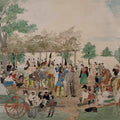
Fresh to my eyes was Oscar Edmund Berninghaus’ (1874-1952) Indians and Spanish Soldiers, Pueblo Village (1914). The “Pueblo Village” is unmistakably Acoma – Sky City. I recognized it instantly because I was fortunate enough to visit Acoma in 2025. Another engagement with Pueblo culture I’ll never forget. They all are.
Berninghaus’ painting depicts a troop of armored Spanish colonizers mingling among the Acoma people. A spectacular New Mexico blue-bird sky backdrops the painting, as does a menacing building. A church. This is the San Estevan del Rey Mission Church the Spanish enslaved the Acoma to build following conquest and mass murder.
The mesa-top church still stands today. Thankfully, the Spanish are gone. The Acoma remain. Tours are available. The Pueblo has transformed the Church’s meaning from one of death and misery to one of pride; the ancestors built this. Remember them.
The ancient Greek philosopher Heraclitus said, “No man ever steps in the same river twice, for it’s not the same river and he’s not the same man.”
The same can be said of an art museum.