James Lavadour is Nature
By Chadd Scott on
James Lavadour is nature.
In his artwork.
Lavadour’s tumultuous, abstract landscape paintings depict the effects of fire and wind and erosion on the land. Powerful, dramatic forces. Forces he mirrors in paint with a brush in his hand.
The surface is the land, the paint the elements, Lavadour the forces of nature and time.
"In paint there is hydrology, erosion, mass gravity, mineral deposits, etc.; in me there is fire, energy, force, movement, dimension, and reflective awareness,” Lavadour has said.
Brushed, poured, scraped, and dripped, Lavadour’s painting echoes the movements of earth, water, and stone, reflecting the elemental energy of the land and sky.
“One of the things he has said consistently the whole time he's been a working artist since the 80s, ‘Everything that's in the land is in me. Everything in me is in the land,’” University of Oregon Jordan Schnitzer Museum of Art McCosh Curator Danielle Knapp said. “What affects the earth in terms of the natural order of things, humans are part of that. We're not separate from nature. All of that is also in paint. When he goes in the studio and he is dripping painting, scraping oil paint, he is nature. He’s enacting in paint the forces he's observed in landscape or in the atmosphere.”
Knapp curated a career retrospective of Lavadour’s paintings on view now at the Jordan Schnitzer Museum of Art.

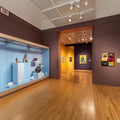
'James Lavadour Land of Origin' installation view at University of Oregon Jordan Schnitzer Museum of Art. Photo by Brian Davies. (2)
Lavadour (b. 1951: enrolled member of the Confederated Tribes of the Umatilla Indian Reservation and Walla Walla) began his career working in oil on canvas. In the 90s, he switched to wooden panels. The canvas was taking too much of his nature away. His influence. Soaking up too much paint, removing his hand from the landscape. On gessoed wood panels, he could move paint more smoothly. Flow.
“A big question guiding him his whole career is stretching himself; what can painting do? What's possible with paint,” Knapp said.
In thinking about what might be possible with paint, he’s looked outside of painting.
“He’s interested in poetry and music and ways of non-linear storytelling; none of his works are meant to be narrative,” Knapp explains. “A piece of writing or a piece of music that resists a singular understanding of it… how do we do that painting?”
One way Lavadour has found to do so is by arranging his single panel paintings into grids. Group compositions of individual artworks.
“Multiple images, your eyes are moving everywhere, your mind is moving everywhere. That is motivated by how we experience the land,” Knapp said. “If we go out and walk or hike in nature, we're not just looking straight ahead, we're looking up, down. It's multi-directional, multi-perspectives. We're looking all around. We're responding. So for him, the grid is the closest thing he knew how to express in paint to actually being out in the land.”
Two of Lavadour’s newest grids, made in 2024, Lucky Star and Bold as Love, will be debuted in the exhibition.

Portrait of James Lavadour in Pendleton, OR. Photo by Mario Gallucci.
‘Land of Origin’
“James Lavadour: Land of Origin,” includes painting and printmaking spanning over 40 years, celebrating his status as one of the Pacific Northwest’s most original and powerful painters. The art and its accompanying catalog highlight his connection to the Blue Mountains region of northeastern Oregon where he has spent most of his life.
Lavadour expresses the vibrancy of the land and sky he observes on daily sunrise drives and walks on the Umatilla homelands.
“My art education came from the land,” Lavadour has said. “I learned through endless walking, looking, hearing, and feeling the natural world around me.”
An artist’s deep observation.
“It puts him in the right mindset for painting,” Knapp said. “He goes out for a sunrise visit to the land, drives out for like two hours, watching the earth wake up and observing animals. That's part of his daily practice. Then when he goes back in the studio and picks up where he left off.”
At any given time, Lavadour may be working on 40 or 50 paintings. Some days, he’ll work on a layer of red paint to multiple panels. Other days, blue. Some days he focuses on one. Lavadour seeks inspiration from the improvisation of jazz.
“Some days the energy is flowing, and inspiration is there, the spontaneity is there, and other days, he's got to trust that will come back, even if it takes days or weeks, but he's not working from any images,” Knapp explained. “He's working from his deep knowledge of that process of the land, not planning out, ‘I'm going to make one that resembles a river,’ or ‘I'm going to make a panel that looks more mountainous.’ He likes to be surprised and delighted by what the paint does.”
From the new panels and older work kept in his studio, Lavadour composes his grids. Once a grid is set, it’s indivisible.

Art and Influence
Lavadour’s paintings express a tremendous amount of upset, fire, trauma. Literally, yes. Figuratively, no.
“For us in the West, living near wildfires or the threat of wildfire, in this region, it's almost impossible to look at some of his images and not immediately think of wildfire or that kind of turmoil on the land. He recognizes people see that,” Knapp said. “It’s an expression of energy, for good or for bad. That fiery, almost cataclysmic feeling of the works that have those elements, they're not any sort of commentary or negative expression – that’s a human reading – they are recognizing the incredible power of the land, the energy of eons of geological change, erosion, mountains arriving, and earthquakes and volcanoes – that's a really powerful and violent process.”
Observers may see raging wildfire and death and fear.
Lavadour sees nature. Natural cycles.
“James Lavadour: Land of Origin” remains on view at the Jordan Schnitzer Museum of Art in Eugene, where adult general admission costs only $5, through January 11, 2026, at which point it embarks on an ambitious, multi-year tour around the West thanks to a partnership with Art Bridges. Look for it at the Northwest Museum of Arts and Culture in Spokane, the Boise Art Museum, the Whatcom Museum in Bellingham, WA, the Heard Museum in Phoenix, and concluding at the Missoula Art Museum.
James Lavadour’s commitment to the arts goes beyond his own artmaking. In 1992, along with Phillip Cash Cash (Cayuse and Nez Perce), he founded the Crow’s Shadow Institute of the Arts on the Umatilla Indian Reservation. The nonprofit center provides printmaking facilities and training in traditional Indigenous art forms. Located in Pendleton, OR at the foothills of the Blue Mountains on the ancestral homelands of the Umatilla, Walla Walla, and Cayuse people (CTUIR), the Institute serves as a beacon for artistic innovation and cultural heritage.
A biennial exhibition of contemporary prints produced at CSIA over the past two years can be seen through June 20, 2026, at the Hallie Ford Museum of Art in Salem, OR.