Visiting the National Museum of the American Indian in New York
By Chadd Scott on
George Gustav Heye (1874-1957) made a killing on Wall Street before leaving finance as a young man to pursue an abiding passion for Indigenous art from the Americas – North, Central, and South. He began collecting in Arizona in 1897. His money allowed him to travel everywhere. To buy everything.
His appetite for collecting was voracious.
Not satisfied buying individual items, his collecting grew to include the acquisition of entire museum collections and the entire collections of other collectors. He’d buy hundreds and thousands of objects in one fell swoop.

Indigenous artworks from the Southwest on view at National Museum of the American Indian in New York.
Over the decades, he amassed roughly 800,000 pieces of Indigenous art from the Americas, believed to the largest assemblage ever put together by one person.
In 1916, Heye established the Museum of the American Indian – Heye Foundation in New York. The museum opened to the public in 1922. In 1989, Long after Heye’s death, his collection was transferred to the Smithsonian Institution. To the American people. The items became the founding collection of the National Museum of the American Indian in New York.
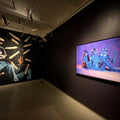
This is what visitors to NMAI see – in part – when visiting today.

Artworks from Plains Tribes on display at National Museum of the American Indian in New York.
Collecting in the Reservation Era
Heye was collecting during a period of Native American history in the late 19th and early 20th centuries known as the Reservation Era. This followed the last of the Indian Wars on the Plains. Native people in what is today known as America were being forcibly moved onto increasingly smaller and smaller reservations across the nation.
There was never a better time to be a white collector. There was never a worse time to be a Native seller.
Prices Heye would have paid for items directly from Native people, be they the maker or possessor of the object, would have been dirt cheap, probably exploitative. Indigenous people were often desperately poor and hungry and willing to part with treasured cultural items for next to nothing.
This was also the era of assimilation when the prevailing opinion, even among Native people, was that survival meant adoption of white lifeways and the abandonment of cultural traditions. If you could sell a cherished pot or basket or blanket for enough money to feed your family for a week, or a day, a few bucks, why not?
What were the ethics of Heye’s collecting?
I wonder.
The question nagged at me during my visit in January 2026 and since.
Wall text at the museum didn’t have much to say about it. Didactics did mention that Heye hired anthropologists to undertake collecting expeditions and sponsored “excavations at ancestral Native sites.” Even if Heye were ethical, how likely would it have been that all of the white anthropologists he hired were? Doubtful for that era.
“Excavating ancestral Native sites” sounds unethical in the extreme. Sounds like graverobbing.
With whose permission were these excavations undertaken? Who did these objects belong to?
These items were typically treated like gold or copper during the time, buried underground, and therefore up for grabs; the Native people who once lived there and to whom they belong, exterminated or moved off.
This was an era highlighted by white collectors, anthropologists, and museums raiding Native cultural heritage items, often paying next to nothing or literally nothing. Relic hunting. Finders keepers. Gobble this stuff up before all the people were gone.
I found a petroglyph chunk depicting mountain sheep in the Coso style from Inyo County, California dated to A.D. 600-1300 particularly troubling. Petroglyphs cover that area. How was this one collected? Did it just happen to fall off the rock face for one of Heye’s anthropologists to pick up? How convenient. Was it chiseled off?
Neither of those methods of acquisition means it was Heye’s – or Heye’s team’s – for the taking.
Some items previously on display at the National Museum of the American Indian in New York have been removed over concerns of cultural sensitivity, so the issue is not totally lost on administrators. And it is a super-prominent, public collection, so it’s not like what’s on view there is a secret to Native people or scholars, but the provenance of some of the items is a cause of deep concern.
Highlights of the National Museum of the American Indian in New York
The historic collection of the National Museum of the American Indian in New York is distinguished in innumerable ways. While covering geographies across the Americas, it is particularly strong in objects from present day California. The Indigenous art of this area is often overlooked in favor of the Plains and Southwest.
A Kumeyaay condor feather dance skirt from California circa 1920-1940 stands out. The skirt is composed of 50 condor feathers. An object of immense cultural, artistic, historic, and ecological significance. I’ve never seen anything like it.

Kumeyaay condor feather dance skirt from California circa 1920-1940 on display at National Museum of the American Indian in New York.
I’ve also never seen anything like the Lakota square hand drum circa 1860-1870 composed of hide, horn, wood, and paint acquired from present day North or South Dakota.
Or the Kwakwaka’wakw mechanical mask from Cape Mudge, Vancouver Island, British Columbia circa 1900. Astonishing. One of the most extraordinary art objects I’ve seen in my travels around the world looking at art.

Kwakwaka’wakw mechanical mask from Cape Mudge, Vancouver Island, British Columbia circa 1900 on view at National Museum of the American Indian in New York.
“This large fish mask, worn on the back of a ceremonial dancer, may represent Namxilagiyu, a halibut-like sea monster,” wall text at the museum reads. “Constructed of many pieces, the mask would have been manipulated to great theatrical effect while being danced at lavish potlaches for which the Kwakwaka’wakw are especially well known.”
NMAI’s holdings are also especially magnificent in Northwest Coast masks.
The skirt, the drum, the mask, even among the thousands of exceptional items on view at the museum, these jump out from the cases. At least they did to me. You may have others.
The Dat So La Lee woven baskets. The Helen Cordero storyteller pottery figure. Julian Martinez’ 1930’s hide painting. A stunning, circa 1890 Hopi manta from Waalpi, Arizona. A Siksika Blackfoot beaded blanket strip made about 1890 from present day Montana.
New York is arguably the greatest art museum city in the world. The Met, MoMA, The Whitney, The Guggenheim, the Studio Museum in Harlem, The Frick. A partial list. The National Museum of the American Indian is of that caliber. What’s on display there equals the greatest artworks ever produced anywhere.